
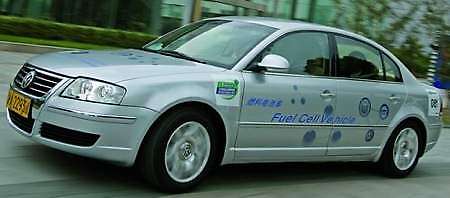
Volkswagen’s American division has announced that it has shipped 16 Passat-Lingyu fuel cell cars over from China for a demonstration run at the California Fuel Cell Partnership event. These fuel cell cars with zero harmful emissions which are based on the VW Passat were jointly developed in China by a partnership between Volkswagen Shanghai, Volkswagen’s Research Group and the Tongji University.
With the hydrogen fuel cells located on the floor of the Passat, it is able to produce 55kW of power by simply converting hydrogen into water and electricity with the help of oxygen. The energy produced is then channeled to a 376 Volt lithium-ion battery pack. The Passat-Lingyu is able to reach a top speed of about 145 km/h, and is able to deliver 235 kilometers in terms of range will a full tank of fuel. These environment-friendly cars were first presented at the Olympic Games in China last year.
Looking to sell your car? Sell it with Carro.






Having done a small amount of research in this field, I am biased towards the fuel cell. However i must warn proponents of this technology that fuel cells are a very wide topic and the PEMFC is probably the most viable for automobile applications. Hydrogen of course the a good energy carrier but the infrastructure for refuelling as we kno is zilch. But one thing here caught my attention, the article mentions the use of lithium-ion batteries. What is the life cycle for this battery and how environmentally sustainable is it. Another thing is fuel cells are not 100% recyclable.
hey this is the china passat based on the skoda superb but uglified
KT,
Its a chicken and egg thing. Someone will have to bite the bullet.
Its interesting its using liONs as well. Perhaps to boost power (sort of like a hybrid) as the primary fuel cell alone may not be sufficient. Paul only noted they were good for only 55kW. 55kW is only about 74hp if I had not messed up my conversions…..
The more systems u introduce into an entity, the more complex it gets. To the naive mind, it may sound all exciting with jargons such as liON and fuel cells, but the laws of nature dictate that introducing more systems, inevitably produce something known as entropy. Simply put, such a system as mentioned above introduces more oppurtunities for losses hence reducing efficiency. I bet through gross calculations, that this FC vehicle is actually less environmentally friendly than a diesel powered car.