
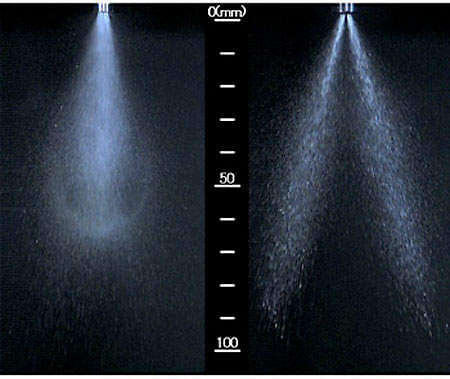
Left: One port of the Dual Injector Right: Conventional system injecting to both ports
Nissan has announced a new Dual Injection System that is expected to be introduced in various Nissan production cars in 2010. At first you may think its something like Toyota’s D4-S twin injection system which uses one direct injector and one port injector.
But it’s not. It’s designed to be somewhere in between conventional port injection and direct injection. As the name suggests, the new system uses one injector for each port (typically 2 intake ports in a 4 valve engine) rather than one per cylinder, making it a total of two injectors per cylinder. This system, said to be the world’s first, helps speed up fuel vaporization and reduces the amount of unburned fuel and hydrocarbon emissions.
The system has a number of benefits including, reducing the diameter of the fuel droplets by about 60%, resulting in smoother, more stable combustion, reducing system production cost by about 60% compared to direct-injection engines of similar displacement and more. Nissan says direct injection has been hard and expensive to use on small displacement engines because of high pressure pumps that complicate system design, thus making the component layout less cost-efficient.
The system also features a continuous valve timing control on the exhaust side which Nissan says is to help improve heat efficiency, reducing pumping losses and raising fuel efficiency by up to 4%, compared to Nissan’s other gasoline-powered engines in the same class. The new system also uses half the amount of rare metals in the catalyzer while maintaining the efficiency of the catalytic conversion system.
Looking to sell your car? Sell it with Carro.











@_@
When it'll hit our shores?
its nothing new..
the fuel become very small droplet for easier combustion?
i'm noobie here :)
Leave it to the Japanese to come out with innovation like this. If the American came out with this invention 1st, the Detroit giants wont went bankrupt as a result of the last fuel hikes.
lets heard what basher thinks of proton on this innovation ? haha
Sounds good. I'll wait for it before I change my current Nissan. :D
This is very interesting approach because Jap car companies have tried to produce direct injection engine but never really succeeded like the Germans have. Only lexus managed to have some success.
Now, it seems that an upgrade to the old port injection system is enough to improve fuel efficiency. I wonder if it will improve compression ratio in Turbocharged engines like the way direct injection engines can.
Will be 4-5 years before you see it in a car in Malaysia. Then Its a Nissan. The local dealer is not really quick at brining in new models which have been released world wide 1/2 years
err..care to explain how this efficient burning will lead to higher compression ratio for forced induction?
i'm newbie here.
2 spark plugs/cyl, 2 times more valve/cyl, now 2 injectors/cyl,what's next?i would love to see how anyone would implement 2 pistons per cylinder
if 2 is good, then make it 4….
Good technology, we welcome all good technology for good use of fuel and also good for environment…keep all these good technology rolling…
One injector per port, that no brainer for proton to learn. Turbo charge it and add a 8 speed gear box ( http://www.chinacartimes.com/2010/04/13/shengruis-8-speed-automatic-gearbox/ ) that should spice things up.
..but it looks more like a dream……….