
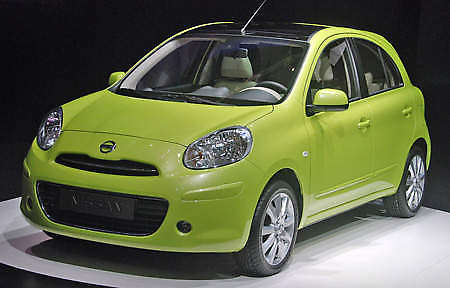
Nissan Motor Thailand (NMT) has announced that the new Nissan March will be the first model offered for sale under Thailand’s “eco-car” program, created to encourage the development of energy-efficient vehicles. Still fresh from its Geneva debut, production has started and the car will be launched at the Bangkok motor show on March 26.
Designed to appeal to both developed and emerging markets, the March is built on a new platform. It will come with a new 1.2-litre, 3-cylinder engine with 78 bhp/108 Nm. Nissan’s Thai dealers have begun accepting bookings, and vehicle delivery will start within a few weeks for the five-speed manual version. The CVT variant will reach buyers in June. The price range is from 375,000 baht to 537,000 baht.
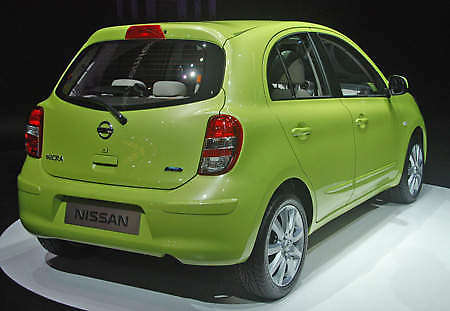
Our northen neighbour will join China, India and Mexico as global manufacturing hubs for the March (known as the Micra in some markets), which ultimately will be offered in 160 countries. NMT will export the March to countries in the Asian and Oceania markets, according to Toshiyuki Shiga, COO of Nissan Motor Co.
As a recap, to obtain eco car status, a car has to achieve at least 20 km/l and emit less than 120g/km of CO2. Engine capacity must not exceed 1.3 litres if petrol-powered and 1.4 litres for diesels. The manufacturer is rewarded with a 50% cut in excise duty, no income tax for eight years and no import duty for factory machinery imports.
Live images of the March from the Geneva show is after the jump.
[zenphotopress number=999 album=903]
Looking to sell your car? Sell it with Carro.

 p4k4bu
on
p4k4bu
on 

 ago87
on
ago87
on  DariusDrake
on
DariusDrake
on  Peter
on
Peter
on  ckk
on
ckk
on  proton
on
proton
on  tikus
on
tikus
on  rexis
on
rexis
on  please gov decrease
on
please gov decrease
on  Mazda 3 MPS
on
Mazda 3 MPS
on  S.Roma
on
S.Roma
on  theanswer
on
theanswer
on  perkasa
on
perkasa
on  staff
on
staff
on  jebon lonely ranger
on
jebon lonely ranger
on  think
on
think
on  niamafufu
on
niamafufu
on  awak
on
awak
on  howitzer
on
howitzer
on  MoFaz
on
MoFaz
on  Martin (Member)
on
Martin (Member)
on  KH
on
KH
on  proton
on
proton
on  littleboy
on
littleboy
on  ban_87
on
ban_87
on  pltan
on
pltan
on  g-spot
on
g-spot
on  man
on
man
on  _Zephyre_
on
_Zephyre_
on  roszi
on
roszi
on  limsk (Member)
on
limsk (Member)
on  leong
on
leong
on  aremere
on
aremere
on 


AI-generated Summary ✨
Comments express limited enthusiasm for the Nissan March starting production in Thailand, citing its design as boring and overpriced for Malaysia, and question whether it will be available locally. Many compare Thailand’s automotive advancements unfavorably to Malaysia’s slower progress, highlighting Thailand's successful auto industry policies, R&D investments, and lower vehicle prices. Some participants suggest that Malaysia should adopt more proactive policies and encourage local industry growth, contrasting it with China's rapid development and advanced technology initiatives.