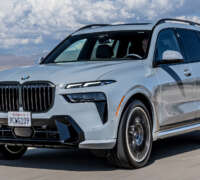
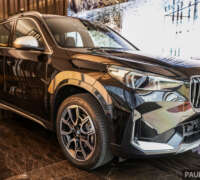
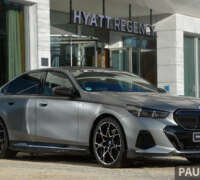
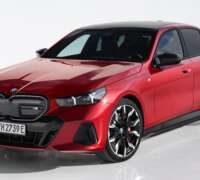
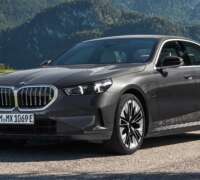
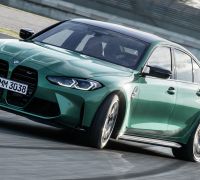
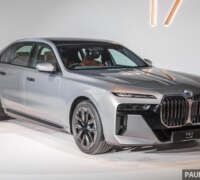
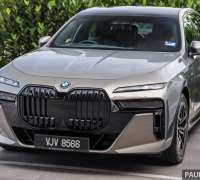
Pretty good looking renderings by Theophilus Chin, although it would probably be closer to hitting the mark if the bumper was inverted like the M5, the X5 M and X6 M. This bumper shape is usually used by the M-Sport cars.

BMW ActiveHybrid 3: turbo-ed six pot does 6.4L/100km
BMW’s reveal of the new F30 BMW 3-Series comprises of a total of 5 different cars – the Sport Line, the Modern Line, the Luxury Line, the traditional M Sport package and the car you see here – the BMW ActiveHybrid 3. It’s basically a 335i with an electric motor integrated into the 8-speed automatic.
Maximum combined output is 340 horsepower and 450Nm of torque, with 306hp coming from the engine and about 54hp from the electric motor. The car can run on electric power only for between 3km to 4km on a full charge of the battery in the boot. Top speed in electric only mode is about 60km/h under load, and up to almost 160km/h during coasting.
I was hoping to see a more reasonably sized engine paired with an electric motor since BMW has the new four cylinder turbo N20 engines to play with, but BMW continues with the philosophy of focusing on high fuel efficiency with their EfficientDynamics turbo diesel models and keeping the ActiveHybrid cars as more of a greener performance car kinda thing. The ActiveHybrid 3 ended up being a smaller ActiveHybrid 5, or you can consider it a 335i with a KERS system, depending on how you want to look at things.
Average fuel consumption for the BMW ActiveHybrid 3 is expected to be less than 6.4 litres per 100km on the EU test cycle, which BMW says is a savings of 12.5 percent compared to other BMW models of a similar performance level. As a comparison, the 320d EfficientDynamics is rated at just 4.1 litres per 100km on the EU driving cycle.
VIDEO: BMW new 3-Series Modern, Luxury and Sport Line
BMW has put up an interactive video on YouTube where they introduce the concept of trim “lines” to their latest compact sports sedan. This concept of lines first debuted on the 1-Series, where it was offered as either an Urban Line, a Sport Line or the M-Sport.
For the 3-Series, three different trim lines are introduced at launch – the Luxury Line, the Modern Line and the Sport Line. It kinda reminds me of Mercedes-Benz’s Classic, Elegance and Avantgarde. Watch the video above, and choose either one of the three different trim levels when prompted to in the little interactive menu at the end.
BMW F30 3 Series unveiled: four engines at launch, three equipment lines, market debut in Feb 2012
BMW has unveiled its sixth-generation 3 Series in its sedan form, and the F30 will roll in with plenty to offer aficionados when it makes its market debut beginning Feburary 11 next year.
At point of launch, the car will be available with four engine choices, all TwinPower Turbo units. The range topper is the 335i, with its 3.0 litre, 306 hp and 400 Nm mill leading the way. Next is the 328i, which sees the 2.0 litre petrol TPT unit offering 245 hp at 5,000 to 6,500 rpm and 350 Nm at 1,250 – 4,800 rpm.
The remaining two are diesel jobs, these being the 320d and the 320d EfficientDynamics Edition. Both run a 2.0 litre commonrail DI variable geometry turbocharged block, with differing outputs – the 320d ED Edition puts out 163 hp, while the 320d offers 184 hp, both at 4,000 rpm. Torque figures are identical, with both offering 380 Nm at 1,750 – 2,750 rpm.
The F30 will come with a six-speed manual transmission as standard, with an eight-speed automatic – a first in this segment class – available as an option for all four engine choices; both the manual and the automatic models are equipped with Auto Start-Stop function.
In spring of next year, three further engines will be introduced for the car. The first is the new 320i, which will be the second model to be powered by the new-generation 2.0-litre four-cylinder petrol engine – figures for the TwinPower Turbo unit are 184 hp at 5,000 rpm and peak torque of 270 Nm at just 1,250 rpm.
The other two are turbodiesel models, the 318d, which will have 143 hp at 4,000 rpm and 320 Nm from 1,750 and 2,500 rpm, and the 316d, with 116 hp at 4,000 rpm and maximum torque of 260 Nm, again at between 1,750 and 2,500 rpm.
Further engine versions are set to follow, including a six-cylinder diesel unit and a slew of xDrive models – the 335i xDrive, 328i xDrive, 320i xDrive and 320d xDrive all-wheel-drive models will go on sale in the summer of 2012. Next year will also see BMW’s first full-hybrid 3 Series making its premiere in autumn with the introduction of the ActiveHybrid 3.
The car is larger than the outgoing E90, with a wider track (front increased by 37 mm, rear by 47 mm) particularly prominent, and increased length (by 93 mm) and augmented wheelbase (by 50 mm) being just some of the numbers.
The increased exterior dimensions also bring about increased interior space, with rear passengers set to enjoy the benefits of extra legroom; there’s 15 mm of additional knee room and 8 mm of extra head room to help things along. Despite its larger dimensions, the F30 weighs up to 45 kg less than the E90, depending on model.
Exterior shape-wise, elements include the new BMW face, with flat headlights reaching along as far as the kidney grille, and an accentuated width, which helps to improve the car’s presence. Aside from the merged headlights/grille design, the F30 replaces the central air intake of the E90 with two larger intakes, positioned underneath the headlights to the outer edges of the front end.
On the sides, highlights include flanks that are shaped by a double swage line made up of two character lines running alongside each other, helping to reinforce the silhouette’s dynamicism, and the back features richly contrasting light surfaces that give the rear end a fresh dynamic perspective.
Interior features include a driver-focused cockpit, angled towards the driver by seven degrees, with the four main circular dials (fuel gauge, speedometer, rev counter and oil temperature gauge) dressed with a black panel display.
The F30 also features more interior storage space – for example, larger pockets in the front doors now mean space for drinks bottles up to one litre in size, and two large drinks holders are now integrated into the centre console ahead of the gearshift lever, among others. Boot space on the F30 is also up, with 480 litres of capacity, 20 litres more than that of the E90. Additionally, 40:20:40 split rear backrests mean the ability to carry longer items.
The F30 will be available in three equipment lines, in addition to the entry-level version. The Sport Line, Luxury Line and Modern Line, as they are called, will allow customers to personalise their rides and adapt it to their individual preferences, with exterior design elements and selection of materials and colours available for each model. Next year will see an M Sport package with special exterior and interior features joining the fray.
The M Sport package includes a lowered M Sport suspension, featuring a 10 mm drop in ride height, which works with firmer suspension and damping as well as harder anti-roll bars, and also featured are 18 or 19-inch M alloy wheels. A further option is an Adaptive M Sport suspension, with electronically controlled damping.
The package will be completed by an M aerodynamics package, which can be specified separately, featuring special body parts and by chrome tailpipes, exclusive exterior paintwork and interior trim to match – the last has sports seats boasting distinctive cloth/Alcantara upholstery, trim elements with blue accent strips, an M Shortshifter (in models with manual gearbox), M door sill finishers, an M driver’s footrest and the new M leather steering wheel.
An electromechanical power steering system EPS (Electronic Power Steering) – which uses an electric motor to provide steering assistance and which only operates the EPS when steering assistance is actually required – comes as standard, though an optional new, purely mechanical variable-ratio steering system is available, offering a more precise response to input and sharper handling. In the case of the 335i and 328i, a Servotronic function for speed-sensitive power assistance is standard issue.
The F30 wears a larger brake system, with lightweight sliding-calliper brakes with large vented discs, and at the front the use of aluminium for the callipers bring a further reduction in unsprung masses. If that’s not enough, one can plonk for the optional M Sport brake system, with aluminium four-piston fixed callipers at the front and two-piston fixed callipers at the rear, replete with blue paint finish.
For wheels, the 335i and 328i run on 17-inch Star-spoke wheels, wearing 225/50 R17 tyres, while the 320d and 320d EfficientDynamics Edition diesel models ride on 16-inch V-spoke or Streamline-style alloy wheels, wrapped with 205/60 R16 tyres.
Alongside Dynamic Stability Control (DSC), which offers ABS, ASC, DTC, DBC and CBC, along with start-off assist, brake drying and an electronic limited slip function for the rear differential under its operating umbrella, the new 3er will come with a new Driving Experience Control function as standard specification on all models – four modes are available for this one, namely COMFORT, SPORT, SPORT+ and a new mode called ECO PRO.
The latter, as its name suggests, supports an extra-efficient and economy-conscious driving style. It does this by changing the accelerator mapping so that the same pedal travel delivers less power than in the standard mode.
Also, in this mode, the Optimum Shift Indicator for manual models and the transmission control strategy for automatic models are modified, so as to bring forward upshifts and to delay downshifts, while intelligent energy and climate management reduces the mechanical power consumption as well as the consumption of electrical systems. All of which enables additional fuel savings, depending on individual driving style, of up to 20%.
Elsewhere, the F30 is loaded with tons of ConnectedDrive tech, from driver assistance systems to infotainment. New to the car is the latest-generation, full-colour Head-Up Display, and aside from this the likes of Lane Change Warning System, Lane Departure Warning System, Active Protection safety package and Advance eCall are items on the list.
Other CD-related tech available for the car includes BMW Parking Assistant, Surround View (with Side View and Top View), Active Cruise Control with Stop&Go function, Speed Limit Info including No Passing Info display and Real-Time Traffic Information (RTTI). Elsewhere, new Bluetooth office functions allow internet-based services such as weather and news, as well as calendar entries and text-based messages (SMS and e-mail), to be viewed in the Control Display of the iDrive operating system and read out via the Text to Speech function.
As with any new BMW, we’re expecting the F30 to debut as a CBU unit first with CKD/SKD to come later. Please enjoy the photo gallery that we’ve uploaded after the jump. They’re of medium res for now – we’ll upload hi-res galleries later as the BMW Press servers become more stable.
[Read more...]
VIDEO: BMW Laser Light: headlamps of the future?
Forget LED headlamps – according the BMW, the next logical step in car lighting development is laser lights. Laser lighting is radically different from sunlight or any different kind of artificial lighting used today, including the different types of light sources we use in vehicle headlamps.
Laser lighting is monochromatic, which means that all the light waves have the same length. It is also a “coherent” light source, which means its waves have a constant phase difference. As a result, laser lighting can produce a near-parallel beam with an intensity a thousand times greater than that of conventional LEDs, while having less than half the energy consumption of LED headlamps.
The intensity of laser light poses no possible risks to humans, animals or wildlife when used in car lighting. Amongst other things, this is because the light is not emitted directly, but is first converted into a form that is suitable for use in road traffic. The resulting light is very bright and white.
Check out the videos in this post for some demos that I managed to record while attending the BMW Innovation Days in Munich. You can see how the thin blue laser beam is converted into a bright white light.