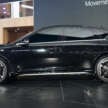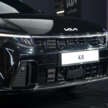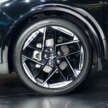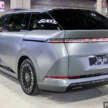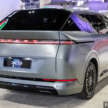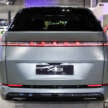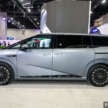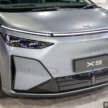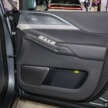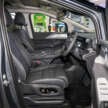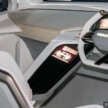




2026 Proton Saga review - all the good & bad in full detail


Sell your car to Carro, get paid in 24 hours

Latest Stories

  • Top 20 car brands in May 2026 – Perodua eases to 24k as market cools, Leapmotor cracks top 20

    Top 20 car brands in May 2026 – Perodua eases to 24k as market cools, Leapmotor cracks top 20

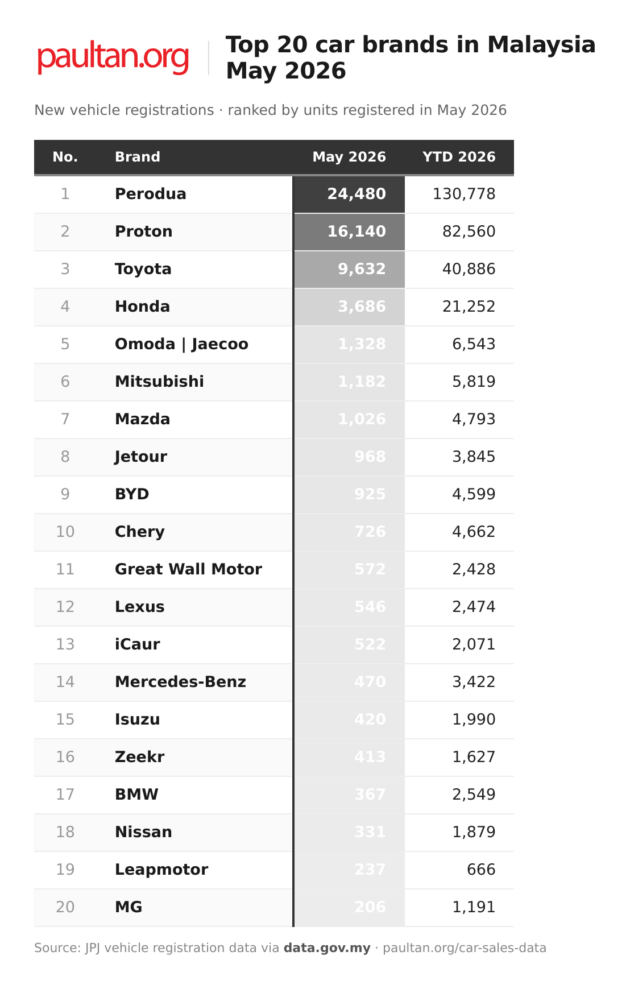
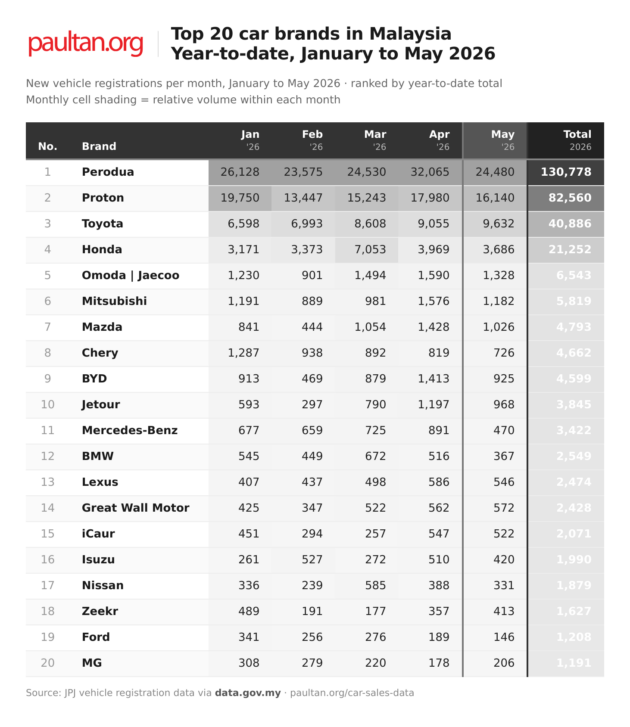
    The road transport department (JPJ) has released its latest vehicle registration data for the month ending May 2026, and Perodua is once again on top. The national carmaker registered 24,480 units last month, easing off from the 32,065 units it managed in April as the overall market cooled, but it comfortably extends its lead with a year-to-date (YTD) total of 130,778 units.

    Proton holds on to second place with 16,140 units, bringing its YTD tally to 82,560 units. Toyota stays third and was the only brand in the top three to grow on the month, with 9,632 units in May, up 6.4% on April and its best single-month result so far this year (this figure also includes recon units), for a YTD total of 40,886 units.

    Outside the top three is Honda in fourth with 3,686 units (21,252 YTD), followed by Omoda | Jaecoo in fifth with 1,328 units (6,543 YTD). Mitsubishi takes sixth with 1,182 units (5,819 YTD), holding the position it climbed to in April on the back of Xforce deliveries.
    Top 20 car brands in May 2026 – Perodua eases to 24k as market cools, Leapmotor cracks top 20

    Mazda is seventh with 1,026 units (4,793 YTD), still in four-digit territory despite the softer month. Jetour follows in eighth with 968 units (3,845 YTD), edging ahead of both BYD and Chery this month after sitting behind BYD in April. BYD is ninth with 925 units (4,599 YTD), while Chery rounds out the top ten with 726 units (4,662 YTD), its larger YTD total reflecting a stronger start to the year.

    Great Wall Motor takes 11th with 572 units (2,428 YTD) and was one of the few brands to grow on the month, up 1.8%. It is followed by Lexus in 12th with 546 units (2,474 YTD), iCaur in 13th with 522 units (2,071 YTD), Mercedes-Benz in 14th with 470 units (3,422 YTD), Isuzu in 15th with 420 units (1,990 YTD) and Zeekr in 16th with 413 units (1,627 YTD), the latter up 15.7% on April.

    As for the remaining four brands in the top 20, BMW took 17th with 367 units (2,549 YTD) and Nissan 18th with 331 units (1,879 YTD). The standout at the bottom of the table is Leapmotor, which more than doubled its April figure to 237 units to break into the top 20 in 19th (666 YTD). MG completes the list in 20th with 206 units (1,191 YTD), up 15.7% on the month.
    Top 20 car brands in May 2026 – Perodua eases to 24k as market cools, Leapmotor cracks top 20

    Overall, the market cooled in May, with total new-vehicle registrations of 66,053 units, down 15.1% from April’s 77,819 units. You can explore the full month-by-month and YTD breakdowns, by brand, model, body type and fuel, on our car sales data tool.
     
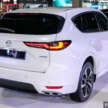
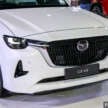
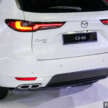
  • Mazda CX-60 3.3L MHEV launched in Malaysia – inline-six cylinder turbo petrol, CBU Japan; RM252k OTR

    Mazda CX-60 3.3L MHEV launched in Malaysia – inline-six cylinder turbo petrol, CBU Japan; RM252k OTR

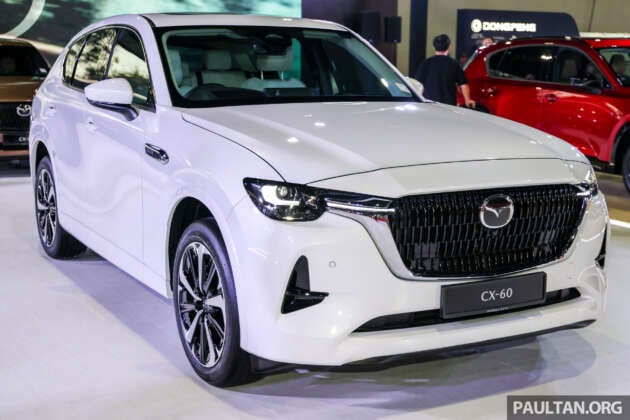
    Bermaz has expanded the CX-60 lineup with the launch of the range-topping 3.3L MHEV variant, which joins the 2.5L version introduced in September.

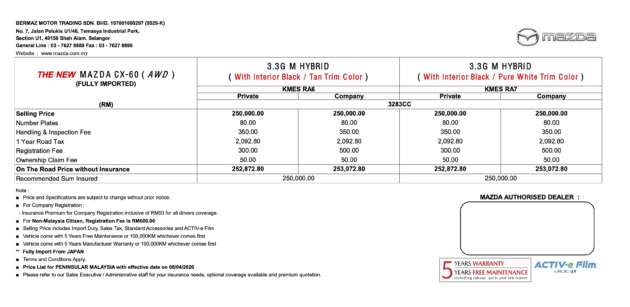
    Shown at the 2026 Kuala Lumpur International Mobility Show (KLIMS 2026), the upmarket SUV with the 3.3L inline-six cylinder turbocharged, mild-hybrid powertrain combined with all-wheel-drive and an eight-speed automatic transmission is offered in two variants, both priced at RM252,872 on-the-road without insurance.

    Rated to produce 284 PS from 5,000 rpm to 6,000 rpm and 450 Nm from 2,300 rpm to 3,500 rpm, the turbocharged petrol engine is augmented by a 48-volt mild-hybrid system which Mazda calls M Hybrid Boost, which features an integrated starter generator rated at 16 PS and 153 Nm, drawing from a 0.33 kWh lithium-ion battery.

    Mazda CX-60 3.3L MHEV launched in Malaysia – inline-six cylinder turbo petrol, CBU Japan; RM252k OTR

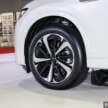
    Though identically priced, the two variants of the CX-60 3.3G AWD High Plus – to go by its official designation – are differentiated by specific parts. Internally codenamed KMES RA6 and RA7, the version with the RA6 suffix gets 20-inch alloy wheels in a black metallic finish, while the RA7 version (photographed here) gets the same wheels in a two-tone machined finish. The two are also differentiated inside; more on that to come.

    These wheels and tyres are of the same dimensions, shod in 235/50R20 tyres across both 3.3L turbo mild-hybrid and 2.5L naturally aspirated variants. Being on the same Large Product Group architecture with a longitudinal engine layout, all CX-60 variants get double-wishbone front and multi-link rear suspension, as well as Kinematic Posture Control as standard.

    Other shared equipment across the range includes LED headlamps and taillights with signature illumination, LED daytime running lights, keyless entry and start, a panoramic sunroof with sliding and tilt glass, and front and rear parking sensors.

    Also on are a 12.3-inch digital instrument cluster, a windshield-projected head-up display, paddle shifters, dual-zone climate control with rear vents, a 10-way powered driver’s seat, a 12.3-inch infotainment touchscreen, Apple CarPlay and Android Auto support, a 12-speaker Bose sound system and a wireless charger. The 3.3G High Plus also gains 12-way adjustable front seats with ventilation.

    Where the two versions of the CX-60 3.3G AWD High Plus differ is in the upholstery. The RA6 version gets the Nappa leather interior in Tan with a Tan/Black two-tone steering wheel, while the RA7 is specified with the same material in White, with the steering wheel in black, in addition to the aforementioned different alloy wheel finishes.

    For safety and assistance functions, there are seven airbags, adaptive LED headlamps, blind spot monitoring, front and rear cross traffic alert, lane departure warning, lane keep assist, emergency lane keeping assist, driver attention alert, front and rear Smart Brake Support (autonomous emergency braking), Mazda Radar Cruise Control (MRCC) with stop and go as well as high-speed Cruising & Traffic Support (CTS), in addition to passive safety systems.

    For exterior colours, the Mazda CX-60 3.3G AWD High Plus is available in Rhodium White, Zircon Sand, Platinum Quartz, Soul Red Crystal and Jet Black, and a new addition, Machine Gray is exclusive to the 3.3G AWD High Plus. The CX-60 comes with a five-year, 100,000-km manufacturer’s warranty and free service package.

     
  • MG QS previewed in Malaysia – seven-seat premium SUV, 2.0 litre turbo, 208 PS and 360 Nm, AWD

    MG QS previewed in Malaysia – seven-seat premium SUV, 2.0 litre turbo, 208 PS and 360 Nm, AWD

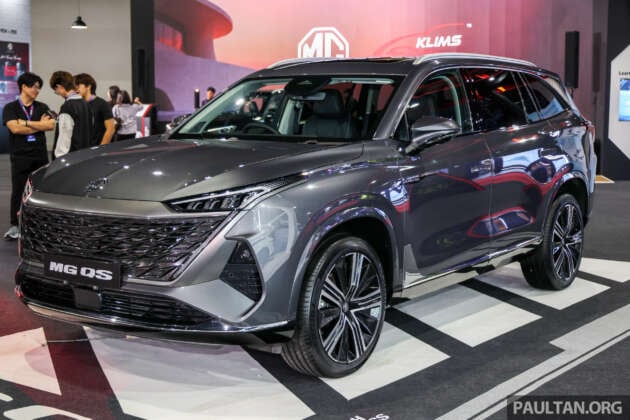
    Besides the MG ZS, for which the order books have opened, SAIC Motor Malaysia has a few other vehicles on show at the Kuala Lumpur International Mobility Show (KLIMS) 2026, which opens to the public tomorrow and runs until June 21. One of these is the MG QS. The premium seven-seat SUV hasn’t been officially earmarked for our market, but is being used to gauge public interest.

    Measuring in at 4,983 mm long, 1,967 mm wide and 1,778 mm tall, with a 2,915 mm-long wheelbase, the QS is certainly not diminutive, and is positioned very much as a family-oriented offering. The three full-size rows feature a sliding second row to aid load capacity or provide additional legroom. With both second and third rows folded, the rear offers up to 1,052 litres of cargo space.

    In certain markets, the powertrain line-up includes a PHEV, but the mainstay performer is a 2.0 litre turbocharged petrol engine offering 208 PS (205 hp) and 360 Nm, which is paired with a nine-speed automatic transmission. Two drive configurations are available, front-wheel drive and all-wheel drive, the latter to be found on the KLIMS display example.

    Kit includes dual 12.3-inch instrument display and infotainment screens, a panoramic sunroof, tri-zone air-conditioning (with vents for second and third rows), a powered tailgate, with the top-spec Ultimate AWD variant also featuring premium leather upholstery, heated/ventilated front seats and a high-end 12-speaker Bose sound system. The variant also rides on 21-inch alloys, wrapped with 235/45 profile tyres.

    The safety and driving assistance equipment list includes seven airbags and a full ADAS suite, with adaptive cruise control, AEB, lane change and lane keep assist, lane departure warning, rear cross traffic alert and braking among the host of items in that bag.

    GALLERY: MG QS Ultimate AWD at KLIMS 2026

     
  • Kia K4 previewed in Malaysia – Forte/Cerato successor shown at KLIMS in GT-Line spec with 193 PS 1.6T

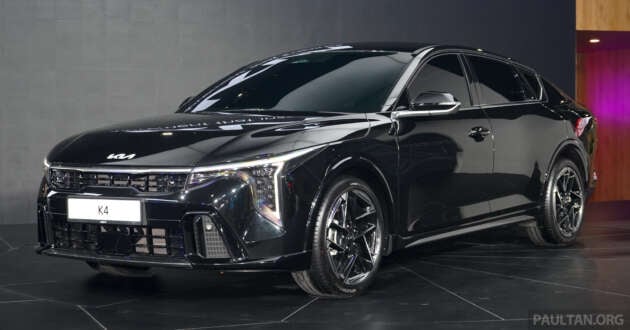
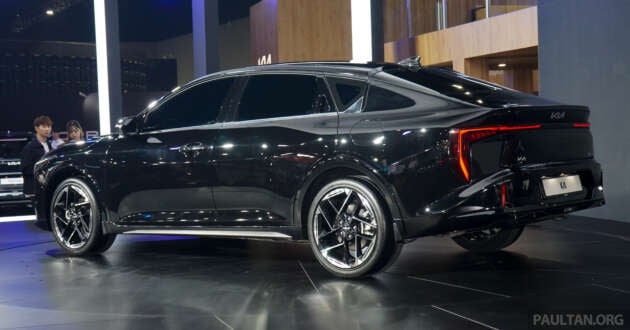
    Kia K4 previewed in Malaysia – Forte/Cerato successor shown at KLIMS in GT-Line spec with 193 PS 1.6T

    Kia Sales Malaysia (KSM) is showing off the Kia K4 at this year’s Kuala Lumpur International Mobility Show (KLIMS), although the company isn’t saying if the Honda Civic rival will be launched here anytime soon.

    The K4 is the successor to the Forte and Cerato, both previously also known as the K3, a name which has now been used for a B-segment sedan that replaces the Rio. First making its debut in March 2024 as a sedan, which is what you’ll see at KLIMS, the K4 would later gain a hatchback version in September 2025 and a wagon (called the Sportswagon) in January this year.

    Measuring 4,710 mm long, 1,850 mm wide, 1,420 mm tall and with a wheelbase spanning 2,720 mm, the K4 sedan occupies a larger footprint than the Civic, although the later has a slightly superior wheelbase.

    Kia K4 previewed in Malaysia – Forte/Cerato successor shown at KLIMS in GT-Line spec with 193 PS 1.6T

    Design-wise, the K4 showcases the brand’s ‘Opposites United’ philosophy with its star map signature lighting that is accompanied by small cube LED projector headlamps and a modern take on the ‘Tiger Face’.

    You’ll also find a fastback profile and prominent haunches over the wheels, while the rear bumper incorporates an air diffuser. This show car rides on 18-inch alloy wheels wrapped in 235/40 profile tyres, with MacPherson struts at the front and a multi-link rear setup.

    It also gets the GT-Line package, hence the different front and rear, gloss black accents, satin chrome beltline as well as gloss black mirror caps, window trim and side sills.

    Kia K4 previewed in Malaysia – Forte/Cerato successor shown at KLIMS in GT-Line spec with 193 PS 1.6T

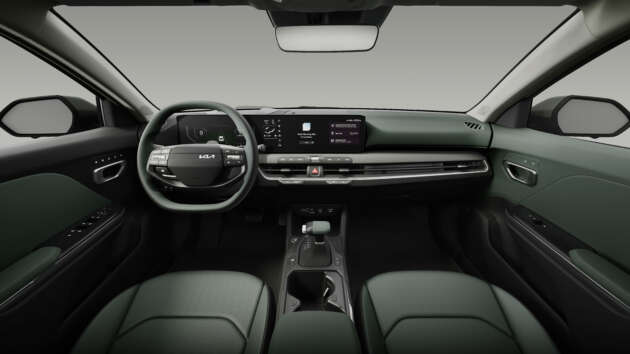
    Inside, there’s a two-tier dashboard with a widescreen display panel consisting of a 12.3-inch digital instrument cluster, a 5-inch climate display and a 12.3-inch infotainment touchscreen. KSM says the car comes with wireless Android Auto and Apple CarPlay, a wireless charger, dual-zone climate control, ventilated front seats and a 60:40 split-folding rear bench.

    Powering this K4 is a Smartstream G 1.6 litre turbocharged inline-four petrol engine that makes 193 PS (190 hp or 142 kW) and 265 Nm of torque. The T-GDI mill is paired with an eight-speed automatic transmission sending drive to the front wheels. A VTEC Turbo-equipped Civic makes less power than this at 182 PS (180 hp or 134 kW) and 240 Nm.

    According to KSM, the K4 is only here for a preview and there’s no indication for now that the sedan will eventually go on sale in Malaysia. What do you think though? Do you like what the K4 has to offer?

     
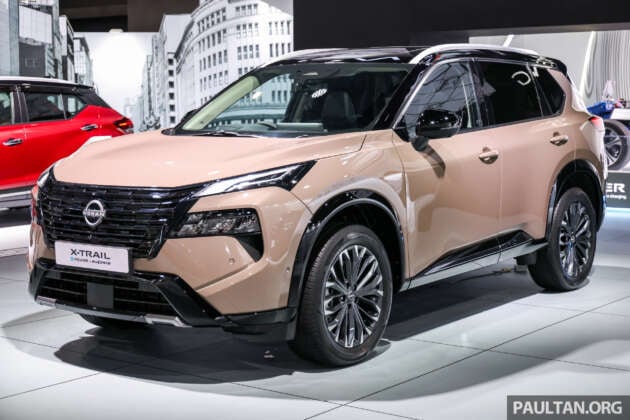
  • Nissan X-Trail e-Power e-4orce launching in Malaysia Q4 – T33 facelift makes regional debut at KLIMS 2026

    Nissan X-Trail e-Power e-4orce launching in Malaysia Q4 – T33 facelift makes regional debut at KLIMS 2026

    Taking centrestage at Edaran Tan Chong Motor‘s (ETCM) Kuala Lumpur International Mobility Show (KLIMS) 2026 stand is indeed the Nissan X-Trail e-Power. Deja vu? Well, not quite, as this is the T33 facelift (the one at KLIMS 2024 was the pre-facelift), and now ETCM has confirmed that the model will launch in Malaysia in the fourth quarter this year.

    This is actually a regional debut for the T33 facelift, as Indonesia and Thailand still have the pre-facelift. What’s different here? Well, there’re still two tiers of front lights, but there’s a new V-motion grille – it was previously just a bowl with dashes inside, but there’re now horizontal slats. New front and rear bumpers too – up front, the C-shaped ‘cut-outs’ on the sides now touch the lower intake surround.

    The X-Trail e-Power’s 1.5 litre KR15DDT turbo three-cylinder engine with VC-Turbo variable compression has only one job, which is to charge a 1.8-kWh lithium-ion battery. This battery feeds two electric motors – 204 PS/330 Nm up front and 136 PS/195 Nm out back – so it has e-4orce AWD. Like the Serena e-Power and Kicks e-Power, there’s e-Pedal one-pedal driving.

    The seven-seater in pre-facelift form is quite similarly-equipped in Thailand and Indonesia, getting 19-inch alloys, a hands-free powered tailgate, a panoramic sunroof, black leather upholstery, powered front seats, a 40:20:40-split second row, a 50:50-split third row, a 12.3-inch digital instrument cluster, a 12.3-inch touch-screen, a 10.8-inch head-up display, Android Auto/Apple CarPlay, nine Bose speakers, a 15-watt wireless charger, a 360 camera with Moving Object Detection, and three-zone air-con.

    T33-facelift Nissan X-Trail e-Power e-4orce at KLIMS 2026

    T33-facelift Nissan X-Trail e-Power e-4orce official photos at KLIMS 2026

     
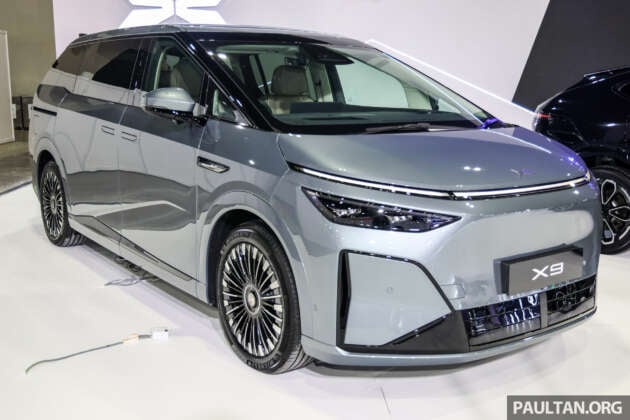
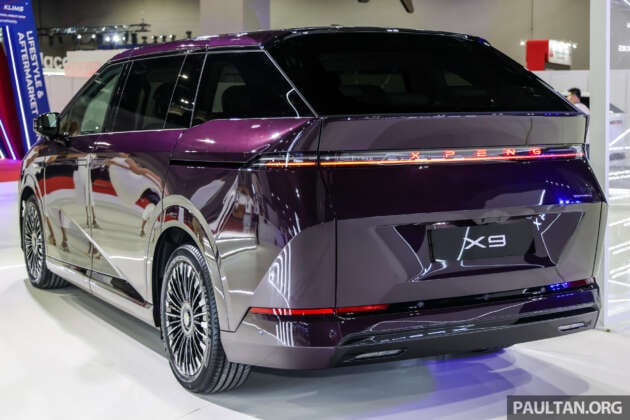
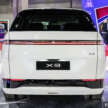
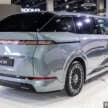
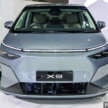
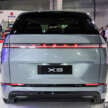
  • 2026 Xpeng X9 at KLIMS – seven-seater MPV in 2WD, AWD variants, up to 615 km WLTP; RM281k-RM336k

    2026 Xpeng X9 at KLIMS – seven-seater MPV in 2WD, AWD variants, up to 615 km WLTP; RM281k-RM336k

    Fresh from its Malaysian market launch earlier this week, the Xpeng X9 facelift will be on public display at the 2026 Kuala Lumpur International Mobility Show (KLIMS 2026) at the Malaysia International Trade and Exhibition Centre (MITEC) in Kuala Lumpur, from June 12 to 21, 2026.

    In Malaysia, three variants of the X9 facelift are available from the outset. The line-up starts with the X9 2WD Standard Range at RM281,073, joined by the X9 2WD Long Range at RM299,073, before topping out at the X9 AWD Performance at RM335,573; all prices are on-the-road without insurance.

    All three variants are offered with optional home chargers; either a 7 kW AC charger (single-phase with installation) at RM4,300, or an 11 kW AC charger (three-phase with installation) at RM5,000.

    2026 Xpeng X9 at KLIMS – seven-seater MPV in 2WD, AWD variants, up to 615 km WLTP; RM281k-RM336k

    2026 Xpeng X9 AWD Performance

    The 2WD Standard Range gets a 94.8 KWh lithium iron phosphate (LFP) battery that is rated for up to 537 km of range on the WLTP testing standard, while the 2WD Long Range and AWD Performance both receive a 110 kWh nickel manganese cobalt (NMC) battery, for 615 km (WLTP) and 580 km (WLTP) respectively.

    Fast charging via DC is significantly stepped up compared to the pre-facelift, with the updated model now from 537 kW for the 2WD Standard Range, while the 2WD Long Range and AWD Performance with the larger battery goes even higher with 542 kW DC charging; all variants therefore attain the 10-80% recharge in 12 minutes.

    Both 2WD versions get a 346 PS/450 Nm single-motor setup driving the front wheels, with the Standard Range doing 0-100 km/h in 8.2 seconds; the Long Range is marginally quicker at 7.75 seconds. The dual-motor AWD Performance boasts of 537 PS and 640 Nm, propelling the MPV to 100 km/h in 5.9 seconds.

    2026 Xpeng X9 AWD Performance (row below, left); 2WD Standard Range (row below, right)

    All variants of the X9 facelift in Malaysia from launch are of a seven-seat configuration, where the Standard Range and Long Range variants get 14-way power-adjustable second-row seats.

    The second row in the AWD Performance gets upgraded to a more luxurious “Grand Sofa” specification, offering 18-way adjustment. Across all variants are two 50-watt air-cooled wireless device chargers, along with seat cushion and backrest ventilation and heating (three-speed adjustable).

    The third row offers 60:40 split-folding, where the seats fold into the floor, and also offer electrically adjustable backrests and headrests, and two cupholders. Also included in the luggage compartment is a switch to raise or lower the vehicle on its suspension.

    Interior displays feature a 10.25-inch driver’s instrument display, a 17.3-inch central screen, a 21.4-inch roof-mounted passenger entertainment screen, a 21-inch head-up display, while device connectivity includes Apple CarPlay and Android Auto, along with five USB-C, one USB-A and two 12-volt power sockets. Audio is by a 27-speaker Xopera sound system.

    For driving assistance systems, the XPilot Assist ADAS suite is comprised of the XP5 Turing AI chip with three millimetre-wave radar units, 12 ultrasonic radar sensors, and 12 cameras including fatigue monitoring cameras.

    Assistance functions here include adaptive cruise control, lane centring control, adaptive turning cruise, intelligent speed limit assist, enhanced auto parking assist, auto exit parking assist, remote parking assist, remote vehicle summon, 360-degree camera view and transparent chassis view.

    These are joined by forward distance monitoring, forward collision warning, AEB, traffic sign recognition, speed assistant system, driver state monitoring, blind spot detection, door open warning, lane departure warning, lane keep assist, rear collision warning, rear cross-traffic alert, reverse car side warning, and narrow path assistance.

    In Malaysia, the 2026 Xpeng X9 facelift is sold with a five-year, 120,000 km warranty and an eight-year, 160,000 km warranty on the battery pack and drive motors. Also included is a complimentary service package for five years or 100,000 km.

     
  • Honda HR-V e:HEV – the complete SUV that balances fuel efficiency, safety and versatility; now with 360 cam

    Honda HR-V e:HEV – the complete SUV that balances fuel efficiency, safety and versatility; now with 360 cam

    There’s no shortage of options in the market, especially for the SUV segment. If anything, consumers might be spoilt for choice, making a decision less than straightforward. Perhaps it’s time to sit back, take a wider view and ask yourself – what do you truly want in a family car?

    Fuel efficiency to make your Budi95 quota go further every month? Top-level safety to keep your family safe? Ultimate versatility for everything that an active lifestyle throws at you? The Honda HR-V checks all boxes, and then some.

    In e:HEV hybrid form, the Honda HR-V delivers performance and efficiency in equal measure. The powertrain combines a 107 PS/131 Nm DOHC i-VTEC Atkinson-cycle with an 131 PS/253 Nm electric motor. The engine primarily acts as a generator but can also drive the front wheels at higher speeds as ICE is more efficient than EV at a fast cruise. In daily driving, the e-motor’s 253 Nm from standstill provides pep in cut and thrust urban driving.

    Best of all, the HR-V e:HEV returns fantastic fuel economy – with FC of 4.1 litres per 100 km (24.4 km/l), this hybrid will go the distance with your fuel budget.

    Honda believes in safety for all, and the Honda SENSING suite of ADAS features is available across the entire HR-V range. Forward Collision Warning, Collision Mitigation Braking System, Lane Departure Warning, Lane Keep Assist System, Road Departure Mitigation System, Adaptive Cruise Control with Low Speed Follow, Auto High Beam and Lead Car Departure Notification are all standard fit.

    Honda HR-V e:HEV – the complete SUV that balances fuel efficiency, safety and versatility; now with 360 cam

    For a vehicle serving an owner with an active lifestyle, or a family, user friendliness, space and versatility are important factors. Big screens and light shows might be eye-catching in the showroom, but it’s things like a spacious rear cabin and Honda’s famed Multi Utility Seat that truly shine in everyday use.

    The HR-V’s Multi Utility Seat features Utility Mode where the rear seats are folded down to boost boot space, Long Mode where the front passenger seat is also folded down to fit long items, and Tall Mode. The latter flips up the rear seat base for the rear cabin to transport tall items, upright. This is a nifty idea that you won’t appreciate until you need it.

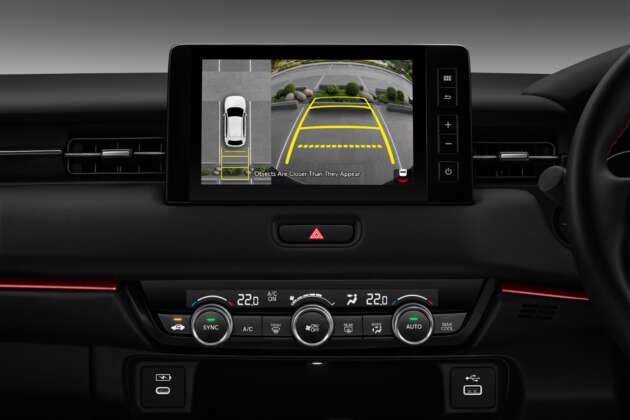
    Honda has been making cars since the 1960s, and its decades of experience means that the company excels in interior packaging and driver ergonomics. All frequently used functions are presented via conveniently located physical controls, ensuring that your full attention is where it’s supposed to be – on the road ahead and not fiddling with sub-menus of a touchscreen. The HR-V’s good all-round visibility is now enhanced with a 360° View Camera, which live feed on the centre screen assists with parking.

    Many of the above features might sound basic, but you’ll be surprised at how many cars today get the simple things wrong. Things like good fuel efficiency, comprehensive safety, space versatility and ergonomics might not be as attention-grabbing as big horsepower and big screens, but they combine to deliver a satisfying long-term ownership experience that just works.

    The 360° View Camera is now available on the Honda HR-V e:HEV and V variants, with no price increase. Experience the HR-V and test it out for size with the family at your nearest Honda showroom. More info here. Follow Honda Malaysia on Facebook, Instagram and TikTok.

     
  • Perodua teases new model with QV-E styling at KLIMS, coming soon – next-gen Myvi, Bezza?

    Perodua teases new model with QV-E styling at KLIMS, coming soon – next-gen Myvi, Bezza?

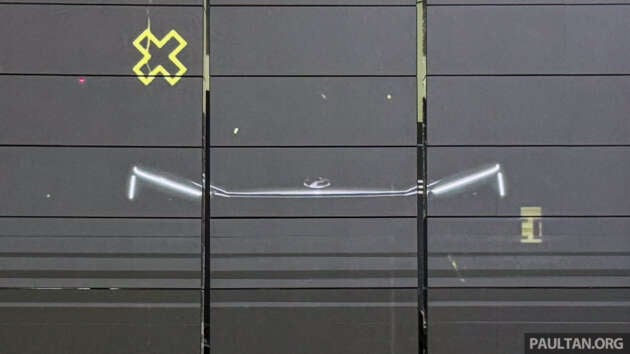
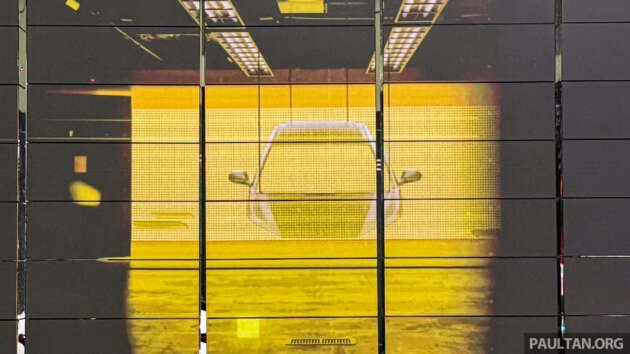
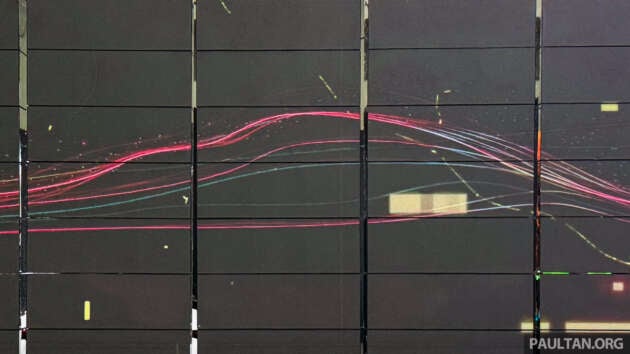
    Such is the sheer number of cars and displays at Perodua’s Kuala Lumpur International Mobility Show (KLIMS) stand that you’d be forgiven for missing a “Coming Soon” screen at the centre of it all. It’s not helped by the fact that the LED panels frequently rotate, rather annoyingly obscuring what they’re showing.
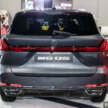

    But if you’re patient, you’ll be able to spot a few shadowy angles of a new model from the national carmaker. At first, the full-width light bar across the front end and the bonnet-mounted Perodua badge brings to mind the QV-E, but the vertical illuminated lines on either corner marks the car out as something entirely different.

    The headlights are also integrated into the daytime running lights as a single unit, rather than being split as per the EV. Also visible in the video are inverted L-shaped taillights.

    Perodua teases new model with QV-E styling at KLIMS, coming soon – next-gen Myvi, Bezza?

    From what we can tell, there are only two existing models that are ripe for replacement. The current Myvi and Bezza are eight and ten years old respectively, and the next generations of both have been speculated on for some time. Of these two, the Myvi seems to be the one most in need of a refresh, given that the Bezza remains Malaysia’s most popular car (well, until last month, that is).

    It’s the car’s profile that is throwing us off. The abstract flowing lines hint at a long and low car with a sleek roofline that curves towards the rear – almost like a Porsche 911. This would rule a Myvi out, as that car is supposed to be a practical, pragmatic hatchback.

    We could perhaps see the Bezza adopt a fastback design, much like the latest Vios. It must be said, however, that Perodua itself has previously admitted that the next-gen sedan is still years away from entering production, so a launch this year looks unlikely. We’re also pretty certain that the car is not related to the C2 Concept also being shown at KLIMS, as it presages P2’s next EV instead.

    Perodua teases new model with QV-E styling at KLIMS, coming soon – next-gen Myvi, Bezza?

    In any case, the next Perodua model will continue to be developed in partnership with Daihatsu, as opposed to being an entirely in-house effort like the QV-E. Sporting a Perodua-designed body (or “tophat”), it should continue to utilise the ubiquitous 106 PS/ 1.5 litre 2NR-VE naturally-aspirated four-cylinder engine and a Dual-Mode CVT.

    Perodua also has aspirations to bring hybrid powertrains to market, and this new model could be the perfect springboard. It could use either Daihatsu’s e-Smart Hybrid – which uses the electric motor for propulsion and the combustion engine solely as a generator – or Toyota’s system from the Vios and Yaris Cross that features a planetary gearset to manage the two power sources.

     
  • Jetour T2 i-DM PHEV open for booking in Malaysia – 1.5T, 2 motors, 3-speed DHT, 1,200 km, RM169k est

    Jetour T2 i-DM PHEV open for booking in Malaysia – 1.5T, 2 motors, 3-speed DHT, 1,200 km, RM169k est

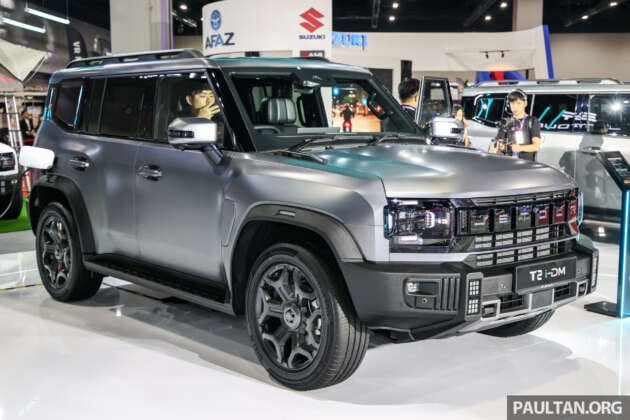
    Jetour has announced the start of order-taking for its first hybrid – the Jetour T2 i-DM PHEV – at an estimated price of RM168,888. Yup, the popular RM155,669 T2 (RM2,000 early-bird rebate included) can soon be had as a plug-in hybrid in Malaysia.

    Thanks to a 1.5 litre turbo direct-injected engine, two electric motors and a three-speed dedicated hybrid transmission (DHT), the Jetour T2 i-DM has 360 PS and 610 Nm at its disposal (T2 ICE: 245 PS/375 Nm). EV-only and combined ranges are claimed to be over 100 km and 1,200 km respectively (cycle unspecified but likely NEDC).

    Jetour Malaysia says the car will come with Level 2 ADAS, six airbags, a panoramic view monitoring system and “a comprehensive ownership and warranty package.” For context, the T2 ICE comes with a seven-year/150,000-km vehicle warranty, a 10-year/one-million-km powertrain warranty and five times’ free service (parts and labour).

    No other specs have been officially released so far, but we can look at South Africa, where the right-hand drive PHEV gets 20-inch alloys, 255/55 tyres, a 15.6-inch touchscreen, a 10.25-inch instrument panel, 12 Sony speakers, a 540 camera, wireless charging, faux-leather upholstery, powered front seats, ambient lighting, a panoramic glass sunroof and a powered tailgate, according to Cars.co.za. Excited?

    Jetour T2 i-DM PHEV at KLIMS 2026

    Jetour T2 i-DM PHEV official images

     
  • Zeekr 009 Grand open for booking in Malaysia – four-seat luxury MPV with 43-inch TV; from RM600k est

    Zeekr 009 Grand open for booking in Malaysia – four-seat luxury MPV with 43-inch TV; from RM600k est

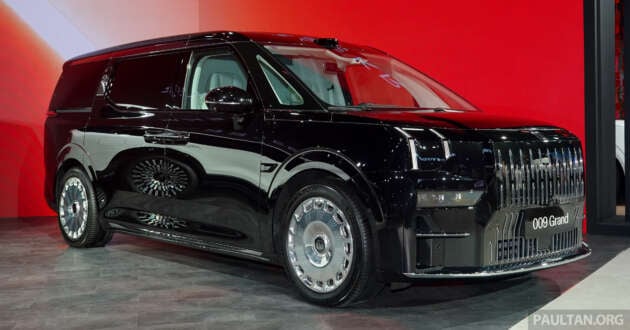
    Parked alongside the Zeekr 9X at this year’s Kuala Lumpur International Mobility Show (KLIMS) is the 009 Grand, which is a four-seat version of the brand’s electric MPV. Like its ultra-lux SUV stablemate, the 009 Grand is currently being previewed ahead of an eventual launch in 2026, with order books now open if you’re interested.

    According to Zeekr Malaysia, the 009 Grand will be priced from RM600,000, which would make it the second-most expensive model in the line-up after the 9X that is set to start from RM800,000. In China, the 009 Grand goes for 789,000 yuan (about RM474k), if you need to know.

    For more context, the regular, non-Grand 009 that we currently get is priced between RM299,800 and RM359,800 on-the-road without insurance across three variants (seven-seat Executive and Luxury, six-seat Ultra Luxury). The comparable Lexus LM 500h, also a four-seater but with a hybrid, not an electric powertrain, is well over a million ringgit.

    With the 009 Grand being twice the base 009 variant’s price, what do you get for all the extra money? Not much if you sit at the front, as the 009 Grand looks basically identical to a regular 009 in terms of the dashboard design and general layout of controls, with the exception of some trim differences.

    You don’t even get to see into the back because of the partition that serves to provide some privacy to the VIPs, celebrities and CEOs there, although they will be able to lower a small window to converse with their chauffeur if needed.

    As with the four-seat LM, the whole point of the 009 Grand is pampering rear passengers. To that end, the seat upholstery is mainly aniline leather with touches of Ultrasuede, the latter also used for the headliner. You’ll also find soft wool carpets, while the interior trim is described as “natural marble trim from the Himalayas.”

    The seats themselves are different from other 009 variants and look more like what you might find in the first-class section of an airplane. As you’d expect, they have plenty of functions, including heating, ventilation and massage, the last with plenty of programmes, including a hot stone therapy paired with a 20-point massage.

    To reinforce the lounge concept further, there’s a 43-inch mini-LED display that is controlled via the centre console-integrated touch panel, which also provides access to almost all functions in the rear (seats, climate system, windows, etc.).

    Said centre console also has two storage areas stacked on top of each other which you can lock using a PIN code in the touch panel. If that isn’t enough, you also get spaces to store your shoes, there’s a refrigerator just under the large display, and the seats have pull-out tray tables, again, like in an airplane.
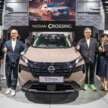

    This left-hand drive unit you see here comes from China, and over there, the 009 Grand has yet to be facelifted. As such, it soldiers on with an 800-volt system, a 108-kWh nickel manganese cobalt (NMC) battery for 702 km of CLTC-rated range and dual electric motors – one on each axle – rated at 789 PS (778 hp or 580 kW) and 810 Nm of torque. We should point out those outputs are higher than any 009 variant currently sold in Malaysia.

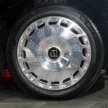
    What else? Well, the 20-inch wheels are forged and there’s a LiDAR sensor, which right-hand drive units of the 009 do not get, even in Hong Kong. If you’re a big-time tauke, is this the MPV of your dreams?

     
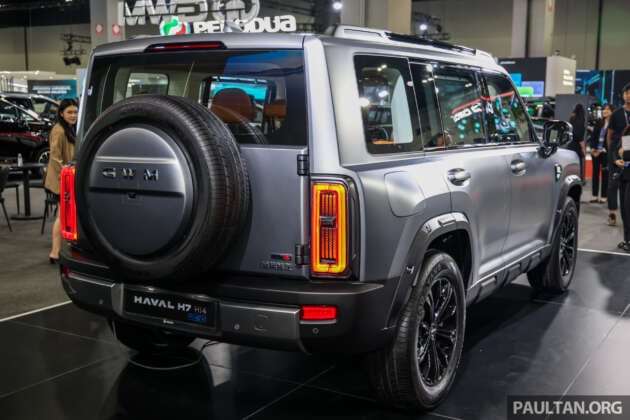
  • 2026 GWM Haval H7 Hi4 previewed in Malaysia – AWD PHEV Jetour T2 rival, 370 PS, 115 km WLTP EV range

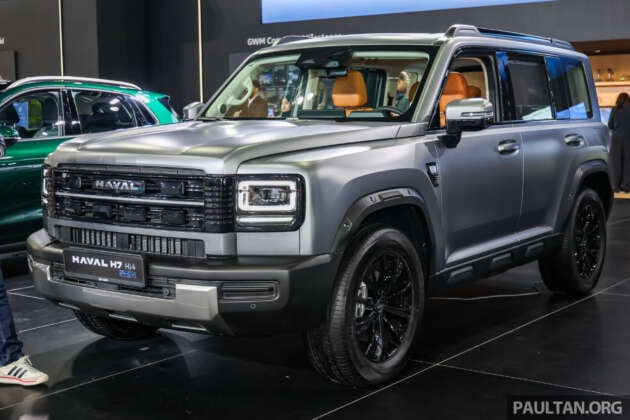
    2026 GWM Haval H7 Hi4 previewed in Malaysia – AWD PHEV Jetour T2 rival, 370 PS, 115 km WLTP EV range

    As teased earlier this week, the GWM Haval H7 has made an appearance at the Kuala Lumpur International Mobility Show (KLIMS), signifying the brand’s growth into the lifestyle off-roader sector. In other words, this car has the surprise hit that is the Jetour T2 right in its sights.

    Just like its rival, the H7 is a unibody SUV that looks like a 4×4 – in this case, it’s a facsimile of the body-on-frame H9. With its boxy design, upright stance, squared-off wheel arches and external spare tyre mounted on a sideways-opening tailgate, it certainly looks the part, even if it may not be quite as fashionable as the Defender-aping T2.

    The car arrives in facelifted form, sporting rectangular headlights in place of round ones – putting some distance between it and that H9 – and a new grille with a horizontal light bar. At the back, the quad square taillights have been replaced by twin vertical clusters. The wheels measure 19 inch in diameter and come in a black multi-spoke design.

    2026 GWM Haval H7 Hi4 previewed in Malaysia – AWD PHEV Jetour T2 rival, 370 PS, 115 km WLTP EV range

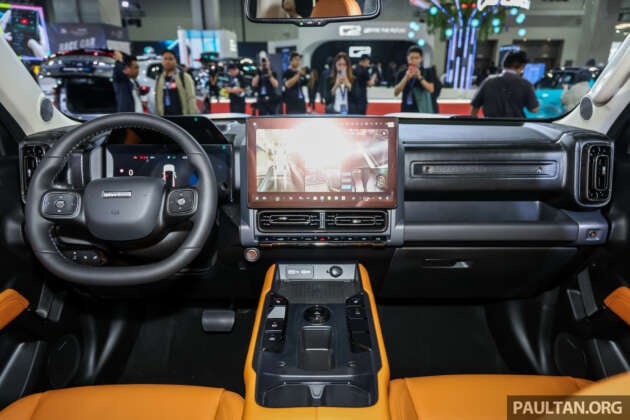
    The rugged design continues on the inside with an angular dashboard and a chunky passenger grab handle. Ahead of the driver sits a rather cutesy two-spoke steering wheel and a 12.3-inch instrument display, the latter topped by a strange “hood” incorporating the P-R-N-D indicator.

    Meanwhile, the infotainment touchscreen measures 15.6 inches and runs GWM’s latest Coffee OS. There’s a welcome row of physical air-con controls underneath and a wide centre console housing a smattering of physical controls and a rotary drive mode selector. Available features include a power-adjustable driver’s seat, cooled centre console storage, a head-up display, a panoramic sunroof and rear air vents.

    Measuring 4,800 mm long, 1,950 mm wide and 1,843 mm tall, the H7 is 15 mm longer, 56 mm narrower and 27 mm lower than the T2, while its 2,738 mm wheelbase is 62 mm shorter. The extra length is thanks to the full-size external spare tyre, which beats the Jetour’s space saver housed in a slim “backpack”.

    2026 GWM Haval H7 Hi4 previewed in Malaysia – AWD PHEV Jetour T2 rival, 370 PS, 115 km WLTP EV range

    At KLIMS, the H7 is being shown in full-fat Hi4 plug-in hybrid form, powered by twin electric motors. The one at the front makes 109 PS and 170 Nm of torque, while the rear pushes out 204 PS and 350 Nm. This is paired with a 150 PS/230 Nm 1.5 litre turbo four-cylinder engine and a two-speed dedicated hybrid transmission (DHT) for a total system output of 370 PS and 750 Nm.

    So equipped, the H7 is able to sprint from zero to 100 km/h in 6.2 seconds, while the 27.54 kWh LFP battery – larger than the 19.09 kWh set to be offered in the Philippines – delivers a pure electric range of up to 150 km on the CLTC cycle, or 115 km on the WLTP cycle. All in all, GWM quotes a total range of over 1,000 km.

    Aside from the Hi4, the H7 is also available in 2WD hybrid and PHEV forms, both with a 177 PS/300 Nm front motor for total outputs of 244 PS and 540 Nm for the hybrid and 322 PS for the PHEV. The latter is also fitted with a smaller 19.09 kWh LFP pack, maintaining an NEDC range of 105 km (circa 90 km WLTP).

    Even though the H7 isn’t a pukka 4×4, GWM has still baked in some decent off-road capability, with an electronic locking rear differential and approach, breakover and departure angles of 25 degrees, 32 degrees and 20.1 degrees respectively. The max water wading depth, however, is only 580 mm, which is significantly lower than the T2’s 700 mm.

    Pricing and availability have yet to be announced, but expect the H7 to arrive later this year, likely in CKD locally-assembled form. It will need to be to match the price of the T2, which retails at RM156,800 nett.

     
  • GWM Ora 5 HEV previewed in Malaysia at KLIMS 2026 – 1.5T hybrid ‘Good Cat SUV’, over 1,100 km WLTP

    GWM Ora 5 HEV previewed in Malaysia at KLIMS 2026 – 1.5T hybrid ‘Good Cat SUV’, over 1,100 km WLTP

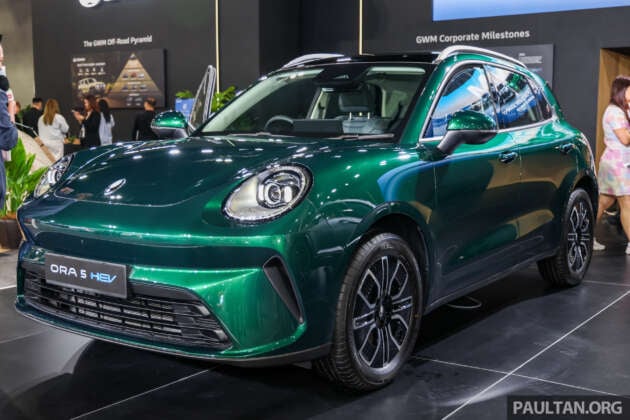
    Always liked the looks of the Ora Good Cat but wished it was a bit bigger? GWM Malaysia has previewed the Ora 5 HEV at the ongoing Kuala Lumpur International Mobility Show (KLIMS) 2026.

    What it is, is a little SUV powered by GWM’s Hi2 hybrid system – ‘H’ for hybrid, ‘i’ for intelligent and ‘2’, GWM says, represents two benefits, namely efficiency and performance. You can also think of ‘2’ as referring to two-wheel drive (since GWM calls its four-wheel drive hybrids Hi4), because only the front wheels are powered on the Ora 5 HEV.

    Let’s get the powertrain out of the way first – the Ora 5 HEV has a 1.5 litre turbo engine, a two-speed dedicated hybrid transmission (DHT) with an integrated electric motor, a 1.09-kWh battery and a 223 PS/476 Nm combined output for a 7.7-second 0-100 km/h time, a 22.7-km per litre claimed fuel economy and a WLTP range of over 1,100 km.

    At 4,471 mm long, 1,833 mm wide and 1,641 mm tall, with a 2,720-mm wheelbase, the Ora 5 sits between the BYD Atto 3 and the Proton eMas 7 where size is concerned. It’s also 236 mm longer, 58 mm wider and 45 mm taller than the Good Cat, while having a 70-mm longer wheelbase.

    There are MacPherson struts and ventilated discs up front; multi-links and solid discs out back. The 18-inch alloys are wrapped in 225/60 rubber.

    Going by Thai specs, the car gets a 10.25-inch instrument panel, a 14.6-inch touch-screen, wireless Apple CarPlay/Android Auto, app functionality, OTA updates, six speakers (nine on the range-topping Ultra), 50-watt wireless charging, a six-way powered driver’s seat (Ultra adds ventilation and three memory settings), a four-way manual front passenger seat (Ultra adds power adjustment and ventilation) and leather seats.

    ADAS is standard, including AEB, ACC and various lane functions, but the Ultra adds lane change assist, blind spot detection, door open warning, emergency lane keeping, rear cross traffic alert, rear cross traffic braking, front cross traffic alert and front cross traffic braking.

    The starting price in Thailand is 729k baht (RM90k) but since our Ora Good Cat Ultra and Ora Good Cat GT are already RM110k and RM120k respectively, how much are you willing to fork out for the Ora 5 HEV?

     
  • 2026 Proton X50 Sport Edition on display at KLIMS – kitted-out variant to go on sale later in lifecycle?

    2026 Proton X50 Sport Edition on display at KLIMS – kitted-out variant to go on sale later in lifecycle?

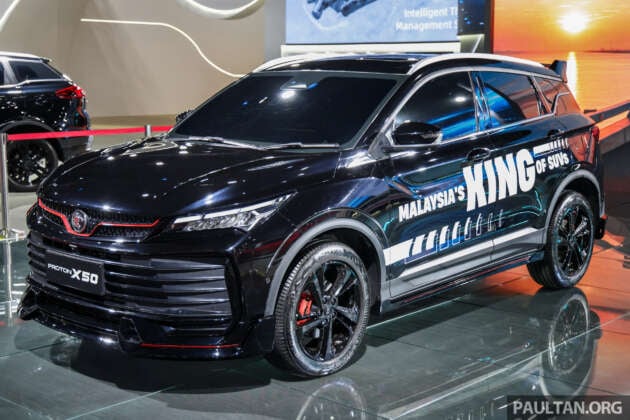
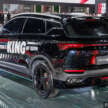
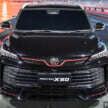
    The 2026 Proton X50 Sport Edition gets its public showing at the 2026 Kuala Lumpur International Mobility Show (KLIMS 2026), and the facelifted B-segment SUV that was launched in July last year gets a selection of styling tweaks.

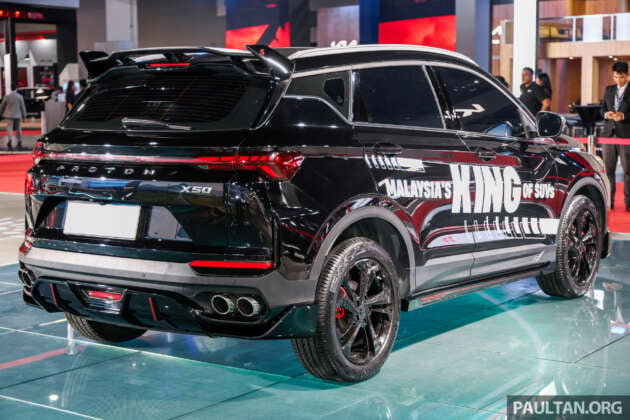
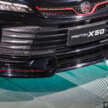
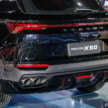
    Taking on a black-out aesthetic similar to that of its larger stablemate the X70 Sport Edition, the X50 Sport Edition is shown with a black exterior colour that is joined by the black-out treatment for its trim sections which are in matte silver on the regular X50.

    Meanwhile, red highlights – such as on the grille trim of the standard-run model – also feature on the front splitter, side skirts and the rear diffuser. The rather prominent rear spoiler is actually standard on the X50 Flagship.

    The Sport Edition treatment for the latest X50 mimics that of the previous version, which was shown at the 2024 running of KLIMS. Like its predecessor, this latest Sport Edition isn’t available to purchase at this initial public showing, though it could go on sale later on in the X50’s lifecycle.

    2026 Proton X50 Sport Edition on display at KLIMS – kitted-out variant to go on sale later in lifecycle?

    It remains to be seen as to which variant of the X50 will underpin the Sport Edition should it come to market, and it won’t necessarily be based on the range-topper, as the previous Sport Edition was based on the Premium rather than the Flagship with the more powerful engine in the X50 line-up at the time.

    There’s yet to be access to the interior of the latest X50 Sport Edition, though like its predecessor, the black-and-red colour scheme of its cabin already matches that of the dressed-up exterior.

    In the case of the current X50, its powerplant is the 1.5 litre BHE15TD turbocharged and direct injected unit, producing 181 PS at 5,500 rpm and 290 Nm of torque between 2,000 rpm and 3,500 rpm, driving the front wheels through a seven-speed wet dual-clutch automatic transmission.

    Three variants of the Proton X50 facelift are currently on sale – the 1.5TD Executive at RM89,900, the 1.5TD Premium at RM101,800, and the 1.5TD Flagship at RM113,300.

     
  • Perodua C2 Concept unveiled at KLIMS 2026 – ‘Chapter 2’ prototype previews P2’s future EV sedan

    Perodua C2 Concept unveiled at KLIMS 2026 – ‘Chapter 2’ prototype previews P2’s future EV sedan

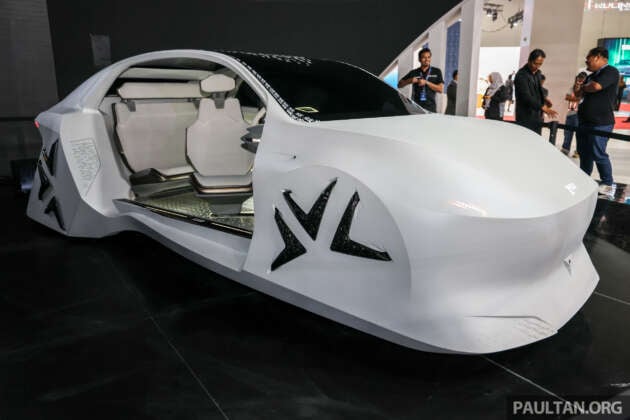
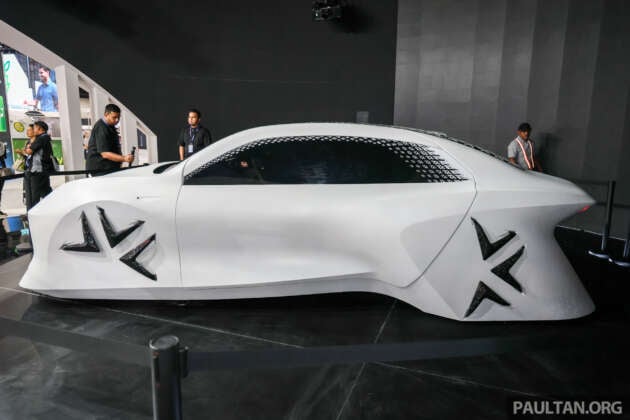
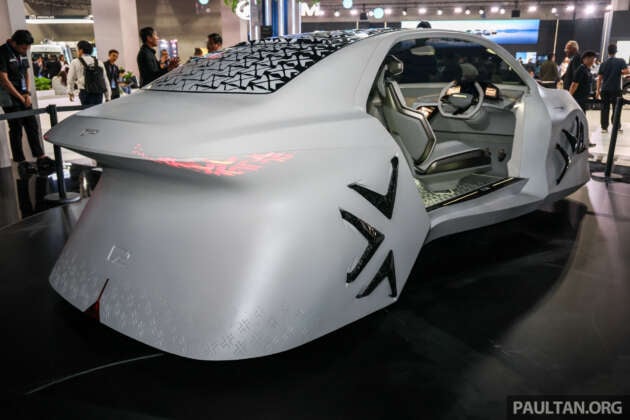
    There’s only one world debut at the KL International Mobility Show (KLIMS) 2026, which opens for the media today at MITEC (public days are from June 12-21), and its from local carmaker Perodua. The quiet folks from Rawang pulled the drapes off the Perodua C2 Concept moments ago, and it’s quite a sight.

    C2 stands for ‘Chapter 2’ and this B-segment sedan showcar is our first look at the second chapter of Perodua electric vehicle journey, following the QV-E that was launched in December 2025.

    Perodua says that the C2 ‘represents an entirely different styling direction, incorporating the latest technology and created by our young and talented designers, which represent their vision of what the future of EV would look like’. It’s inspired by the Alpha and Beta generations, they say.

    Perodua C2 Concept unveiled at KLIMS 2026 – ‘Chapter 2’ prototype previews P2’s future EV sedan

    “The C2 is part of our ongoing EV storyline. It expands our narrative of made by Malaysians for the world as we improve the future of mobility experience for our customers,” said Perodua president and CEO Datuk Seri Zainal Abidin Ahmad. “The C2 will be our basis for our future EV, and we are looking forward to engaging with visitors to our booth on their views and comments to ensure that our future product will exceed our customers’ expectations,” he added.

    The P2 C2 is conceptualised with AI driving assist features such as real-time navigation, charging station locations, traffic updates, enhanced anti-theft features and assisted parking.

    “We have greatly integrated our P-Circle super app into this prototype so that our customers can access a world of convenience – from a secure e-wallet app to priority genuine parts delivery – the C2 represents the future in mobility integration,” Zainal said. The P-Circle super app and its ecosystem was launched in October 2025, intended for P2’s EV future. By then, battery swapping might be a thing.

    Perodua C2 Concept unveiled at KLIMS 2026 – ‘Chapter 2’ prototype previews P2’s future EV sedan

    Perodua says that the C2 represents a new phase of its design language that is distinct from the previous eMO look that culminated in the production QV-E. The wavy body features a bunga pecah lapan theme (as seen on the lighting at both ends) as well as a new logo, which if you look closely, is a stylised P2 – do you see the ‘2’? The steering doesn’t have this ‘P2’ logo but the full Perodua script instead.

    Future Bezza EV? What do you think of the Perodua C2 Concept?

    GALLERY: Perodua C2 Concept at KLIMS 2026

     
  • TQ Wuling Huajing S makes Malaysian debut at KLIMS – six-seat 1.5T PHEV SUV co-developed with Huawei

    TQ Wuling Huajing S makes Malaysian debut at KLIMS – six-seat 1.5T PHEV SUV co-developed with Huawei

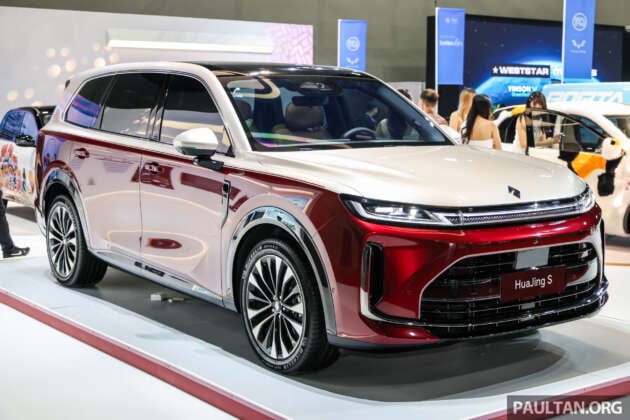
    TQ Wuling clearly has intentions of moving upmarket beyond the little Bingo, as the TQ Wuling Huajing S has been unveiled at the ongoing Kuala Lumpur International Mobility Show (KLIMS) 2026 – not only is it a Malaysian debut for the six-seat PHEV; it’s its first appearance outside China.

    Sold under the (slightly) more upmarket Baojun marque in China, the Huajing S (which will almost certainly be renamed for Malaysia) debuted globally at Auto China 2026 in Beijing, so it’s very new. It’s a joint development between SAIC-GM-Wuling and Huawei – hence the ‘Hua’ in the name.

    The tech giant has played a significant role in the car’s design as part of the Huawei Inside (HI) Plus model, so it’s no surprise that it bears a slight resemblance to the original Aito M7, developed under the even-more-involved Harmony Intelligent Mobility Alliance (HIMA).

    TQ Wuling Huajing S makes Malaysian debut at KLIMS – six-seat 1.5T PHEV SUV co-developed with Huawei

    That much is visible through the visor-like front end, which on the Huajing S incorporates the headlights and a striking lightning-shaped full-width light bar. This sits above a large hexagonal lower grille and vertical corner air inlets, joined together by a large U-shaped chrome bar.

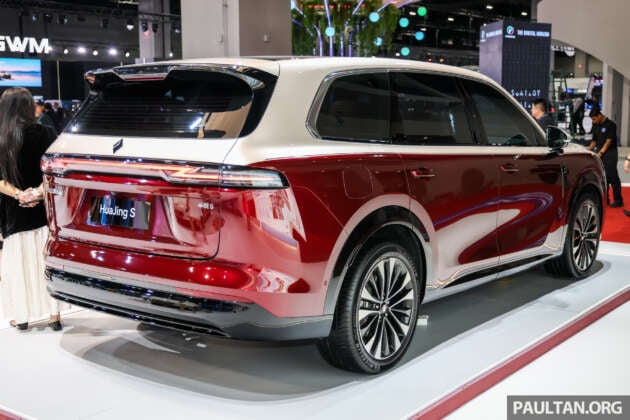
    Meanwhile, the side profile is dominated by a hockey stick-like swage line that incorporates the front fender appliqués. The D-pillars are fairly upright, befitting the car’s status as a posher model, while the full-width taillights mirror the front’s lightning graphic.

    Standing in contrast to the bijou Bingo, the Huajing S is a massive SUV, measuring 5,235 mm long, 1,999 mm wide and 1,800 mm tall with a 3,105 mm wheelbase. That makes it a whopping 415 mm longer than the already-sizeable Jaecoo J8 and even the new Denza B8.

    TQ Wuling Huajing S makes Malaysian debut at KLIMS – six-seat 1.5T PHEV SUV co-developed with Huawei

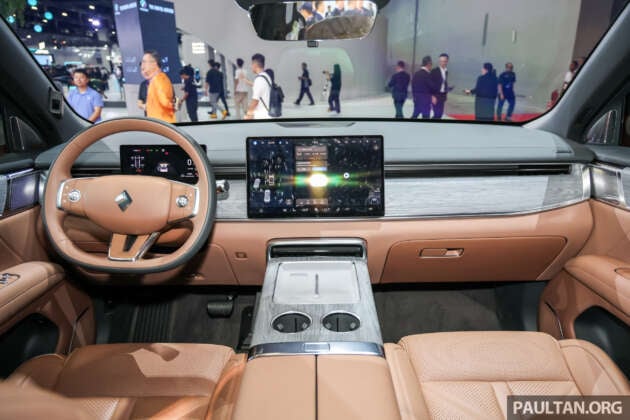
    Inside, the Huajing S features a cookie-cutter Chinese car interior, with a minimalist dashboard, big screens and twin smartphone holders. As befits a Huawei-developed model, there’s plenty of tech on board, with the 8.8-inch instrument display and 15.6-inch infotainment touchscreen both running on HarmonySpace 5, the automotive version of the firm’s in-house HarmonyOS 5 software.

    Also fitted as standard is Huawei Qiankun ADS Pro, a suite of driver assists that uses the Limera (lidar and camera) array at the top of the windscreen to deliver highly-automated highway and city driving and remote park assist with an automated valet function. Don’t expect this to make it to Malaysia, however.

    Other features include a 50-watt Qi wireless charger, 15-speakers, dual sunroofs, powered second-row captain seats with ottoman, heating, ventilation and massage for the first two rows, a fridge with heating and cooling, and a 15.6-inch roof monitor. The boot swallows 423 litres even with all six seats up.

    Power comes from a single front electric motor producing 272 PS (200 kW) and 310 Nm of torque, with an available dual-motor all-wheel-drive version pushing out a sum total of 525 PS (386 kW) and 620 Nm. This is paired with a 143 PS/220 Nm 1.5 litre turbo four-cylinder engine and a single-speed dedicated hybrid transmission (DHT).

    The motors are juiced by a choice of two LFP batteries – a 31 kWh unit in the base FWD model delivers a claimed CLTC range of 200 km, while a 41.9 kWh CATL pack boosts this figure to 255 km, or 235 km with AWD. Expect WLTP numbers closer to 160 km, 200 km and 190 km respectively. The car also supports up to “3.5C” DC fast charging (around 145 kW) and can be charged from 10 to 70% in as little as 14.5 minutes.

    If the Huajing S does go on sale here, it will likely be the second Huawei-influenced model offered in Malaysia, with the Avatr 07 from Changan – another HI Plus car – also being considered. Will TQ Wuling be able to justify this huge gap to the Bingo? Let us know what you think in the comments.

     
  • Proton FutureMotion HEV at KLIMS – i-HEV hybrid coming soon, to debut in AMA02 this year?

    Proton FutureMotion HEV at KLIMS – i-HEV hybrid coming soon, to debut in AMA02 this year?

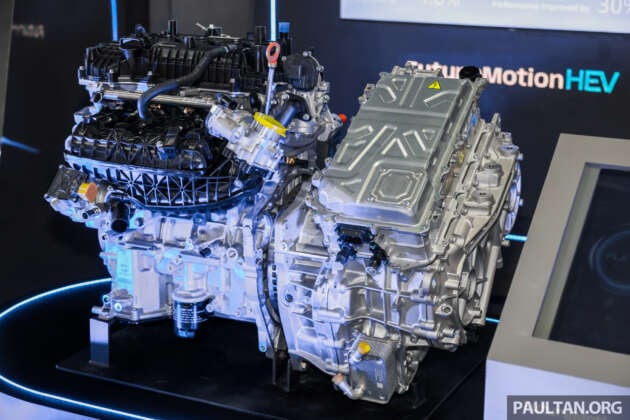
    Aside from the new eMas 7 Premium Plus and CKD locally-assembled eMas 5, Proton has also showcased its FutureMotion HEV hybrid technology at the Kuala Lumpur International Mobility Show (KLIMS). This is a version of Geely’s i-HEV powertrain, which debuted in China earlier this year.

    The setup is essentially that of the eMas 7 PHEV, except shorn of its large 18.4/29.8 kWh Aegis short blade LFP battery. This is led by a 1.5 litre BHE15 four-cylinder engine, with the one shown here being the naturally-aspirated version.

    Proton calls this a dedicated hybrid engine (DHE), closer in design to the eMas 7 PHEV’s mill instead of the i-GT engine used in the turbo X50 and NA Saga. It uses a slightly modified block and runs on an Atkinson cycle full-time, rather than only in certain conditions as per the other cars, and is fitted with single instead of dual VVT.

    Proton FutureMotion HEV at KLIMS – i-HEV hybrid coming soon, to debut in AMA02 this year?

    The powertrain is already fitted to Geely hybrids like the Emgrand i-HEV

    The engine also adopts an electrically-powered alternator and air-con compressor, joining the electric water pump the Saga already comes with and eliminating the auxiliary belt. The exhaust gas recirculation (EGR) system is different from one in the i-GT mills as well.

    The only model currently on sale with this powertrain is the Geely Preface i-HEV, which uses a 111 PS/136 Nm version of the engine – with a record thermal efficiency of 48.41% – and a 190 PS/240 Nm motor housed within the 11-in-1, single-speed dedicated hybrid transmission (DHT).

    As the eMas 7 PHEV proved, however, this DHT could easily be mated to the less powerful 99 PS/125 Nm BHE15-DFN mill, which has a thermal efficiency of just 46.5%. The electric motor is also available in a less powerful 163 PS/210 Nm tune, as used in the Geely Galaxy Starshine 6/Emgrand EM-i.

    Proton FutureMotion HEV at KLIMS – i-HEV hybrid coming soon, to debut in AMA02 this year?

    Saga Cross render by Theophilus Chin

    This is important because Proton has already confirmed that it will use a “DHT120” for a yet-to-be-launched SUV, with the number standing for the motor’s output in kW – this conveniently converts to 163 PS. The company’s deputy CEO Abdul Rashid Musa said during his KLIMS presentation that the powertrain is slated to debut in a new model very soon, with the engine and DHT set to be assembled in house in Tanjung Malim.

    We can think of two separate possible models. The first is a rebadged version of the fifth-generation Geely Emgrand, which will soon receive the i-HEV powertrain in China. We don’t expect this to arrive here within the next couple of years, however, as such a vehicle would at least partially replace the S70 – and given that the sedan has only recently been refreshed, it will likely soldier on for a while yet.

    The much more likely option would be the second model built on the Advanced Modular Architecture (AMA02), expected to be a Perodua Ativa-rivalling A-segment SUV. The car, widely tipped to be called the Saga Cross, will enter production at the end of the year. Excited? Let us know in the comments.

     
  • 2026 Proton eMas 7 Premium Plus launched with 68.39 kWh battery, 115 kW DC, 450 km WLTP; RM119k OTR

    2026 Proton eMas 7 Premium Plus launched with 68.39 kWh battery, 115 kW DC, 450 km WLTP; RM119k OTR

    The Proton eMas 7 Premium Plus is now the range-topping variant for the eMas 7 EV line-up and it has been launched in Malaysia, packing a larger, 68.39 kWh battery and taking after its overseas twin, the Geely EX5 with the larger battery and resulting longer battery range, as well as added equipment.

    The eMas 7 Premium Plus sits at the top of a three-strong range that is locally assembled (CKD) at Proton’s dedicated EV plant in Tanjong Malim:

    eMas 7 Premium Plus – RM118,800
    eMas 7 Premium – RM112,800
    eMas 7 Prime – RM96,800

    2026 Proton eMas 7 pricing and specifications; click to enlarge

    Here, launch pricing for the eMas 7 Premium Plus includes a RM5,000 trade-in rebate, a RM1,500 complimentary 7 kW home charger, a RM500 V2L adapter, and a five-year, unlimited data plan with RM1,800, as well as a complimentary tonneau cover.

    In the Premium Plus, this offers up to 450 km of range on the WLTP standard when specified with 19-inch wheels shod in 235/50R19 tyres (as on the Premium), up from the 410 km WLTP range figure of the Premium variant with the 60.22 kWh battery, or an 40 km increase.

    Drivetrain is unchanged from before, and thus the eMas 7 EV carries over the 218 PS/320 Nm front-mounted motor takes slightly longer on the 0-100 km/h benchmark at 7.4 seconds, compared to the Prime that takes 6.9 seconds and the Premium that takes 7.1 seconds. According to Proton, the Premium Plus with the larger battery weighs 1,815 kg, or 50 kg heavier than the Premium that weighs 1,765 kg.

    2026 Proton eMas 7 Premium Plus launched with 68.39 kWh battery, 115 kW DC, 450 km WLTP; RM119k OTR

    The larger battery capacity is accompanied by a fast charging figure of 115 kW DC, and Proton quotes the same 20 minute duration for charging from 30-80%. Likewise, AC charging continues to be at 11 kW, and thus takes 6.7 hours for a 10-100% charge; up from 6.1 hours for the Premium with the 60.22 kWh battery.

    New equipment added to the Premium Plus includes a leg rest for the front passenger seat, and a massage function for the driver and front passenger ventilated seats.

    Elsewhere, the Premium Plus mirrors the Premium for equipment with memory for front passenger seat adjustment, and a front passenger seat leg rest, plus a self-dimming rear view mirror, a 16-speaker Flyme audio system with headrest speakers, and a windshield-projected head-up display.

    The same applies to ADAS, thus the Premium Plus similarly gets brings evasive manoeuvre assist, active lane change assist and front cross traffic alert as found in the Premium, in addition to intelligent cruise control, AEB, emergency lane keep assist, lane change safety warning and traffic sign recognition that is offered range-wide from the base Prime variant.

    Accompanying the top Premium Plus are the Premium and Prime variants, which continue to use batteries of 60.22 kWh and 49.52 kWh capacities offering 410 km (WLTP) and 345 km (WLTP) respectively.

    Six exterior colours are offered for the 2026 Proton eMas 7; these are Lithium White, Turquoise Green, Slate Grey, Platinum Silver, Quartz Rose and Obsidian Black. Two interior colours are offered, Indigo Blue and Alabaster White, though the latter is exclusive to being paired with Turquoise Green and Quartz Rose in the Premium and Premium Plus variants.

    The 2026 Proton eMas 7 is sold in Malaysia with a six-year, unlimited mileage vehicle warranty and an eight-year, 160,000 km warranty for the high-voltage battery and related components.

    2026 Proton eMas 7 brochure

     
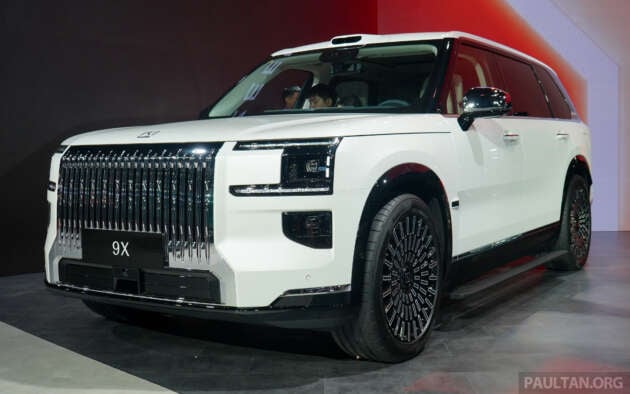
  • Zeekr 9X now open for booking in Malaysia – flagship PHEV SUV previewed at KLIMS; est price from RM800k

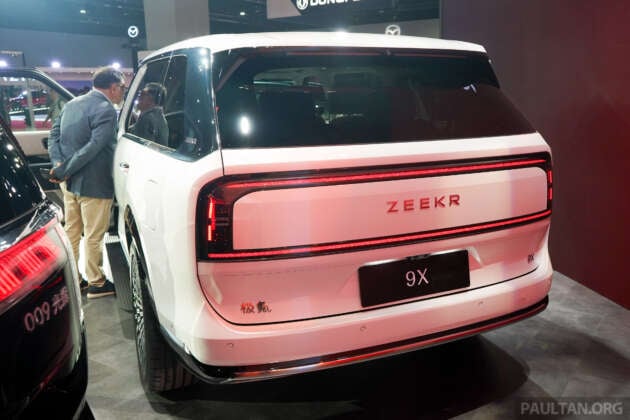
    Zeekr 9X now open for booking in Malaysia – flagship PHEV SUV previewed at KLIMS; est price from RM800k

    As planned, Zeekr Malaysia has revealed the Zeekr 9X at this year’s Kuala Lumpur International Mobility Show (KLIMS) as part of a preview before a launch takes place in late 2026 or early 2027.

    Order taking for the brand’s flagship SUV starts today as well, with estimated pricing from RM800,000. If the price announced on launch day is around that mark, the 9X will be the most expensive Zeekr model on sale in Malaysia.

    However, you’re getting a lot for the money. Measuring 5,239 mm long, 2,029 mm wide, 1,819 mm tall and with a wheelbase of 3,169 mm, the 9X occupies a large footprint and looks properly stately with its boxy shape, imposing front grille, dual-tier front lighting and full-width taillights. Some call it ‘China’s Rolls-Royce Cullinan’, and they do have a point.

    As for the three-row interior, you get fancy materials like Nappa leather seat upholstery, a suede headliner, ‘Nordic’ natural wood veneer trim and a crystal media control knob. No shortage on toys either, as the 9X is available with ambient lighting, powered seats (with heating, ventilation and massage functions), a 13-inch digital instrument cluster, dual 16-inch 3.5K OLED infotainment and front passenger touchscreens, a refrigerator, 32 speakers and a rear 17-inch ceiling-mounted display.

    Zeekr 9X now open for booking in Malaysia – flagship PHEV SUV previewed at KLIMS; est price from RM800k

    Built on the SEA-S platform with a 900-volt electrical architecture, the 9X features the Geely Group’s SEA Super Hybrid, which is a plug-in hybrid system. The fundamentals include a 2.0 litre turbocharged engine making 279 PS (275 hp or 205 kW), which is augmented by electric motors that are linked to a nickel manganese cobalt (NMC) battery pack in either 55- or 70-kWh capacities.

    In its most potent form, the 9X comes with a 70-kWh battery and three electric motors (two rear, one front) for a total system output of 1,400 PS (1,381 hp or 1,030 kW) and 1,410 Nm of torque. We’re told the 9X previewed at KLIMS is with a lesser powertrain, one with just two electric motors (one front, one rear) and a choice of a 55- or 70-kWh battery for 897 PS (885 hp or 660 kW) and 935 Nm.

    These figures will scare many sports cars, with the 9X capable of getting from 0-100 km/h in as little as 3.1 seconds. (3.9 or 4.2 seconds with lower outputs). Top speed is limited to 240 km/h across the line-up.

    Following the WLTP standard, the 9X’s electric-only range is between 235 and 302 km depending on the powertrain configuration, with the combined hybrid driving range between 982 and 1,015 km. With its high-voltage system, DC fast charging from 20-80% state of charge takes just nine minutes.

    The list goes on, as the 9X comes with dual-chamber air suspension and continuous damping, with 48-volt active roll stabilisation available as an option. Unsurprisingly, the flagship gets a comprehensive suite of ADAS functions powered by a smorgasbord of hardware, including a roof-mounted LiDAR.

    The 9X ranges from 465,900 to 599,900 yuan (about RM280k to RM360k) in China. Given it is a PHEV, it is not subject to the same excise duty as a pure electric vehicle (EV) imported into Malaysia. Instead, engine displacement decides what excise duty is charged, which ranges between 75% and 105% – 90% since this is within the 2,000 to 2,499 cc tier.

    We should point out the car being displayed is a left-hand drive example from China and isn’t fully reflective of what we’ll get. As such, we’ll have to wait for Zeekr Malaysia to provide more details but for now, know that the 9X is expected to be priced from RM800,000. Looking forward to this tauke mobile?

     
  • Proton eMas 5 CKD shown in Malaysia – new tonneau cover standard since June 1, still 325 km, fr RM57k

    Proton eMas 5 CKD shown in Malaysia – new tonneau cover standard since June 1, still 325 km, fr RM57k

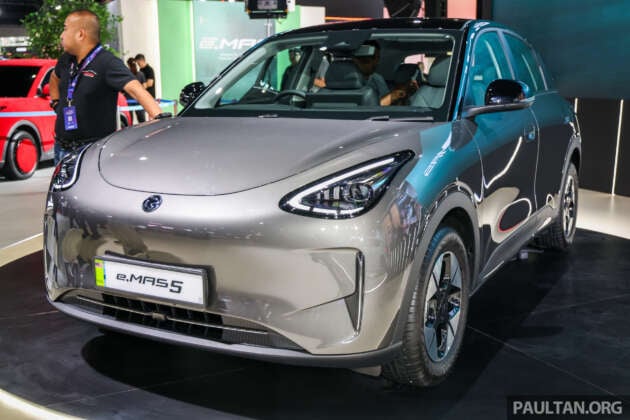
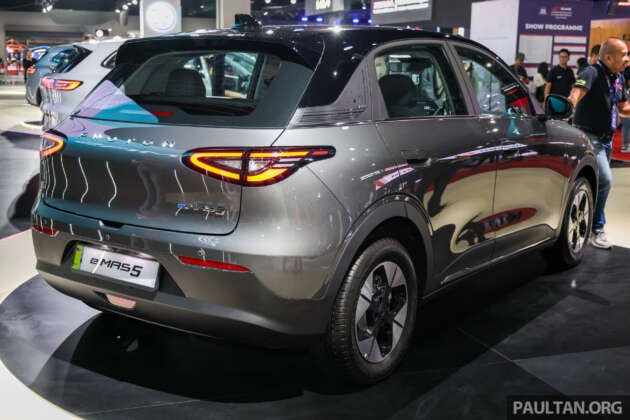
    Continuing our coverage of the Kuala Lumpur International Mobility Show (KLIMS), Proton has shown an eMas 5 with a little extra something. If you look at the manufacturer sticker on the driver’s door sill, you’ll spot a Proton version instead of Geely’s, pointing to this being a CKD locally-assembled unit.

    As the national carmaker revealed last week, production at its dedicated EV plant in Tanjung Malim will kick off this month, with the CKD model set to replace CBU fully-imported stock soon. Unlike the eMas 7, which received a price drop with the start of local assembly, the eMas 5 will continue unchanged at RM56,800 on-the-road without insurance for the Prime and RM69,800 for the Premium, both with a RM3,000 launch rebate.

    There are no changes to the cutesy exterior, nor the interior with its dual-cowl design, 8.8-inch instrument display and 14.6-inch infotainment touchscreen. The only tweak is to the 375 litre boot, which gains a standard-fit hard tonneau cover – and which, by the way, will be provided to all customers who purchase the eMas 5 starting June 1, including CBU units. Previous rumours of updates such as power-folding door mirrors and a rear wiper were wide off the mark.

    Proton eMas 5 CKD shown in Malaysia – new tonneau cover standard since June 1, still 325 km, fr RM57k

    Proton has also left the mechanicals well alone. The Prime continues to push 79 PS (58 kW) and 130 Nm of torque through its single rear motor, while the 30.12 kWh CATL LFP battery delivers a range of just 225 km on the WLTP cycle. Meanwhile, the Premium produces 116 PS (85 kW) and 150 Nm, with the larger 40.16 kWh battery enables it to travel a more respectable 325 km on a single charge.

    We should point out that the eMas 5 has yet to receive the Chinese-market Geely Xingyuan’s even bigger 47.14 kWh battery (not that it was realistic to expect that, given that the update was only introduced two weeks ago). This boosts range to 480 km on China’s wildly optimistic CLTC cycle (expect a WLTP figure closer to 390 km). Like the eMas 7, we could see the car gaining it as part of a Premium Plus variant, perhaps sometime next year.

    In any case, the eMas 5 continues to support 53 kW of DC fast charging on the Prime and 71 kW on the Premium; both can be topped up from 30 to 80% in 21 minutes. They also accept up to 6.6 kW of AC charging, taking 4.3 and 5.9 hours respectively to charge from 10 to 100%.

    Standard kit includes halogen headlights, 15-inch steel wheels with hubcaps (still wrapped in Linglong Comfort Master tyres), keyless entry, push-button start, manual air-con, manual seat adjustment, faux leather upholstery, wireless Apple CarPlay and Android Auto, rear air vents, 20 litres of rear under-seat storage, four speakers, a reverse camera and a 70 litre front boot. Safety equipment comprises of six airbags, blind spot monitoring, rear cross traffic alert rear collision warning and a door opening warning.

    The Premium adds LED headlights and daytime running lights, a black roof, 16-inch alloy wheels, a faux leather-wrapped steering wheel, a rear USB-A port, a 360-degree camera setup, six speakers and a powered tailgate. It also gains driver assists such as autonomous emergency braking, adaptive cruise control with stop and go, lane departure warning and traffic sign recognition.

     
  • MG ZS Hybrid+ B-SUV open for booking in Malaysia – early birds get RM3k rebate, 3-year free service

    MG ZS Hybrid+ B-SUV open for booking in Malaysia – early birds get RM3k rebate, 3-year free service

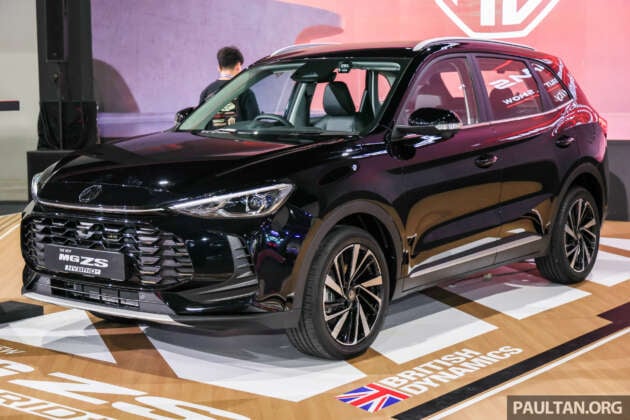
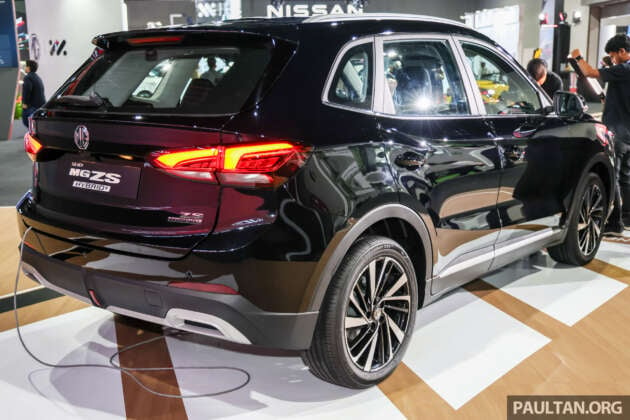
    SAIC Motor Malaysia has unveiled local specifications of the MG ZS at the KL International Mobility Show (KLIMS) 2026, which opens for the media today at MITEC (public days are from June 12-21). Now open for booking, the ZS, a B-segment SUV, will have two powertrain variants in Malaysia – Lux Turbo and Lux Hybrid+. Of the two, the hybrid will be launching soon while the pure-petrol version will come later.

    The ZS actually predates the S5 EV. Not many will remember this, but the ZS EV was one of MG Motor Malaysia’s launch models alongside the MG4 back in March 2024. A new generation ZS appeared later that year, and made it to the previous KLIMS in December 2024.

    This generation of ZS is much larger than the one before – over 100 mm longer (4,430 mm) and nine mm wider (1,818 mm), with a 29 mm longer wheelbase (2,610 mm). MG says that it’s the largest B-segment SUV in town. There’s 443 litres of boot space, expandable to 1,457 litres with the rear seats folded.

    MG ZS Hybrid+ B-SUV open for booking in Malaysia – early birds get RM3k rebate, 3-year free service

    The hybrid’s 102 PS/128 Nm 1.5-litre naturally-aspirated four-pot is paired with a 136 PS/250 Nm electric motor, a three-speed hybrid transmission and a 1.83 kWh battery. Total system output is 196 PS and 465 Nm of torque, good for 0-100 km/h in 8.7 seconds, while achieving claimed fuel consumption of 5.1 litres per 100 km on the WLTP cycle.

    MG says that the ZS is the fastest B-segment hybrid SUV in the market, while offering a range of up to 870 km on a 41-litre fuel tank. By the way, the Turbo that will come later is powered by a 1.5T with 170 PS/275 Nm, mated to a CVT.

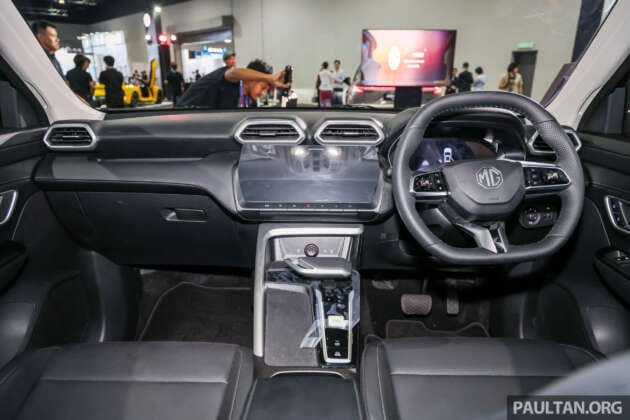
    Highlighted features include ‘Connected Hunter Eyes’ headlights, LED taillights, 18-inch alloys with 215/50 tyres, a 12.3-inch ‘floating’ infotainment display and a digital instrument cluster. The MG Pilot ADAS 2.5 suite of driver assist features is standard, along with the MG iSmart app, which allows owners to remotely access and control key vehicle functions from their phones.

    MG ZS Hybrid+ B-SUV open for booking in Malaysia – early birds get RM3k rebate, 3-year free service

    The MG ZS Hybrid+, which will be CKD locally assembled at the EPMB Melaka plant alongside the S5 EV, is available in four colours – red, silver, black and white – all with an all-black cabin. Final specs and pricing will be unveiled at the launch, which will happen very soon. It’s open for booking now for a RM99 fee, and early birds will get a RM3,000 rebate and three years of free maintenance.

    So, what do you think of the MG ZS Hybrid+’s looks and package?

    GALLERY: 2026 MG ZS Hybrid+ at KLIMS 2026

    GALLERY: MG ZS Hybrid official images


Sell your car to Carro, get paid in 24 hours


Latest Fuel Prices

PETROL
BUDI 95 RM1.99
RON 95 RM3.72 (0.00)
RON 97 RM4.35 (0.00)
RON 100 RM6.45
VPR RM7.68
DIESEL
EURO 5 B10 RM4.67 (0.00)
EURO 5 B7 RM4.87 (0.00)
Last Updated Jun 11, 2026

Latest Videos


Tools