
Paul Tan's Automotive Industry News
   

Archive for Tata Nano

Nano target market may face difficulty with loans

Tata Nano

I think we now know why Maruti’s low cost car was revealed to the banks earlier this month, they were probably pitching it to the banks to see if they would grant loans for people who want to buy it!

Banks in India are saying that they would only grant loans to buy the Tata Nano to second time car buyers instead of motorcycle owners who are looking to upgrade to a car. “We will not look to finance the purchase of the Tata Nano for those who already own a motorcycle but are stretching their budgets to buy a car. We have faced numerous problems of motorcycle loan defaults,” said an unnamed banker in an interview with Business Standard in Mumbai.

Rates to finance the Tata Nano are also expected to be higher at 18 to 19% instead of a usual new car interest rate of 13 to 14%, although it is still lower than the usual used car interest rate of 22%. This is because usually low income owners that buy such cars usually have their finances stretched to the limits every month, especially in the wake of astronomical fuel prices. This is also why Proton cars usually have higher interest rates than foreign makes in Malaysia.

Comments (6)

Tata Nano affects used car prices in India

Tata NanoAccording to a report by Marinews, it seems that the impending launch of the Tata Nano has had a bad effect on the used car market in India, with used car sales dipping between 15 to 30 percent because buyers are waiting for the Tata Nano to be launched before deciding whether to buy a Nano or a used car.

Even used car values are affected, with cars like a 6-year old Maruti 800 dipping in value by 30% from 110,000 rupees to 75,000 rupees and a 5-year old Hyundai Santro’s 200,000 rupee value down to 165,000 rupees. Values of small cars that are usually purchased by budget-concerned buyers are generally hit the most, because of the fear of an impending rise in fuel prices. Some of these buyers would have to go back to bikes.

Comments (11)

Tata Nano to get US$10 airbag?

Tata Nano

The Tata Nano is a no-frills car, but one of the more well-equipped, pricier versions of the Tata Nano will feature dual front airbags. And with luck, they’ll only increase the cost of the car by a minimum. Autoliv IFB India on the request of Tata is trying to develop a US$10 airbag for the Tata Nano, less than 10 times the price of airbags in other compact cars which cost around US$150 per airbag.

Swedish-American company Autoliv currently supplies 28% of the world’s airbags. In our market, an Autoliv joint venture with a Japanese company called Autoliv Hirotako Sdn Bhd supplies airbags for Proton, and the upcoming Perodua MPV.

Given that even these normally priced airbags sometimes do not work completely as intended and may end up injuring or killing occupants rather than saving them, are US$10 airbags really safe to use?

Related Posts:
Tata Nano: how did they do it? Cost-cutting secrets exposed
Tata Nano: the name of the Tata 1-lakh car

Comments (36)

VIDEO: Tata Nano unveiling at Delhi 2008

Tata Nano

This is a series of 3 videos from the Delhi Motor Show - where the Tata Nano was unveiled for the very first time to the public. Watch the videos after the jump.

Click here to read the rest of VIDEO: Tata Nano unveiling at Delhi 2008

Comments (26)

The Tata Nano: how did they do it?

Tata Nano

The Tata 1 Lakh Car was unveiled recently and it was given the name Tata Nano. We know its small, egg-like and comes with a small two-cylinder engine, but what exactly did Tata do to achieve the now famous “1 Lakh” price?

  • Base 1-lakh model has no radio, power steering, power windows or air conditioning.
  • Instrument panel only has the basics - speedometer, odometer and fuel gauge.
  • Its 12 inch wheels only need 3 lug nuts.
  • Small 12 inch tyres are cheaper because they use less material.
  • The 624cc two-cylinder gasoline engine only has a single balance shaft.
  • Does not pass US emission or safety standards.
  • Bosch’s 35 amp generator is lighter than the usual 40 amp model.
  • Bosch used a motorcycle starter motor.
  • Bosch Value Motronic ECU removes 700 of the Motronic’s 1,000 functions, and the chip and housing itself has been shrinked.
  • ECU sensors are smaller and lighter and fewer - 4 instead of the usual 7 or 8.
  • Throttle position sensor is half its usual size because the pressure plate uses more sensitive material.
  • It looks like a hatch but isn’t a hatch - the rear is welded shut and cannot be opened, this means the engine bay which lies under the rear seats also can only be accessed from inside the car.
  • Drum brakes all-round instead of front discs.
  • The basic 1-lakh model does not even come with a brake booster or servo.
  • Reduced NVH materials, instead sheet metal frequencies were designed to control boom and vibration.
  • Seats have a built in headrest and do not recline.
  • No glovebox.

That’s basically the laydown of what cost-cutting measures Tata have taken to bring the Tata Nano’s price down to slightly more than 1-Lakh. Would you buy the Tata Nano if it was available in Malaysia?

Related Posts:
More photos of the Tata Nano
Tata Nano - the name of the Tata 1-Lakh car

Comments (89)

More photos of the Tata Nano

Tata Nano

Here are more photos of the new Tata 1 Lakh Car, the Tata Nano. The photos include some of the car’s interior, which is so basic that its seats do not have reclining functions, and the instrument panel lacks an RPM meter.

The red car in this post with the unpainted black bumper is the basic version, which does not include air conditioning. As you can see, its very basic with steel wheels and etc. The yellow car is the more “luxurious” version, if the word may be stretched this far. It includes alloy wheels, climate control and other features.

View all photos after the jump.

Click here to read the rest of More photos of the Tata Nano

Comments (74)

Tata Nano: The name of the Tata 1-Lakh Car

Tata Nano

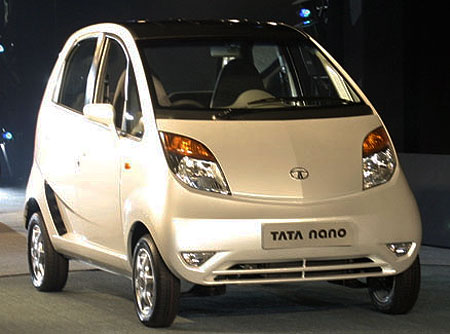
Tata has unveiled its 1-Lakh Car at the 2008 Delhi Motor Show, and its officially been christened the Tata Nano. The model at the motor show was powered by a 33 horsepower 624cc two-cylinder gasoline engine mated to either a stepless CVT transmission or 4-speed manual transmission. A diesel version will soon follow. The car will initially available with the manual, with the CVT to be available later.

The 4-seater (5 if you squeeze) Tata Nano uses 5 liters of fuel per 100km and meets all Indian local crash test and emissions guidelines. It was also designed to pass international side offset and side crash tests as well as Euro 4 emissions tests. It has a length of 3.1 metres, width of 1.5 metres and height of 1.6 metres

The two-cylinder engine, which uses Bosch’s Value Motronic fuel injection and engine management is mounted at the rear of the car together with the battery. There is a small boot at the front where a person would normally expect the engine bay to be.

The car has no power steering, but being so light I don’t think you’d really need one anyway, plus at its 1 Lakh price point you really can’t complain. It also lacks an RPM meter, with its instrument panel consisting of only a speedometer, a fuel gauge and an oil light. The car will be priced at 100,000 Indian rupees, or 1 Lakh, but customers will pay slightly more than 1 Lakh at the dealers because of taxes and other charges.

This 1 Lakh price tag is for the standard car, which does not have air conditioning. The two deluxe models will cost more. 1 Lakh Indian Rupees is roughly RM8,350.

Tata expects to sell 500,000 units of the Tata Nano, and the car will go on sale in the second half of 2008.

Previous Posts on the Tata 1-Lakh Car:
Tata 1-Lakh car to use Bosch Value Motronic ECU
Artist’s Impression: Tata Abarth 1-Lakh Car
More details on the Tata 1-Lakh Car
Tata set to launch US$2,500 car in mid-2008

Comments (82)

Artist’s Impression: Tata Abarth 1-Lakh Car?

Tata 1-Lakh Car
Artist’s Impression - Click to enlarge

LATEST DELHI 2008 UPDATE: Tata has unveiled the Tata 1-Lakh Car and has named it the Tata Nano. Click here for the latest details on the new Tata Nano.

Tata Abarth 1-Lakh Car
Artist’s Impression - Click to enlarge

This is a little bit of imagination going wild here… but something I think is interesting nonetheless. Most of you know that Tata is developing a 1-Lakh car (USD2,500), and we’ve seen an artist’s impression of it when I wrote about the car back in October.

Now, Tata currently has a JV with Fiat, and Fiat’s plant at Ranjangaon, Pune is making both Fiats and Tatas. Tata even uses Fiat diesel engines for its Tata Indica and Tata Indigo. Now, what if Fiat uses the Tata 1 lakh car as a baseline budget model, and a pure styling-enhanced Abarth model is created from it?

Seems like a long shot… but doesn’t stop the very generous Theophilus Chin from flexing his Photoshop muscles and creating something at a request from another paultan.org reader, who had this crazy idea in the first place.

Above is the result, along with a new artist’s impression of the Tata 1-Lakh car, looking alot better than the previous version I posted. The original 1-Lakh car is a 5-door, while the “Abarth” is a 3-door version.

Related Posts:
More details on the Tata 1-lakh car

Comments (13)

More details on Tata 1 Lakh Car

Tata 1 Lakh Car

LATEST DELHI 2008 UPDATE: Tata has unveiled the Tata 1-Lakh Car and has named it the Tata Nano. Click here for the latest details on the new Tata Nano.

Tata Nano

Here are some supposed details of the Tata 1 Lakh Car (Rs 1 Lakh is equivalent to USD2,500) that is supposed to be ready by July 2008. A design sketch of the Tata 1 Lakh car has been shown to selected members of the media sometime earlier and is said to resemble a egg shaped car with a tall roof.

Now Overdrive reveals that the Tata 1 Lakh car will resemble a production version of Tata’s 1998 Zing concept car. It will be a 5-door hatchback but there will be very little space behind the rear seats for a boot. In fact, even rear bench space is expected to be at a premium, making the car a 2+2 of sorts.

Definitely a pure A to B city car with the distance between A to B limited to short journeys where you do not need to carry any luggage. Not a balik kampung car, definitely. The car will be built on a rear engine rear wheel drive platform and will be powered by a two-cylinder engine.

Two of these two-cylinder engines will be offered - a 660cc 2-cylinder petrol and the world’s first low-cost 700cc two-cylinder common rail diesel engine with a special low cost common rail system developed by Bosch. Bosch will also apply a fuel injection system called “value motronic” for the 660cc petrol unit.

Apparently in internal company tests, the petrol version managed to achieve a fuel efficiency of 26 km travelled per liter of fuel consumed. The diesel version is expected to be even better.

As for the car’s name - sources in Tata say the current most favoured name within the company is the Tata Jeh, named after Tata’s previous chairman, Jehangir Tata.

Related Posts:
Tata 1-Lakh Car to use Bosch Value Motronic ECU
Tata set to launch US$2,500 car in mid-2008
Tata Abarth 1 Lakh Car

Source

Comments (39)

Tata set to launch US$2,500 car in mid-2008

Tata LogoLATEST DELHI 2008 UPDATE: Tata has unveiled the Tata 1-Lakh Car and has named it the Tata Nano. Click here for the latest details on the new Tata Nano.

While countries around the world are competing to see who will play host to the tallest building in the world, something similiar is happening in the automotive industry: with every new small economical car announcement the target price level is being set lower and lower, with the latest being Tata Motors Ltd’s planned US$2,500 (RM8,600) car.

Tata’s head of sourcing for this project E. Balasubramoniam says the new project will redefine the concept of an entry-level car and targets a million of these US$2,500 cars sold annually. Tata is still working on the car and a target launch date is July net year. Bala says the final price must be kept at the US$2,500 level or the business case for the car will collapse.

Previously, sketches have been shown to the media that seemed to resemble a small egg-shaped car with a high roof. These ultra-entry level cars are intended for developing countries and might even find a place in countries like ours - where the cheapest brand new car currently still costs more than RM20,000.

Source

Comments (20)
