
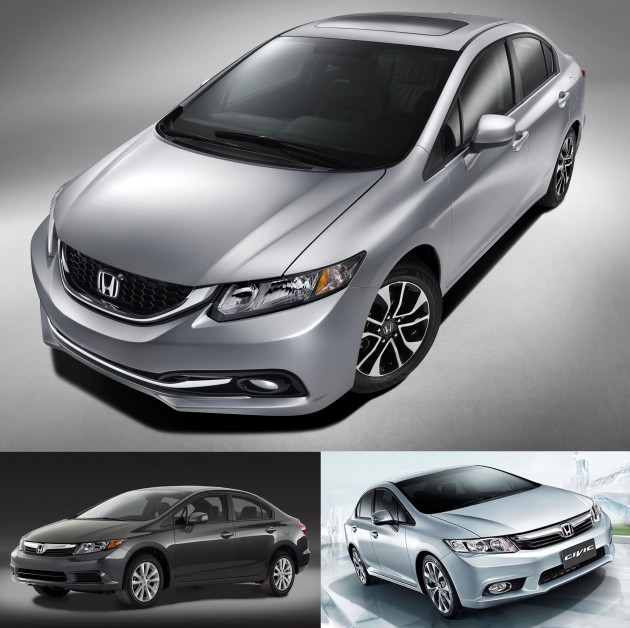
Top: 2013 Civic USDM facelift, bottom left: Honda Civic USDM pre-facelift, bottom right: Malaysian Civic
This is one of the quickest facelifts in history, coming in at only 1.5 years after the current 9th generation Honda Civic sedan was unveiled in the US. This is the US market car which looks different than our Asian market model to begin with, and the US car’s facelift was designed to correct criticism from the US market, so the Asian Civic that’s in our market might not get any update.
It will make its debut at the 2012 Los Angeles Auto Show on November 29. The Civic features a new open-mouth lower bumper with a horizontal chrome accent and a sportier, black honeycomb mesh grille, anchored by new integrated fog lights on upper trims. The grille is flanked by new clear-lens corner lights. There’s also a new more deeply faceted hood and a collection of new wheel designs.
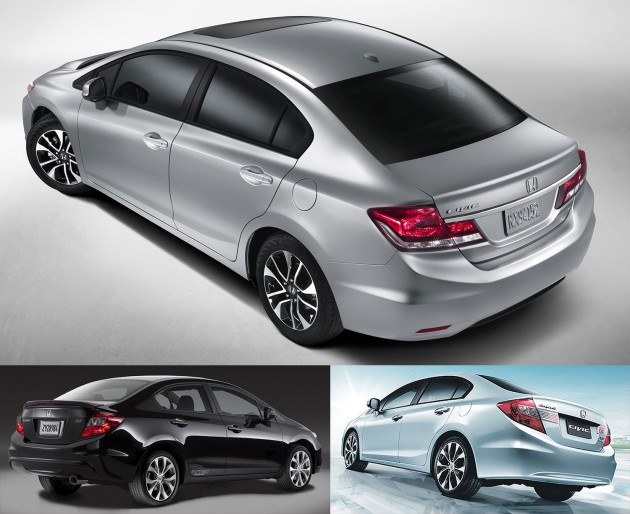
Top: 2013 Civic USDM facelift, bottom left: Honda Civic USDM pre-facelift, bottom right: Malaysian Civic
The rear of the US market Civic has also been updated. A new rear bumper design and new rear trunk lid are capped by a clean, horizontal chrome trim piece. The rear bumper features integrated reflector treatments and a new lower diffuser panel finished with a honeycomb mesh vent.
The US market car’s taillights are now L-shaped and now carries into the trunk face. The pre-facelift US market tail lamps were kind of triangle shaped, and for the Asian Civic that we get here, it has a similiar triangle tail lamps design with a small part that extends onto the boot lid, like a sideways ‘tree’.
Looking to sell your car? Sell it with Carro.

 Pelar
on
Pelar
on 

 Swag
on
Swag
on  yeah
on
yeah
on  frenzy
on
frenzy
on  crank
on
crank
on  Kerr
on
Kerr
on  rufi
on
rufi
on  henry
on
henry
on  Janji da 3rd Parti
on
Janji da 3rd Parti
on  OMG
on
OMG
on  Something must be done
on
Something must be done
on  Gianny
on
Gianny
on  jai
on
jai
on  AVH
on
AVH
on  Just me
on
Just me
on  Name
on
Name
on  Fai
on
Fai
on  _xXx_
on
_xXx_
on  unforgiven
on
unforgiven
on  helmi
on
helmi
on  meemihun
on
meemihun
on  Cosmo Artemis
on
Cosmo Artemis
on  Beemer
on
Beemer
on  aaronang
on
aaronang
on  Brazbuz
on
Brazbuz
on  wrong again
on
wrong again
on  silver
on
silver
on  Severe Tyre Damage
on
Severe Tyre Damage
on  lollipop
on
lollipop
on  salgoodguy
on
salgoodguy
on  Ray
on
Ray
on  Arai
on
Arai
on  Reebok
on
Reebok
on  beatnik
on
beatnik
on  Musalmah Endut
on
Musalmah Endut
on  carlover
on
carlover
on  Sumo_Boy_Berlin
on
Sumo_Boy_Berlin
on  mojo1ne
on
mojo1ne
on  jc
on
jc
on  me
on
me
on  ML
on
ML
on  King Abra
on
King Abra
on  TurboMan
on
TurboMan
on  MrBmw
on
MrBmw
on  Yoyo
on
Yoyo
on  polo saga
on
polo saga
on  Dj
on
Dj
on  Sham
on
Sham
on  bool
on
bool
on  Sgt Scoop
on
Sgt Scoop
on  Fadli
on
Fadli
on  chrisg
on
chrisg
on  disgusted
on
disgusted
on  NCAP
on
NCAP
on  bonbon
on
bonbon
on  1st time conti
on
1st time conti
on  tunggguuu
on
tunggguuu
on  breezehaw
on
breezehaw
on  CTRFD2
on
CTRFD2
on  albag
on
albag
on  ws
on
ws
on  T or H both are the same
on
T or H both are the same
on  NISSpengAN
on
NISSpengAN
on  tanfocus
on
tanfocus
on  Mire
on
Mire
on  Bambee
on
Bambee
on  armandd
on
armandd
on  John
on
John
on  Chong
on
Chong
on  sudonano
on
sudonano
on  Sam Loo
on
Sam Loo
on  anson
on
anson
on  bitting one's foot
on
bitting one's foot
on  Kelvin
on
Kelvin
on  Kelvin
on
Kelvin
on  James
on
James
on 


AI-generated Summary ✨
Comments express mixed reactions to the 2013 Honda Civic facelift, with some praising its improved look and similarity to the Malaysian version, while others criticize its design as unattractive and outdated. Many focus on the car's specifications, reliability, and features rather than aesthetics, emphasizing Honda's reputation and sales success. Several comments highlight the Malaysian market's preference for brand loyalty and practicality over design. Overall, the sentiment is a blend of appreciation for improvements and disappointment with the styling.