
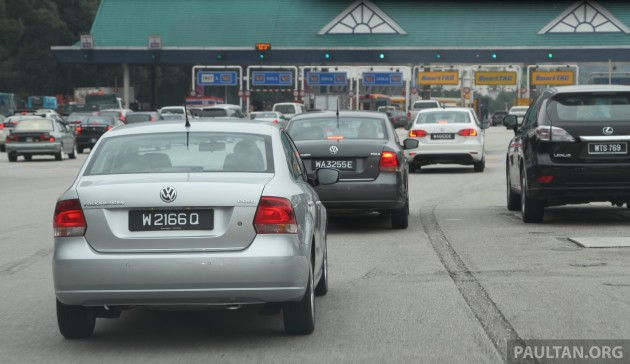
It was reported earlier this week that only four highways are entitled to toll hikes next year, with those highways being the Johor Bahru Eastern Dispersal Link (EDL), Kajang–Seremban Highway (LEKAS), Senai–Desaru Expressway (SDE) and the Guthrie Corridor Expressway (GCE), and that any deferment in rate increases will cost the government RM59.77 million in compensation to the highway concessionaires.
It appears that the deferment and therefore, the compensation to the highway concessionaires will be taking place, according to works minister Datuk Seri Fadillah Yusof in a report by The Star. “The Cabinet on October 12 agreed to postpone any restructuring of toll rates for the year 2016 and 2017. This means that there will be no toll hikes for the four highways this year and next year,” he said.
Fadillah also told the Dewan Rakyat that toll rate adjustments proposed for eight highway concessions this year will also be halted, as reported by The Sun. This would also mean that the highway concessions will be compensated too, though Fadillah did not specify the cost of compensating them.
Meanwhile, PLUS Malaysia confirmed that there will be no changes in toll rates for the eight highways it operates, which include the North-South Expressway (NSE), the New Klang Valley Expressway (NKVE), Federal Highway Route 2 (FRHR2), and the Seremban Port-Dickson Highway (SPDH), North-South Expressway Central Link (NSECL), the Malaysia-Singapore Second Crossing (MSSC), Lebuhraya Butterworth-Kulim (BKE), and the Penang Bridge.
Looking to sell your car? Sell it with Carro.

 man
on
man
on 

 Mikey
on
Mikey
on  Sama L00
on
Sama L00
on  Wahai Orang Kampung
on
Wahai Orang Kampung
on  Kunta bin Kinte
on
Kunta bin Kinte
on  Jimmy
on
Jimmy
on  Periasamy
on
Periasamy
on  john
on
john
on  Hamdan
on
Hamdan
on  Hahaha
on
Hahaha
on  Faiz Roslan
on
Faiz Roslan
on  Hot Cat not Hot Dog
on
Hot Cat not Hot Dog
on  Michael
on
Michael
on  KenJi
on
KenJi
on  Jack
on
Jack
on  Deadpool
on
Deadpool
on  pengayubasikal
on
pengayubasikal
on  palehotak
on
palehotak
on  Qhair1e
on
Qhair1e
on  lilytan
on
lilytan
on  therealpurist
on
therealpurist
on  AkooIm
on
AkooIm
on  Ben Yap
on
Ben Yap
on  Susukotak
on
Susukotak
on  applegreen
on
applegreen
on  pengguna tol
on
pengguna tol
on  sabahan
on
sabahan
on  FIST (Member)
on
FIST (Member)
on  Hito
on
Hito
on  Bernard
on
Bernard
on  Mike
on
Mike
on  Megane
on
Megane
on  Pondan
on
Pondan
on  kiki lala
on
kiki lala
on  Wak
on
Wak
on  Sam Loo (ori1)
on
Sam Loo (ori1)
on  Hadi75
on
Hadi75
on  DK
on
DK
on 


AI-generated Summary ✨
Comments express a mix of frustration and skepticism towards toll hikes and government compensation, with many feeling taxpayers unfairly bear the burden. Some accuse the government of being influenced by cronies and prioritize profit over citizens' welfare. Others criticize the lack of transparency and argue that toll increases and compensation programs benefit a few at the expense of the general public. There is widespread concern about national debt, unfair contracts, and the need for better public transportation.