
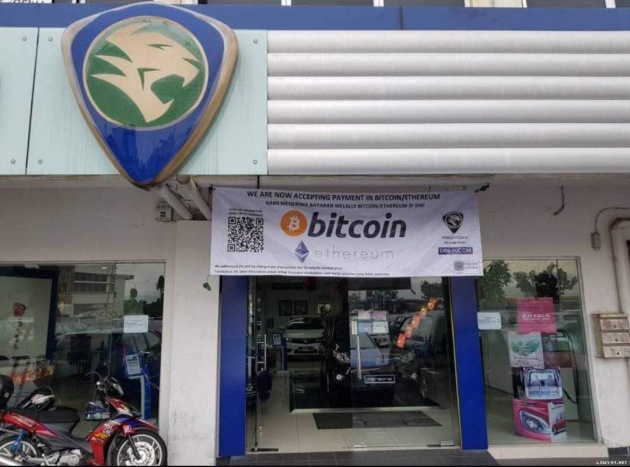
A photo of a Proton dealership apparently accepting cryptocurrency, more specifically Bitcoin and Ethereum, as payment for new Proton cars has gone viral on social media recently. Such transactions, however, is not valid, the company has clarified.
The offer was independently initiated by that particular dealer, and is not recognised by Proton. The dealer has since been suspended, pending further investigation, according to the local carmaker.
Through an official statement, Proton also adds that while it “is open to innovative ways of car sales to keep customers’ interest in our cars, we would also like to caution our sales network to exercise consideration and due care in carrying out promotional activities which are not endorsed by the company.”
There are complications with cryptocurrency’s unstable nature, obviously. At the time of writing, one Bitcoin is worth RM67,500, enough to buy a Proton Preve. Just three weeks ago, it was worth around RM10,000 more, and at this time last year, it was RM4,200, just enough for a downpayment on a new Iriz. It’s also worth noting that Bank Negara Malaysia has announced that cryptocurrency is not a legal payment method in the country.
What do you think of this, dear readers – would you actually want to use cryptocurrency to pay for cars? Let us know your thoughts below.
 Proton S70
from RM59,800
Proton S70
from RM59,800  Proton X90
from RM106,800
Proton X90
from RM106,800  Proton eMas 7 PHEV
from RM109,800
Proton eMas 7 PHEV
from RM109,800  Proton X70
from RM106,800
Proton X70
from RM106,800  Proton Saga
from RM38,990
Proton Saga
from RM38,990  Proton eMas 5
from RM59,800
Proton eMas 5
from RM59,800  Proton X50
from RM89,800
Proton X50
from RM89,800  Proton eMas 7
from RM103,800
Proton eMas 7
from RM103,800 
 Jeffri Taib
on
Jeffri Taib
on 

 epul
on
epul
on  john
on
john
on  Useless Parent
on
Useless Parent
on  LOLOL
on
LOLOL
on  sarawak sarawak
on
sarawak sarawak
on  Chettynutz
on
Chettynutz
on  Rip
on
Rip
on  Damian Wong
on
Damian Wong
on  Mani Maran
on
Mani Maran
on  Alex
on
Alex
on  sohai
on
sohai
on  Waters
on
Waters
on  polla
on
polla
on  Borneo Darul Seram
on
Borneo Darul Seram
on  12yrsold
on
12yrsold
on  Raymond
on
Raymond
on  MSA
on
MSA
on  Bernard
on
Bernard
on  Ioma
on
Ioma
on  Diao Ma
on
Diao Ma
on  Rain
on
Rain
on  Ben Yap
on
Ben Yap
on  Heyo
on
Heyo
on  Mike
on
Mike
on  Adib
on
Adib
on  Chong
on
Chong
on  Afandi Al-Banna
on
Afandi Al-Banna
on  George Singam
on
George Singam
on  smalluck
on
smalluck
on  Mike
on
Mike
on  Razak Najib
on
Razak Najib
on  Fari
on
Fari
on  ohlala
on
ohlala
on  isitlegal
on
isitlegal
on  Chicken for car
on
Chicken for car
on
AI-generated Summary ✨
Comments reflect skepticism and concern over Proton accepting cryptocurrencies like Bitcoin for car payments due to their volatility and lack of legal recognition. Many emphasize the risks for dealers and question the practicality of instant conversions and fluctuating values. Some suggest that as long as payments are settled in RM, acceptance doesn’t matter, but overall, there’s a consensus that crypto’s instability and legality issues pose significant challenges, and traditional methods remain safer and more reliable.