
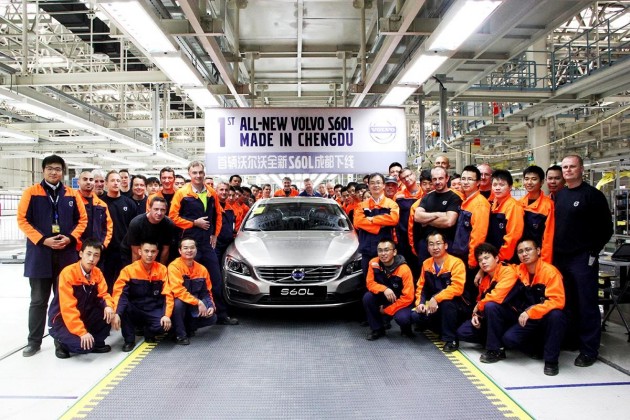
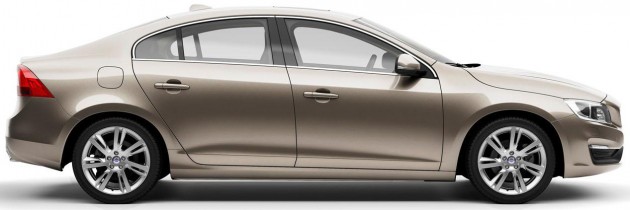
Volvo will be exporting the Chinese-built long-wheelbase version of its S60, the Volvo S60L, to the United States as part of a larger plan to turn the Middle Kingdom into an export hub.
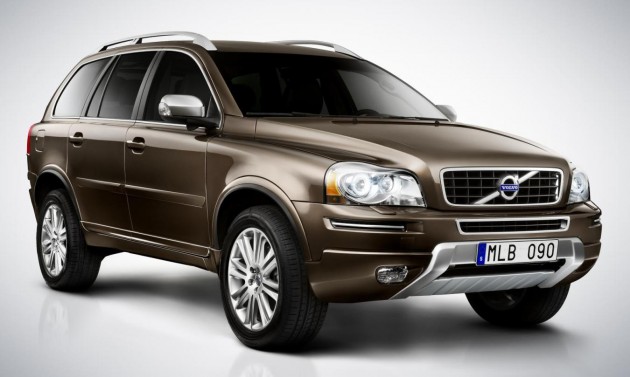
Reuters reported that apart from the S60L, Volvo will also be exporting the XC90 (it is unclear whether this refers to the current model or the next generation unveiling later this year) to Russia, as well as other markets such as South East Asia. These plans are slated to be put in motion as early as late next year, and Volvo will eventually export as many as 10,000 S60Ls and a few thousand XC90s out of China each year.
Despite quality concerns over Chinese-made products, Volvo reportedly wanted to safeguard itself from any currency risks, with an executive saying, “The dollar and the yuan has the best relationship, a more stable relationship than the euro and the dollar.”
Volvo will be producing cars in China from two plants. One in Chengdu has been churning out S60Ls since late last year, while the other in Daqing is ramping up XC90 production. The two plants will be able to achieve full capacity of about 250,000 units a year by 2018.
The company is also on track to beat its own sales target for China this year by at least 13% as it opens more showrooms in the world’s biggest car market, with sales likely to soar by almost 50% from the year before to more than 90,000 cars. This is well above the 80,000-unit target and will make China Volvo’s biggest market, ahead of the United States.
But certain quarters within Volvo are exercising caution, with the company’s global head of media relations David Ibison saying that despite the phenomenal growth in China (35% increase in sales year-on-year), selling 90,000 cars in 2014 could be “a step too far”. He added that the company is focusing to make sure “our growth is profitable and sustainable.”
Volvo has been owned by Chinese manufacturer Geely since 2010. Last year, the company sold 427,840 vehicles globally, an increase of 1.4% from the year before.
 Volvo ES90
from RM339,888
Volvo ES90
from RM339,888  Volvo XC60
from RM328,888
Volvo XC60
from RM328,888  Volvo XC90
from RM418,888
Volvo XC90
from RM418,888  Volvo EX90
from RM428,888
Volvo EX90
from RM428,888  Volvo EX30
from RM208,888
Volvo EX30
from RM208,888  Volvo EC40
from RM248,888
Volvo EC40
from RM248,888  Volvo XC40
from RM268,888
Volvo XC40
from RM268,888 
 Semi-Value (Member)
on
Semi-Value (Member)
on 

 China Low Quality
on
China Low Quality
on  Aliana
on
Aliana
on  provos
on
provos
on  mango
on
mango
on  steen
on
steen
on  tokmoh (Member)
on
tokmoh (Member)
on  Big Hippocrate!
on
Big Hippocrate!
on  Obviously (Member)
on
Obviously (Member)
on  Low Budget
on
Low Budget
on  tokmohsucky
on
tokmohsucky
on  tokmon
on
tokmon
on  Same L0r
on
Same L0r
on  Grow up
on
Grow up
on  semeloer
on
semeloer
on  Kangkung
on
Kangkung
on  Leo
on
Leo
on  Black Dog
on
Black Dog
on  Baja Lapis Seng
on
Baja Lapis Seng
on  gbt
on
gbt
on  salescar
on
salescar
on  weidi G
on
weidi G
on  Dave
on
Dave
on  muixxium
on
muixxium
on  unforgiven
on
unforgiven
on  Ah Long
on
Ah Long
on  vovlo
on
vovlo
on  vulber
on
vulber
on  Visitor
on
Visitor
on  boiarbs
on
boiarbs
on  Captain
on
Captain
on  geliy
on
geliy
on  Arancio Costa
on
Arancio Costa
on  blanco
on
blanco
on  Vincent Ang
on
Vincent Ang
on  rally_fan (Member)
on
rally_fan (Member)
on  Annoynimouse
on
Annoynimouse
on  damonlee
on
damonlee
on  Sandleir
on
Sandleir
on  ST
on
ST
on
AI-generated Summary ✨
Comments generally acknowledge China’s progress in car manufacturing, including Volvo’s quality standards, with some emphasizing that manufactured products, including Apple and Tesla, are of acceptable quality. Many defend China-made vehicles as meeting international standards, criticizing stereotypes and prejudices. Others express skepticism about high-priced Chinese cars like Volvo, pointing out concerns about quality and safety. Overall, sentiments are mixed, with recognition of China's advancement but lingering doubts about the quality of China-built premium vehicles.