
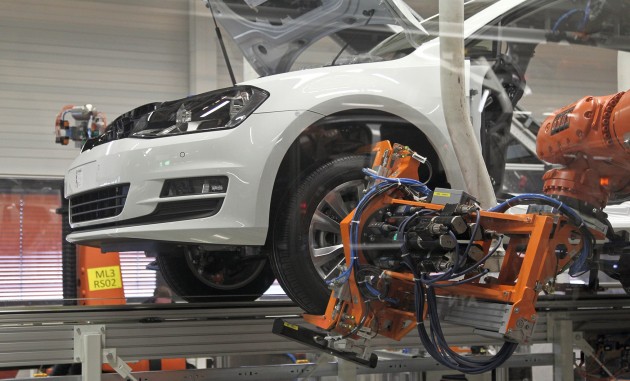
Reuters has reported, citing German daily Frankfurter Allgemeine Zeitung, that Thailand is set to approve the construction of a Volkswagen factory near the port of Bangkok, and that a decision from the Thai investment authority BOI could come as early as next week.
The investment, under Phase 2 of Thailand’s Eco Car programme, would give Volkswagen tax and customs breaks if it produces fuel-efficient cars, provided the facility builds upwards of 100,000 vehicles a year and comes on stream by 2019. BOI officials told the German publication that Volkswagen plans to export cars from Thailand.
The German carmaker has wanted to do this for the longest time – we reported its intention as early as 2008, before it applied to set up a Thai plant earlier this year. Carmakers reportedly had until March 31 to apply for Phase 2.
The requirements of Phase 2 of Thailand’s Eco Car programme include (for the vehicle) a fuel economy under 4.3 litres per 100 km, CO2 emissions under 100 grams per km, engines displacing 1.3 litres and under (petrol) or 1.5 litres and under (diesel), along with Euro 5, R94 and R95 compliance.
Throw in a minimum investment of 6.5 billion baht (RM643 million) and a minimum production of 100,000 units per year by the fourth year of operation, and the excise duty incentive given is 14% (normally 30%); dropping to 12% if the engine is E85-compatible.
Phase 1 Eco Cars include Hondas Brio and Brio Amaze, Mitsubishis Mirage and Attrage, Nissans Almera and March, the Toyota Yaris and the Suzuki Swift. All have 1.2 litre petrol engines in Thailand.
 Volkswagen Tayron
from RM190,660
Volkswagen Tayron
from RM190,660  Volkswagen Golf R
from RM338,812
Volkswagen Golf R
from RM338,812  Volkswagen Golf
from RM185,990
Volkswagen Golf
from RM185,990  Volkswagen Golf GTI
from RM244,012
Volkswagen Golf GTI
from RM244,012  Volkswagen Touareg
from RM384,972
Volkswagen Touareg
from RM384,972  Volkswagen Arteon
from RM291,012
Volkswagen Arteon
from RM291,012 
 you
on
you
on 

 poinong
on
poinong
on  Open Letter to Dr M
on
Open Letter to Dr M
on  Fake Tun M
on
Fake Tun M
on  almary
on
almary
on  fenzo60
on
fenzo60
on  Malaysia LOSING to Thailand
on
Malaysia LOSING to Thailand
on  Hafiz
on
Hafiz
on  john
on
john
on  Low Budget
on
Low Budget
on  Protonist
on
Protonist
on  p3
on
p3
on  impaled
on
impaled
on  kadajawi (Member)
on
kadajawi (Member)
on  kbc
on
kbc
on  kington
on
kington
on  klata-klata
on
klata-klata
on  Nissan
on
Nissan
on  apholder
on
apholder
on  fd
on
fd
on  wacl
on
wacl
on  munkay
on
munkay
on  Sean
on
Sean
on  neemfa
on
neemfa
on  rocky balboa
on
rocky balboa
on  S
on
S
on  flysheep
on
flysheep
on  Gargantia
on
Gargantia
on  mujinkun (Member)
on
mujinkun (Member)
on  Tegas
on
Tegas
on  protectyourmom
on
protectyourmom
on  doctorproc156
on
doctorproc156
on  unforgiven
on
unforgiven
on  azrai
on
azrai
on  kalam
on
kalam
on  niterunner99
on
niterunner99
on  4G63T DSM
on
4G63T DSM
on  kcng (Member)
on
kcng (Member)
on  tikus
on
tikus
on  Afraid
on
Afraid
on  Calpurnpiso
on
Calpurnpiso
on  vwvw
on
vwvw
on  True Bumi
on
True Bumi
on  Anonymous
on
Anonymous
on  Wee fuk yew
on
Wee fuk yew
on  Henry
on
Henry
on  Steve Kok
on
Steve Kok
on  zxty
on
zxty
on  seman
on
seman
on  National Interest
on
National Interest
on  za
on
za
on  Krasher
on
Krasher
on  Seriously
on
Seriously
on  vw merajuk
on
vw merajuk
on  abdullah
on
abdullah
on  samlok
on
samlok
on  Semi-Value (Member)
on
Semi-Value (Member)
on  mzma
on
mzma
on  Don carleone
on
Don carleone
on  hadi75
on
hadi75
on  apai
on
apai
on  uuu
on
uuu
on  protectyourmom
on
protectyourmom
on  Sam Loo (ori)
on
Sam Loo (ori)
on  Kangkung
on
Kangkung
on
AI-generated Summary ✨
Comments highlight concerns that Malaysia lost significant automotive investment and jobs to Thailand due to higher taxes, protectionism, and protected crony interests like AP monopoly. Many believe Thailand's lower taxes, disciplined workforce, and open policies attract automakers, resulting in more exports and economic growth. Several comments regret Malaysia's protectionist policies and see the move as a blow to national progress, emphasizing the need for better education, policies, and the promotion of local design and manufacturing to remain competitive.