
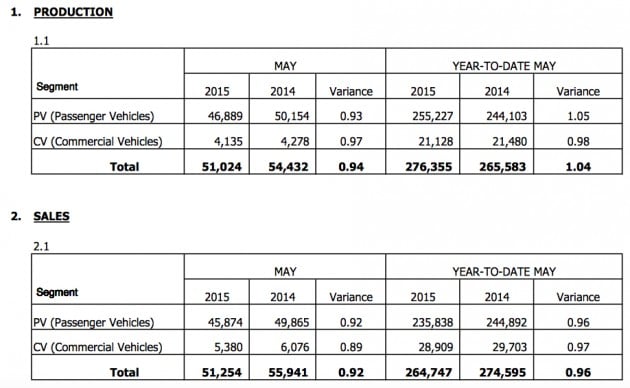
Total vehicle sales for the month of May this year have fallen by 8.4% compared to the same period last year, according to the Malaysian Automotive Association (MAA). A total of 51,254 vehicles were sold, to be exact, with the numbers split between 45,874 passenger and 5,380 commercial vehicles.
In May 2014, a total of 55,941 vehicles – 49,865 passenger and 6,076 commercial vehicles – were sold. This represented a difference of 4,687 units in total. Additionally, total industry volume for the year-to-date of May 2015 was recorded at 264,747 units – a drop of 9,848 units, or 3.6% lower, compared to the corresponding period in 2014.
As for production numbers, the total vehicle build count for May 2015 was recorded at 51,024 units – 46,889 passenger and 4,135 commercial vehicles. In contrast, the figure for May 2014 was recorded at 54,432 units, representing a drop of 3,408 units. Of the total, 50,154 units were that of passenger vehicles while a total of 4,278 commercial vehicles were produced.
According to the MAA, the reason behind the slump in sales performance can be attributed to the introduction of the goods and services tax (GST) – to which a majority of consumers are still finding it hard to adjust to. In return, consumers tend to exercise a lot more caution when it comes to the notion of purchasing a new car. Aside from that, unfavourable exchange rates have caused further uncertainties amongst businesses.
With that said, the MAA has predicted a brighter forecast for the month ahead in terms of sales performance. This is, of course, the result of the myriad of promotions and sales campaigns offered by dealers as part of the Hari Raya festive season.

 tokmoh.
on
tokmoh.
on 

 BNaik
on
BNaik
on  fombangla
on
fombangla
on  The Truth About Raya Sales- MAA Lies
on
The Truth About Raya Sales- MAA Lies
on  Appeal to Datuk Aishah
on
Appeal to Datuk Aishah
on  kzm - kita mesti bercukur
on
kzm - kita mesti bercukur
on  Wiwiwiwiwiw
on
Wiwiwiwiwiw
on  Sam VHL Loo
on
Sam VHL Loo
on  Same L0rrrr
on
Same L0rrrr
on  Anti-Pati
on
Anti-Pati
on  kastard
on
kastard
on  kek hameed
on
kek hameed
on  cendol (Member)
on
cendol (Member)
on  samelordupe
on
samelordupe
on  carCaarcAArrr
on
carCaarcAArrr
on  Donkey J
on
Donkey J
on  Albert
on
Albert
on  buylingerie
on
buylingerie
on  rakyat
on
rakyat
on  skyjuice
on
skyjuice
on  alldisc
on
alldisc
on  Konga
on
Konga
on  Nancy
on
Nancy
on  Middle Age Driver (Member)
on
Middle Age Driver (Member)
on  sammy
on
sammy
on  paanjang16
on
paanjang16
on  Jobless car salesman
on
Jobless car salesman
on  talkkok
on
talkkok
on  BuRaI
on
BuRaI
on  gberd
on
gberd
on  SamShowedMeTheHilux
on
SamShowedMeTheHilux
on  youareliar
on
youareliar
on  ChrisCK
on
ChrisCK
on  Angah
on
Angah
on  Beckscum
on
Beckscum
on  Wee fuk yew
on
Wee fuk yew
on  SAM LOO.
on
SAM LOO.
on  Ananz
on
Ananz
on
AI-generated Summary ✨
Comments highlight that the recent 8.4% drop in vehicle sales is due to high car prices driven by hefty taxes, safety feature downgrades, and economic factors like GST and currency issues. Many express dissatisfaction with manufacturers prioritizing profits over safety, and some believe high costs and taxes reduce affordability, leading consumers to delay or avoid new purchases. The overall sentiment is critical, advocating for reduced taxes, better safety features, and increased focus on consumer interests to revive sales.