
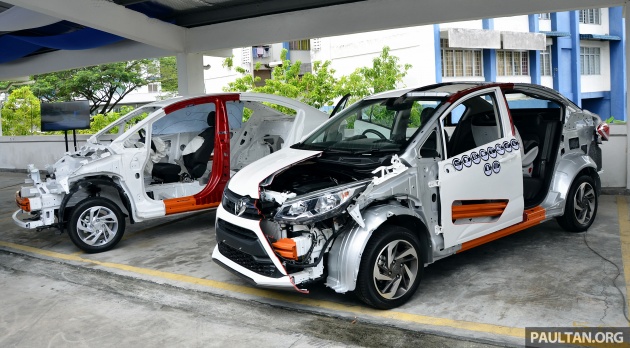
One of the primary concerns for Proton’s new vice president of manufacturing, Yoshiya Inamori, when assuming his new role, is quality. The national carmaker has been experiencing less than satisfactory market sentiment as of late, some of which are attributed to customers’ perception on the quality of its vehicles.
“Because the reputation or variation of the market outcome (involving) customers (relating to) our Proton vehicles for quality, I see (it as) not so good,” he said.
In an attempt to rectify the issue, Inamori revealed a number of steps that have or will be taken. He acknowledges that there is a gap in terms of quality from Proton’s competitors. Efforts include carrying out surveys to better establish the difference in quality between market players to gauge Proton’s position. This will allow it to better set quality targets, which he can then strive towards.

“Now, we are doing some survey work, checking the competitor’s quality. We see some of the gap between the competitors, so in order to overcome the competitor’s quality issue, we are setting the quality target,” he explained.
Aside from observing its competitors, internal key performance indexes (KPIs) have also been revised to promote improved quality. These improvements will be introduced as running changes from model to model (as opposed to through major facelifts), as the company is selling cars every day, according to Inamori.
“My job for the coming months is to overcome the competitor’s quality level. I setup KPIs for the quality, internally, so we have already started to improve our quality KPIs,” said Inamori.
AD: Drive the Proton model of your dreams. Submit your details and Proton PJ will get in touch with you.
 Proton X90
from RM106,800
Proton X90
from RM106,800  Proton S70
from RM73,800
Proton S70
from RM73,800  Proton eMas 7 PHEV
from RM109,800
Proton eMas 7 PHEV
from RM109,800  Proton X70
from RM106,800
Proton X70
from RM106,800  Proton Saga
from RM38,990
Proton Saga
from RM38,990  Proton eMas 5
from RM59,800
Proton eMas 5
from RM59,800  Proton X50
from RM89,800
Proton X50
from RM89,800  Proton eMas 7
from RM103,800
Proton eMas 7
from RM103,800 
 Joholan
on
Joholan
on 

 John Delloid
on
John Delloid
on  Mohd Ishak
on
Mohd Ishak
on  NAP
on
NAP
on  sabahan
on
sabahan
on  stasta
on
stasta
on  Sama L00
on
Sama L00
on  dreamer
on
dreamer
on  ex-VGM staff
on
ex-VGM staff
on  salahsape
on
salahsape
on  john
on
john
on  Ruslan Bahari
on
Ruslan Bahari
on  Chua
on
Chua
on  DK
on
DK
on  matador
on
matador
on  Hafriz Shah (Member)
on
Hafriz Shah (Member)
on  Gomorrah
on
Gomorrah
on  Ex-proton
on
Ex-proton
on  tokmoh.
on
tokmoh.
on  alldisc
on
alldisc
on  seriouslyguzzlinggas
on
seriouslyguzzlinggas
on  Mr Suka Syukur Selalu
on
Mr Suka Syukur Selalu
on  st3wp1d
on
st3wp1d
on  st3wp1d stoopeat
on
st3wp1d stoopeat
on  kia fan
on
kia fan
on  dimitriy
on
dimitriy
on  neo
on
neo
on  rayc216
on
rayc216
on  jamari
on
jamari
on  common sensor
on
common sensor
on  lexusNX
on
lexusNX
on  lilytan
on
lilytan
on  ioma
on
ioma
on  Focus
on
Focus
on  Wanfumi
on
Wanfumi
on  Trueornot
on
Trueornot
on  johnnas
on
johnnas
on  Takpelah
on
Takpelah
on  kohado
on
kohado
on  rally_fan (Member)
on
rally_fan (Member)
on  panjang
on
panjang
on  Old horse
on
Old horse
on  csk
on
csk
on  asali
on
asali
on  Carlover
on
Carlover
on  BbalingBiru
on
BbalingBiru
on  azhar
on
azhar
on  syem
on
syem
on  wer
on
wer
on  MenteriPasola101
on
MenteriPasola101
on  DC
on
DC
on  Weng Soon
on
Weng Soon
on
AI-generated Summary ✨
Comments express skepticism about Proton’s efforts to improve quality, citing past failures, brand reputation issues, and ongoing quality problems, including engine and service center concerns. Many believe Proton needs strong management commitment, better engineering, and higher standards from the design stage to regain trust. Some highlight that competitors like Toyota and Honda are perceived as more reliable and cost-effective, emphasizing the importance of quality, fuel efficiency, and after-sales service over design appeal.