
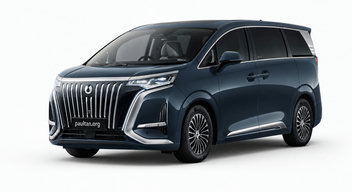
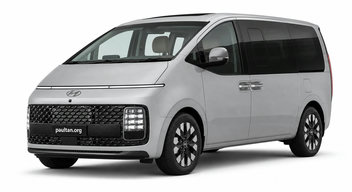
Verdict
The Denza D9 asks RM119,112 more, but brings a 103.36-kWh battery, claimed 520-km range and 166-kW DC charging rather than the Staria’s 2.2-litre diesel and 75-litre tank. Its 308-hp motor cuts the 0-100 km/h time to 9.5 seconds, against 12.4 seconds, and it adds autonomous braking, blind-spot monitoring and adaptive cruise control. The Hyundai counters with 10 seats, a 3,273-mm wheelbase and 430-litre boot, so it is the more rational large-group carrier. The D9 suits seven occupants wanting a much richer cabin and EV use case.
Pick the Denza D9 if seven seats, 520-km EV range, 166-kW DC charging and a stronger safety suite justify the RM119,112 outlay.
Pick the Hyundai Staria if you need 10 seats, a 430-litre boot and a far lower purchase price.
Key differences
- Price: Denza D9 RM299,000; Hyundai Staria RM179,888.
- Powertrain: Denza D9 has a 308-hp, 360-Nm electric motor; Hyundai Staria has a 175-hp, 431-Nm 2.2-litre diesel.
- Acceleration: Denza D9 reaches 100 km/h in 9.5 seconds; Hyundai Staria takes 12.4 seconds.
- Capacity: Denza D9 has 7 seats and a 410-litre boot; Hyundai Staria has 10 seats and a 430-litre boot.
- Wheelbase: Denza D9 is 3,110 mm; Hyundai Staria is 3,273 mm.
- Driver assistance: Denza D9 has autonomous braking, blind-spot monitoring and lane-keeping assist; Hyundai Staria has none of these systems.
D9
- 520-km EV range with 166-kW DC charging
- 308 hp and a 9.5-second 0-100 km/h time
- Ventilated, massaging second-row captain seats and 14-speaker Dynaudio audio
- RM119,112 more expensive
- Seven seats versus the Staria’s 10
- 410-litre boot is 20 litres smaller
Staria
- 10 seats and a 430-litre boot
- RM119,112 lower purchase price
- Longer 3,273-mm wheelbase and 431 Nm of torque
- 175 hp and 12.4-second 0-100 km/h time trail the D9
- No autonomous braking, blind-spot monitoring or lane-keeping assist
- Manual front-seat adjustment and manual air-conditioning
| Price & overview | ||
|---|---|---|
| Price | RM299,000 | RM179,888✓ |
| Body type | MPV | MPV |
| Segment | D-Segment | D-Segment |
| Assembly | CBU | CBU |
| Ownership | ||
| Road tax / year | RM335✓ | RM599 |
| Powertrain | ||
| Engine Tech | 400V architecture | 16-valve DOHC with Common-rail Direct Injection and Variable Geometry Turbocharger |
| Capacity | — | 2,199 cc |
| Horsepower | — | 175 hp |
| Torque | — | 431 Nm |
| Fuel | Electric | Diesel |
| Bore | — | 85.4 mm |
| Compression Ratio | — | 16 |
| Number of Motors | 1 | — |
| Motor Horsepower | 308 hp | — |
| Motor Torque | 360 Nm | — |
| Battery Capacity | 103.36 kWh | — |
| EV Range | 520 km | — |
| Charging Rate (AC) | 11 kW | — |
| Charging Rate (DC) | 166 kW | — |
| V2L | 6 kW | — |
| Drivetrain | ||
| Transmission | Single Ratio Automatic | Conventional Automatic |
| Transmission Name | — | 8-speed Automatic |
| Gears | — | 8 |
| Transmission Manufacturer | — | Hyundai |
| Driveline | Front Wheel Drive | Front Wheel Drive |
| Performance & Efficiency | ||
| 0-100 km/h | 9.5 seconds✓ | 12.4 seconds |
| Top Speed | — | 185 km/h |
| Dimensions | ||
| Length | 5,250 mm | 5,253 mm |
| Width | 1,950 mm | 1,997 mm |
| Height | 1,920 mm | 1,990 mm |
| Wheelbase | 3,110 mm | 3,273 mm |
| Fuel Tank | — | 75 litres |
| Doors | 5 | 5 |
| Seats | 7 | 10 |
| Boot Space | 410 litres | 430 litres✓ |
| Front Tyre | 235/60R18 | 215/65R17 |
| Rear Tyre | 235/60R18 | 215/65R17 |
| Spare Tyre | — | Full Size |
| Factory Tyres | Michelin e-Primacy | Kumho PorTran KC53 |
| Chassis | ||
| Assembly | China (CBU) | Korea (CBU) |
| Front Suspension | MacPherson Strut | MacPherson Strut |
| Rear Suspension | Multi-link | Multi-link |
| Front Wheels | 18" Multi-spoke Alloys | 17" Alloy |
| Rear Wheels | 18" Multi-spoke Alloys | 17" Alloy |
| Steering | Rack and Pinion (Electric Power Steering) | Rack and Pinion (Electric Power Steering) |
| Chassis Notes | Frequency Selective variable dampers | — |
| Safety | ||
| Airbags | Driver and Front Passenger, Front and Rear Side Airbags, Curtain Airbags | Driver and Passenger, Front Side, Front and Rear Curtain |
| ABS/EBD | ✓ | ✓ |
| Stability Control | ✓ | ✓ |
| Alarm | ✓ | ✓ |
| Immobilizer | — | ✓ |
| Airbag Disable Function | — | ✓ |
| Child Safety Lock | Manual for Rear Doors | Manual for Sliding Doors |
| Seat Belts | 7 Three-point | 10 Three-point |
| Blind Spot Info System | ✓ | — |
| ISOFIX | Available on Middle and Outer Third Row Seats | Available on Two Outer Rear Second Row Passenger Seats |
| Autonomous Braking System | Yes | — |
| Lane-keeping Assist | Steering Correction | No |
| Collision Warning | ✓ | — |
| Seatbelt Reminder | All Seats | All Seats |
| Safety Notes | — | Rear Occupant Alert |
| Lighting | ||
| Headlamps | LED Projectors | LED Projector with Auto High Beam |
| Taillamps | Full LED | Bulb |
| LED Daytime Running Lights | ✓ | ✓ |
| Rear Foglamps | ✓ | ✓ |
| Wing Mirror Turn Indicators | ✓ | ✓ |
| Cabin | ||
| Front Seats | Powered Front Seats with Ventilation | Manual Adjustable |
| Rear Seats | Second-row Captain Seats with Ventilation, Massaging and Ottoman Support, 60:40 Split-folding Third Row | 60:40 Split-folding, Sliding and Reclining 2nd Row, Two Flat-folding, Sliding and Reclining 3rd Row Captain Chairs, 60:40 Split-folding 3rd Row |
| Front Air-con | Dual-zone Automatic Climate Control | Manual Air-con |
| Rear Air-con | Single-zone Automatic Climate Control | Ceiling-mounted Vents |
| Sunroof | Front Single-pane Sunroof, Panoramic Rear Glass Roof | — |
| Power Sockets | 1 Front, 2 USB Front, 1 Wireless Charger Front, 2 Wireless Chargers Rear, 4 USB-C Rear | 1 Front, 2 Front USB, 2 Second-row USB, 1 Third-row USB, 2 Last-row USB |
| Interior Lighting | Map Lights, Ambient Lighting | Map Lights |
| Cup Holders | 2 Front, 4 Rear | 2 Front, 2 Middle Row, 4 Last Row |
| Sun Shade | Sunroof Shades | — |
| Audio | 15.6" Touchscreen with Wireless Apple CarPlay & Android Auto, 14-speaker Dynaudio Sound System | 8" Touchscreen Infotainment System with Wireless Apple CarPlay, Wireless Android Auto and 4 Speakers |
| Convenience | ||
| Power Windows | Four Windows, Auto Up and Down with Anti Pinch | Two Front Windows, Auto Up and Down, Manual Slide Rear Windows |
| Engine Start | Keyless Push Button | Keyless Push Button |
| Locks | Keyless Operation | Keyless Entry |
| Auto Headlamps | ✓ | ✓ |
| Auto Wipers | ✓ | ✓ |
| Cruise Control | Adaptive Cruise Control | Passive Cruise Control |
| Steering Audio Control | ✓ | ✓ |
| Steering Tilt | ✓ | ✓ |
| Steering Telescopic | ✓ | ✓ |
| Boot Operation | Powered Boot | Remote Control Activation |
| Parking Sensor Front | 4 Sensors | 4 Sensors |
| Parking Sensor Rear | 4 Sensors | 4 sensors |
| Reverse Camera | Yes, 360-degree Camera | Yes |
| Folding Wing Mirrors | ✓ | ✓ |
| Bluetooth | ✓ | ✓ |
| Navigation | ✓ | — |
| Power Door | Rear Sliding Doors | — |
| Hill Start Assist | ✓ | ✓ |
| Instrument Cluster | Full LCD Monitor | Electroluminescent Analogue |
| Parking Brake | Electronic | Electronic |
| Convenience Notes | Heated and Cooled Compartment, Second Row Tray Tables | — |
| Warranty | ||
| Warranty Mileage Manufacturer | 150,000 km | 160,000 km✓ |
| Warranty Manufacturer | 6 years | 8 years✓ |
| Warranty Notes | 8-year/150,000 km Battery Warranty | — |
Specs shown for the selected variant of each car. ✓ marks the better figure where lower/higher is objectively better. Road tax: West Malaysia, private registration.
Used D9 & Staria for sale
D9 vs Staria FAQ
Is the Denza D9 or Hyundai Staria better?
The Denza D9 is better for a seven-seat EV with 520 km of range, faster acceleration and more driver assistance. The Hyundai Staria is better when 10 seats and a 430-litre boot matter more than EV driving and luxury equipment.
What is the price difference?
The Denza D9 costs RM119,112 more than the Hyundai Staria.
Which one carries more people?
The Hyundai Staria carries 10 people, compared with seven in the Denza D9. It also has a 430-litre boot, 20 litres more than the D9’s 410 litres.