
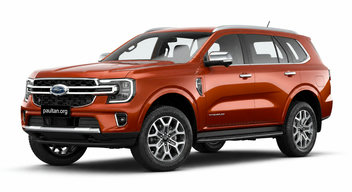
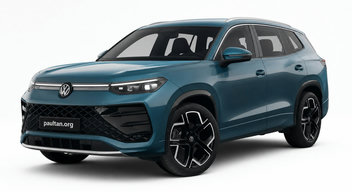
Verdict
At RM281,888, the Ford Everest costs RM91,228 more than the RM190,660 Volkswagen Tayron, and that gap buys a 207 hp/500 Nm 2.0-litre bi-turbo diesel, all-wheel drive and a substantially larger 80-litre tank. It is also 122 mm longer and carries seven. But the Tayron is the more generously equipped family SUV: its 345-litre boot beats the Everest’s 259 litres, while adaptive cruise control, autonomous braking, a 360-degree camera and ventilated massage front seats are all standard. Choose the Everest for torque and AWD; choose the Tayron for road-focused equipment and lower ownership entry costs.
Pick the Ford Everest if you need 500 Nm of diesel torque, all-wheel drive and an 80-litre fuel tank more than driver-assistance and cabin luxuries.
Pick the Volkswagen Tayron if you want the RM91,228 lower entry price, a larger 345-litre boot and far more active safety and parking assistance.
Key differences
- Price: Ford Everest RM281,888; Volkswagen Tayron RM190,660.
- Power and torque: Ford Everest 207 hp and 500 Nm; Volkswagen Tayron 148 hp and 250 Nm.
- Driveline: Ford Everest all-wheel drive; Volkswagen Tayron front-wheel drive.
- Fuel tank: Ford Everest 80 litres; Volkswagen Tayron 55 litres.
- Boot space: Ford Everest 259 litres; Volkswagen Tayron 345 litres.
- Length: Ford Everest 4,914 mm; Volkswagen Tayron 4,792 mm.
Everest
- 207 hp and 500 Nm 2.0-litre bi-turbo diesel
- All-wheel drive and 80-litre fuel tank
- Three-year/100,000-km warranty, plus two-year/60,000-km extension
- RM91,228 higher purchase price
- 259-litre boot is 86 litres smaller
- Lacks autonomous braking, adaptive cruise control and a 360-degree camera
Tayron
- RM91,228 lower purchase price and RM120 annual road tax
- 345-litre boot and 40:20:40 sliding second row
- Autonomous braking, adaptive cruise control, 360-degree camera and auto parking
- 148 hp and 250 Nm are well down on the Everest’s 207 hp and 500 Nm
- Front-wheel drive rather than all-wheel drive
- 55-litre tank is 25 litres smaller
| Price & overview | ||
|---|---|---|
| Price | RM281,888 | RM190,660✓ |
| Body type | SUV | SUV |
| Segment | Truck/4X4 | D-Segment |
| Assembly | CBU | CKD |
| Ownership | ||
| Road tax / year | RM438 | RM120✓ |
| Powertrain | ||
| Engine Tech | Inline-four with Bi-turbo | 16-valve DOHC with direct fuel injection, turbocharger and variable intake valve timing with 48-volt MHEV assistance |
| Capacity | 1,996 cc | 1,498 cc |
| Horsepower | 207 hp✓ | 148 hp |
| Torque | 500 Nm✓ | 250 Nm |
| Fuel | Diesel | Petrol Hybrid/REV |
| Bore | 84.01 mm | — |
| Compression Ratio | 15.8 | — |
| Drivetrain | ||
| Transmission | Conventional Automatic | Dual-clutch Automatic (Wet) |
| Transmission Name | 10R80 SelectShift Automatic | 7-speed Direct Shift Gearbox (DSG) |
| Gears | 10 | 7 |
| Transmission Manufacturer | Ford | — |
| Driveline | All Wheel Drive | Front Wheel Drive |
| Performance & Efficiency | ||
| 0-100 km/h | — | 9.6 seconds |
| Dimensions | ||
| Length | 4,914 mm | 4,792 mm |
| Width | 1,923 mm | 1,852 mm |
| Height | 1,841 mm | 1,660 mm |
| Wheelbase | 2,900 mm | 2,790 mm |
| Weight | 2,201 kg | — |
| Fuel Tank | 80 litres | 55 litres |
| Doors | 5 | 5 |
| Seats | 7 | 7 |
| Boot Space | 259 litres | 345 litres✓ |
| Front Tyre | 255/55R20 | 235/55R18 |
| Rear Tyre | 255/55R20 | 235/55R18 |
| Spare Tyre | 17" Steel Wheel | Space Saver |
| Factory Tyres | Goodyear Wrangler | Hankook Ventus evoSUV |
| Chassis | ||
| Assembly | Thailand (CBU) | Malaysia (CKD) |
| Front Suspension | Double Wishbone | MacPherson Struts |
| Rear Suspension | Coil Spring | Multi-links |
| Front Wheels | 18" Alloy | 18" Napoli Alloys |
| Rear Wheels | 18" Alloy | 18" Napoli Alloys |
| Steering | Rack and Pinion (Electric Power Steering) | Rack and Pinion (Electric Power Steering) |
| Chassis Notes | — | Dynamic Chassis Control Pro |
| Crash Safety Ratings | ||
| ANCAP | 5 stars | — |
| Safety | ||
| Airbags | 7 Airbags (2 Front, 2 Side, 2 Curtain, 1 Driver's Knee) | Driver and Front Passenger, Front & Rear Side Bags, Curtain Airbags & Front Centre Airbag |
| ABS/EBD | ✓ | ✓ |
| Stability Control | ✓ | ✓ |
| Alarm | ✓ | ✓ |
| Immobilizer | ✓ | ✓ |
| Airbag Disable Function | ✓ | ✓ |
| Child Safety Lock | Manual for Rear Doors | Manual for Rear Doors |
| Seat Belts | 7 | 7 Three-point |
| Blind Spot Info System | ✓ | ✓ |
| ISOFIX | Available for two outer middle row passenger seats | Available on Front Passenger Seat and 2 Outer Middle Row Seats |
| Autonomous Braking System | — | Yes, with Pedestrian and Cyclist Detection |
| Lane-keeping Assist | No | Steering Correction |
| Collision Warning | ✓ | ✓ |
| Seatbelt Reminder | All seats | All Seats |
| Lighting | ||
| Headlamps | LED Reflectors with Manual Levelling | LED Projectors |
| Taillamps | LED Combination | Full LED |
| LED Daytime Running Lights | ✓ | ✓ |
| Front Foglamps | ✓ | — |
| Rear Foglamps | ✓ | ✓ |
| Wing Mirror Turn Indicators | ✓ | ✓ |
| Cabin | ||
| Front Seats | Power Adjustable Front Seats | 12-Way Power-Adjustable Front Seats with Memory Function, Ventilation and Massaging |
| Rear Seats | 60:40 Split-folding Middle Row with One-touch Tumble, Manual Recline, 50:50 Split-folding Last Row | 40:20:40 Split-Folding and Sliding 2nd Row, 50:50 Split-Folding 3rd Row |
| Front Air-con | Dual-zone Automatic Climate Control System | Dual-Zone Automatic Climate Control |
| Rear Air-con | Roof-mounted AC Vents | Single-zone Automatic Climate Control |
| Power Sockets | 1 Front | 1 Front, 1 Wireless Charger, 2 USB Front, 2 USB Rear |
| Interior Lighting | Map Lights & Ambient Lighting | Map Lights and Ambient Lights |
| Cup Holders | 2x Front, 2x Rear | 2 Front, 2 Middle Row, 2 Back Row |
| Sun Shade | — | Manual Rear Window Blinds |
| Audio | 10.1" Ford SYNC4A with eight speakers | 12.9" Discover Touchscreen with Wireless Apple CarPlay & Android Auto, 8-speaker Volkswagen Sound System |
| Convenience | ||
| Power Windows | Four Windows, Auto Up and Down with Anti Pinch | Four Windows, Auto Up and Down with Anti-pinch |
| Engine Start | Keyless Push Button | Keyless Push Button |
| Locks | Keyless Operation | Keyless Operation |
| Auto Start/Stop | — | ✓ |
| Auto Headlamps | ✓ | ✓ |
| Auto Wipers | ✓ | ✓ |
| Cruise Control | Passive Cruise Control | Adaptive Cruise Control |
| Paddle Shift | — | ✓ |
| Steering Audio Control | ✓ | ✓ |
| Steering Tilt | ✓ | ✓ |
| Steering Telescopic | ✓ | ✓ |
| Boot Operation | Remote Control Activated | Powered with Contactless Operation |
| Parking Sensor Front | 2 Sensors | 6 Sensors |
| Parking Sensor Rear | 4 Sensors | 6 Sensors |
| Reverse Camera | Yes | Yes, with 360-degree Camera |
| Auto Parking | No | Yes |
| Folding Wing Mirrors | ✓ | ✓ |
| Bluetooth | ✓ | ✓ |
| Navigation | — | ✓ |
| Power Door | No | — |
| Hill Start Assist | ✓ | ✓ |
| Instrument Cluster | Full LCD Monitor | Full LCD Monitor |
| Parking Brake | Electronic | Electronic |
| Warranty | ||
| Warranty Mileage Manufacturer | 100,000 km | Unlimited✓ |
| Warranty Mileage Extended | 60,000 km | — |
| Warranty Manufacturer | 3 years✓ | 2 years |
| Warranty Extended | 2 years | — |
Specs shown for the selected variant of each car. ✓ marks the better figure where lower/higher is objectively better. Road tax: West Malaysia, private registration.
Used Everest & Tayron for sale
Everest vs Tayron FAQ
Is the Ford Everest or Volkswagen Tayron better?
The Tayron is better for a family focused on equipment, safety assistance and cargo space. The Everest is the better fit if its 500 Nm diesel, all-wheel drive and larger 80-litre tank are priorities.
What is the price difference?
The Ford Everest costs RM91,228 more than the Volkswagen Tayron.
Which SUV has the larger boot?
The Volkswagen Tayron has the larger boot at 345 litres, versus 259 litres in the Ford Everest. That is an 86-litre advantage before folding any seats.