
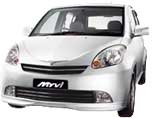
 Perodua has attributed their quick rise to success after only 13 years in business to a win-win alliance with it’s Japanese partner Daihatsu. Perodua Managing Director Syed Hafiz Syed Abu Bakar says “Picking the right partner and picking the right way to move forward together is the key.”
The key is Perodua’s manufacturing unit. Perodua has a subsidiary called Perodua Auto Corporation Sdn Bhd which handles the operations of Perodua Manufacturing Sdn Bhd (PMSB) and Perodua Engine Manufacturing Sdn Bhd (PEMSB). Daihatsu Motor Co Ltd and Mitsui & Co own 51% of Perodua Auto Corporation. This restructuring exercise was done back in 2001, and manufacturing operations are under joint-venture partner control.
This strong strategic alliance has resulted in a win-win situation, bringing Perodua closer towards it’s goal of becoming the king of compact cars in not only Malaysia but the region. It plans to ramp up production at it’s 2 billion ringgit Rawang plant by 25% in preparation for new models and increased export. In times of rising oil prices, compact cars are gaining popularity because of the perception that they are more fuel efficient, though this is not always the case.
Perodua’s manufacturing facilities have improved through the injection of Japanese DNA in the company, like the practice of the Toyota Production System (TPS) and “jishuken” which are self-improvement activities like study groups held together with vendors. It’s vendors are audited by it’s own QRE (quality resident engineers) team. Toyota’s association with Perodua has resulted in a positive halo effect in both reputation and manufacturing processes.
In line with it’s ambitions to be the best compact car manufacturer in the region, Perodua currently has no plans to produce a sedan model although there are such rumors being passed around, but there are plans for compact cars with larger engine capacities of up to 1.5 litre engines. Perodua’s largest compact car engine capacity is currently 1.3 litres, found in the Perodua Myvi and the Perodua Kembara. The Perodua Myvi and Kembara would definitely benefit from a 1.5 litre engine as the current 1.3 litre feels underpowered to me. The engine revs have to be kept higher for sufficient power and this in turn defeats the purpose of a smaller engine so it can be more fuel efficient.
 Perodua Traz
from RM76,100
Perodua Traz
from RM76,100  Perodua QV-E
from RM69,999
Perodua QV-E
from RM69,999  Perodua Axia
from RM33,900
Perodua Axia
from RM33,900  Perodua Alza
from RM62,500
Perodua Alza
from RM62,500  Perodua Myvi
from RM46,500
Perodua Myvi
from RM46,500  Perodua Ativa
from RM62,500
Perodua Ativa
from RM62,500  Perodua Bezza
from RM34,580
Perodua Bezza
from RM34,580  Perodua Aruz
from RM72,900
Perodua Aruz
from RM72,900 
 motorhead (Member)
on
motorhead (Member)
on 

 oversight (Member)
on
oversight (Member)
on  pycazu (Member)
on
pycazu (Member)
on  razib (Member)
on
razib (Member)
on  abe (Member)
on
abe (Member)
on  blunt (Member)
on
blunt (Member)
on  Tracks (Member)
on
Tracks (Member)
on  aesthari (Member)
on
aesthari (Member)
on  mycar_stolen (Member)
on
mycar_stolen (Member)
on  Paul Tan
on
Paul Tan
on  johanbey (Member)
on
johanbey (Member)
on  hypermount (Member)
on
hypermount (Member)
on  olowokandi (Member)
on
olowokandi (Member)
on  whodz (Member)
on
whodz (Member)
on  anwarFan (Member)
on
anwarFan (Member)
on  Wai (Member)
on
Wai (Member)
on  szw (Member)
on
szw (Member)
on  KW Tan (Member)
on
KW Tan (Member)
on  raybrig85 (Member)
on
raybrig85 (Member)
on  fookeatmin1989 (Member)
on
fookeatmin1989 (Member)
on  hazremi (Member)
on
hazremi (Member)
on  king (Member)
on
king (Member)
on  jtshin (Member)
on
jtshin (Member)
on  Imation (Member)
on
Imation (Member)
on  Whopper (Member)
on
Whopper (Member)
on  bazet (Member)
on
bazet (Member)
on  cyborgx (Member)
on
cyborgx (Member)
on  zulkifli6 (Member)
on
zulkifli6 (Member)
on  Akazamabamaboo (Member)
on
Akazamabamaboo (Member)
on
AI-generated Summary ✨
Comments express mixed sentiments about Perodua's ambition to be the regional leader in compact cars, with some supporting the move due to affordability and market dominance, while others criticize reliance on rebadging, quality issues, and lack of innovation. Many highlight the importance of owning platforms and technology development for sustainability, but some feel rebadging is more financially feasible. Overall, there's a mix of patriotism, caution, and skepticism about P2's future growth and quality improvements.