
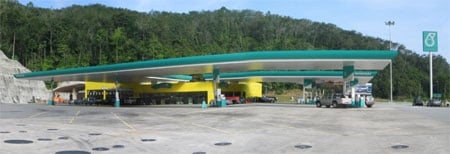
Apparently, we will not be able to fill up at petrol stations anytime after 10pm anymore, thanks to a decision by the Petrol Dealers Association of Malaysia to go ahead with the new closing time with or without the approval of the government.
Yesterday, Association president Alang Zari Ishak said petrol stations along the highways would still remain open 24 hours, but in a report by The Star on page N3 today, acting president Major (Rtd) Wahid Bidin says the decision would also affect petrol stations along the highways.
The petrol dealers cited problems such as armed robberies, increased security costs, higher wages for workers, low night sales, soaring rentals and higher electricity tariffs as reasons for the decision. Average collection after 10pm was only about RM1,000 per station, thus it was not profitable to keep the station open as the margins earned from the RM1,000 during the night did not justify the salary and electricity costs.
They also want customers to bear the 1% commission that is payable to the banks with credit card transactions.
The new opening hours for the petrol stations is proposed to be 7am to 10pm, and the decision is likely to go into effect in 2 months time. I hope they decide not to go ahead with it in this two month’s time, or the government does something to stop them.
BTW, if you are wondering why the association had a president yesterday and today suddenly it’s spokesperson is an acting president, what happened was ex-president Alang Zari Ishak was voted out by 51 out of 65 members for allegedly failing to champion the association’s interests.
Looking to sell your car? Sell it with Carro.

 razor_clawzz (Member)
on
razor_clawzz (Member)
on 

 chanel (Member)
on
chanel (Member)
on  msmar_453 (Member)
on
msmar_453 (Member)
on  Paul Tan
on
Paul Tan
on  pekan (Member)
on
pekan (Member)
on  ganz (Member)
on
ganz (Member)
on  rexis (Member)
on
rexis (Member)
on  ahmadmckk (Member)
on
ahmadmckk (Member)
on  Gus-Gus (Member)
on
Gus-Gus (Member)
on  Dogster (Member)
on
Dogster (Member)
on  aj3377 (Member)
on
aj3377 (Member)
on  moha774 (Member)
on
moha774 (Member)
on  viceice (Member)
on
viceice (Member)
on  jehutyz (Member)
on
jehutyz (Member)
on  anjangAki (Member)
on
anjangAki (Member)
on  bs (Member)
on
bs (Member)
on  4G63T DSM (Member)
on
4G63T DSM (Member)
on  cetait (Member)
on
cetait (Member)
on  engtaokia (Member)
on
engtaokia (Member)
on  proton12vauto (Member)
on
proton12vauto (Member)
on  szw (Member)
on
szw (Member)
on  chuamike (Member)
on
chuamike (Member)
on  Ralliace (Member)
on
Ralliace (Member)
on  greeeny (Member)
on
greeeny (Member)
on  e-nabilll (Member)
on
e-nabilll (Member)
on  trustgtr (Member)
on
trustgtr (Member)
on  dr_blur (Member)
on
dr_blur (Member)
on  kopial (Member)
on
kopial (Member)
on  jules (Member)
on
jules (Member)
on  philippecr (Member)
on
philippecr (Member)
on  mofo (Member)
on
mofo (Member)
on  mcmercedez (Member)
on
mcmercedez (Member)
on  narrowband (Member)
on
narrowband (Member)
on  accordmania (Member)
on
accordmania (Member)
on  osh_kosh (Member)
on
osh_kosh (Member)
on  BanyakMasukWorkshop (Member)
on
BanyakMasukWorkshop (Member)
on  transformer (Member)
on
transformer (Member)
on  mystvearn (Member)
on
mystvearn (Member)
on  PTAllTheBest (Member)
on
PTAllTheBest (Member)
on  KidDie (Member)
on
KidDie (Member)
on  VINCENT (Member)
on
VINCENT (Member)
on  maibatsu_thunder (Member)
on
maibatsu_thunder (Member)
on  tokmoh (Member)
on
tokmoh (Member)
on  navicgator (Member)
on
navicgator (Member)
on  a doctor seeking new car (Member)
on
a doctor seeking new car (Member)
on  Poxxue (Member)
on
Poxxue (Member)
on  spianz (Member)
on
spianz (Member)
on  su30mkm (Member)
on
su30mkm (Member)
on  V_NoZ (Member)
on
V_NoZ (Member)
on  wanwnp (Member)
on
wanwnp (Member)
on  OOOO (Member)
on
OOOO (Member)
on  martiolativo (Member)
on
martiolativo (Member)
on  ed0r (Member)
on
ed0r (Member)
on  aesthari (Member)
on
aesthari (Member)
on  BigFish (Member)
on
BigFish (Member)
on  theblip (Member)
on
theblip (Member)
on  biggie (Member)
on
biggie (Member)
on 


AI-generated Summary ✨
Comments express frustration and opposition to the new 7am-10pm petrol station hours, citing inconveniences like emergencies late at night, longer queues in the mornings, and safety concerns. Many feel the rule unfairly favors profit over consumer needs, especially for those working late or traveling. There is widespread anger over credit card charges, perceived greed of operators, and lack of government support. Some suggest boycotting stations that close early and call for more flexible, customer-focused policies.