
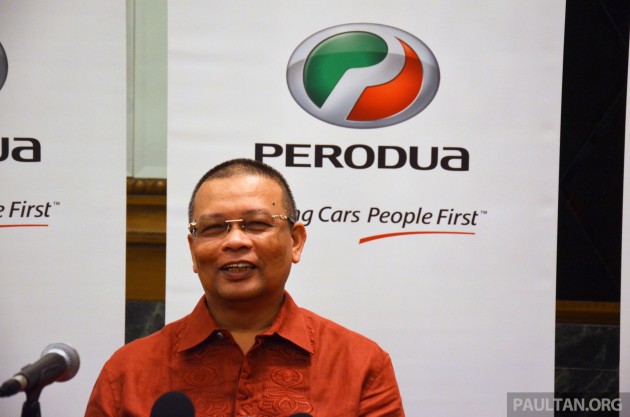
It’s T-minus one day to the tabling of Budget 2015. The Malaysian Automotive Association (MAA) has expressed their wishes; now it’s Perodua’s turn. The Rawang-based carmaker hopes car financing will be made easier for buyers, reports The Malaysian Insider.
“The average (car loan) rejection rate is 28%. At one stage it was at 35%,” TMI quoted Perodua president and CEO Datuk Aminar Rashid Salleh as saying.
“On the one hand, the government encourages people to use quality affordable vehicles, and while we respect the policy of the central bank, we hope it does not get too strict on those who meet the requirements.”
Aminar hopes the government will make things easier for first-car buyers, particularly those who live in areas where efficient public transport is not available. “They need to have their own transport… we hope to provide a solution to that,” he told the publication.
Apart from that, Aminar also expressed his concerns about rising living costs amidst the dawn of the implementation of the Goods and Services Tax (GST). GST is scheduled to take effect next April.
Last week, Malaysia Automotive Institute (MAI) CEO Madani Sahari said that Budget 2015’s auto-related matters are likely to align themselves with NAP 2014’s aspirations. Budget 2015 is also expected to yield a list of zero-rated or tax-exempted items with respect to the upcoming GST – will our petrol and diesel be GST-ed?



 Perodua Traz
from RM76,100
Perodua Traz
from RM76,100  Perodua QV-E
from RM69,999
Perodua QV-E
from RM69,999  Perodua Axia
from RM33,900
Perodua Axia
from RM33,900  Perodua Alza
from RM62,500
Perodua Alza
from RM62,500  Perodua Myvi
from RM46,500
Perodua Myvi
from RM46,500  Perodua Ativa
from RM62,500
Perodua Ativa
from RM62,500  Perodua Bezza
from RM34,580
Perodua Bezza
from RM34,580  Perodua Aruz
from RM72,900
Perodua Aruz
from RM72,900 
 kacimara
on
kacimara
on 

 peyn0
on
peyn0
on  JPJ Director
on
JPJ Director
on  Rakyat
on
Rakyat
on  carlover
on
carlover
on  Ryan
on
Ryan
on  man
on
man
on  seancorr (Member)
on
seancorr (Member)
on  levah
on
levah
on  Thinkg first before simple saying 7 years
on
Thinkg first before simple saying 7 years
on  Afraid
on
Afraid
on  Pokli Seluang (Member)
on
Pokli Seluang (Member)
on  Carlover
on
Carlover
on  MyViva
on
MyViva
on  ioma
on
ioma
on  Joey
on
Joey
on  tishaban
on
tishaban
on  azrai
on
azrai
on  tokmoh (Member)
on
tokmoh (Member)
on  E spec
on
E spec
on  Low Budget
on
Low Budget
on  sudonano (Member)
on
sudonano (Member)
on  Motorbutthead
on
Motorbutthead
on  Clueless
on
Clueless
on  Jinyiwei22
on
Jinyiwei22
on  Besi Buruk
on
Besi Buruk
on  Anti-Establishment
on
Anti-Establishment
on  areos
on
areos
on  dodgeviper88
on
dodgeviper88
on  TheDuh
on
TheDuh
on  4G63T DSM
on
4G63T DSM
on  darkermarker
on
darkermarker
on  Steve Jobs
on
Steve Jobs
on  haji die
on
haji die
on  Axxx
on
Axxx
on  panjang
on
panjang
on  bmpower
on
bmpower
on  screwu (Member)
on
screwu (Member)
on  Albert
on
Albert
on
AI-generated Summary ✨
Comments reflect strong opinions on easier car financing, with some supporting it for aiding low-income buyers, while others criticize it for promoting unnecessary debt and sacrificing safety for profit. Many express frustration about high car prices, taxes, and perceived corporate greed, especially concerning Perodua’s focus on profit and limited safety features. Concerns about long loan tenures, household debt, and government taxes are prevalent, alongside skepticism about true affordability and the impact on traffic congestion.