
Vehicle sales in the country dipped last month compared to that achieved in April – a total of 42,983 units were registered in May, and the total was 4,106 units, or 9% less, than the previous month.
The slow movement was attributed to the government’s announcement to set the goods and services tax (GST) rate at 0% in mid-May, resulting in customers holding back on their purchase due to uncertainty.
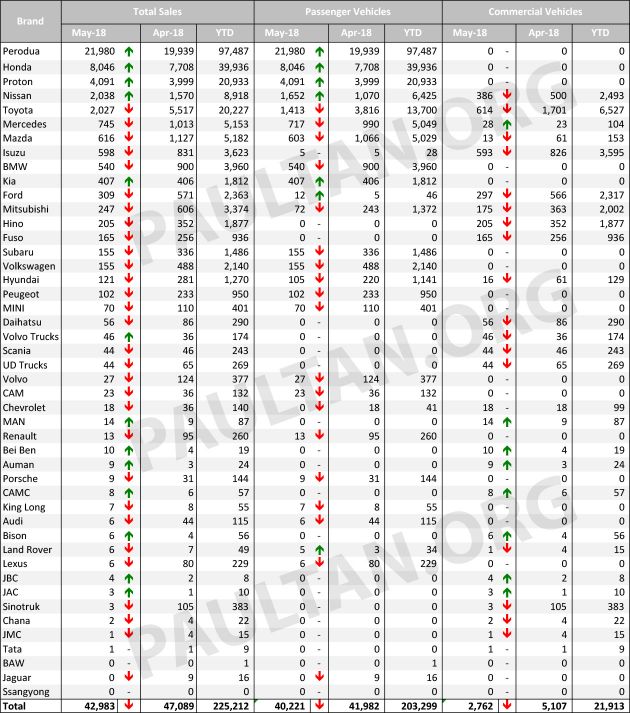
Here’s a quick breakdown of how most brands performed in May. There were not many gainers, but market leader Perodua (+10.2%), Honda (+4.4%), Proton (+2.3%) and Nissan (+29.8%) were brands that showed positive movement. Based on Malaysian Automotive Association (MAA) figures, Perodua’s share of the market 51.1% for May, and its closest competitor was Honda, which had 18.7% of the pie.


Notably, with last month’s numbers, national automaker Proton is now back in third spot in terms of year-to-date numbers, edging in front of Toyota – Proton’s market share is just under 10%. Elsewhere, Kia was also one of those ending up with a green arrow, though the gain was marginal, by just one unit more than that it managed in April.
Meanwhile, brands that saw a decline in sales were Toyota (-63.3%), Mazda (-45.3%), Ford (-45.9%), Mitsubishi (-59.2%), Subaru (-53.9%), Volkswagen (-68.2%), Hyundai (-56.9%) and Peugeot (-56.2%).
As expected with the 0% GST announcement, sales of premium vehicles went out the window in May, with Mercedes-Benz (-26.5%), BMW (-40%), Mini (-36.4%), Volvo (-78.2%), Audi (-86.4%) and Lexus (-92.5%) all recording a slump in numbers. Jaguar ended May having shifted zero cars, from nine the previous month.
Click on the chart below to view a larger version.
Looking to sell your car? Sell it with Carro.

 kpgboyz
on
kpgboyz
on 

 Corn
on
Corn
on  john
on
john
on  thespionkop
on
thespionkop
on  Tokmom Volvo Best
on
Tokmom Volvo Best
on  John Fake News Sdn Bhd
on
John Fake News Sdn Bhd
on  Hassan Hashim
on
Hassan Hashim
on  no_proton_no_basher
on
no_proton_no_basher
on  Rajoo Selvam
on
Rajoo Selvam
on  john
on
john
on  ioma
on
ioma
on  st3wp1d
on
st3wp1d
on  Axxx
on
Axxx
on  yawnz
on
yawnz
on  Bob
on
Bob
on  born
on
born
on  Nico
on
Nico
on  Gaya..
on
Gaya..
on  john
on
john
on  Dislike Toyota
on
Dislike Toyota
on  basherlogic
on
basherlogic
on  tokomoh
on
tokomoh
on  Mankind
on
Mankind
on  Awang Selamat
on
Awang Selamat
on  Nissan The New KING!!
on
Nissan The New KING!!
on  halloha560
on
halloha560
on  Visionery
on
Visionery
on  Abang Alza Pakai Topi
on
Abang Alza Pakai Topi
on  otai
on
otai
on  Kereta Murah
on
Kereta Murah
on  Kereta Mahal
on
Kereta Mahal
on  Operation Manager
on
Operation Manager
on  digidigi
on
digidigi
on  bigboss
on
bigboss
on  Sushi Sucks
on
Sushi Sucks
on  OMG
on
OMG
on  Mikey
on
Mikey
on  taknaktoyota
on
taknaktoyota
on  Whereistokmoh?
on
Whereistokmoh?
on  tokmoh.
on
tokmoh.
on  Nancy Badawi
on
Nancy Badawi
on  Ben Yap
on
Ben Yap
on  Ollie
on
Ollie
on  Muhammad arshad bin mustapaha
on
Muhammad arshad bin mustapaha
on  Aero (Member)
on
Aero (Member)
on  KY
on
KY
on  Sampan Waves
on
Sampan Waves
on  camtakpro
on
camtakpro
on  jjas
on
jjas
on  Dwayne
on
Dwayne
on  olyvia
on
olyvia
on  A Ramli
on
A Ramli
on  Amran
on
Amran
on  Ng
on
Ng
on  Loler
on
Loler
on  Sam 'Ohwai' Loo
on
Sam 'Ohwai' Loo
on  john
on
john
on 


AI-generated Summary ✨
Comments generally express concern over declining sales for brands like Toyota, Proton, and Volvo, with some highlighting Perodua’s strong 50% market share. Many see Toyota’s sales drop as a sign of outdated models or market shifts, while others praise Nissan’s recent growth. Several comments criticize the high costs and perceived poor quality of older or expensive brands. There is overall skepticism about long-term brand vitality, with some optimism towards Proton and perceptions that local management influences sales performance.