
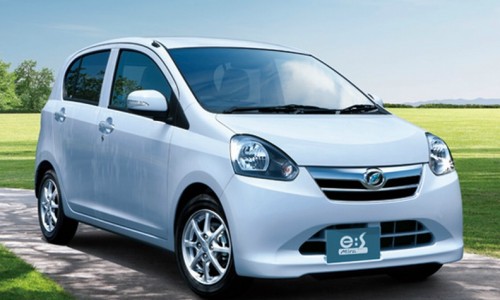
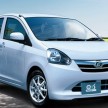
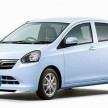
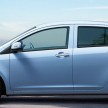
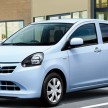
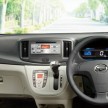
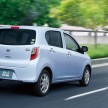
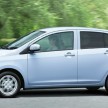
Daihatsu has thrown its latest Kei car contender into the fray, with the introduction of the Mira e:S in Japan. The minicar, which reinterpretates the three-door e:S Concept of two years ago into a five-door form, is available in both two- and four-wheel drive guise domestically, with four level variants (G, X, L and D) for the former and two (Gf and Xf) for the latter.
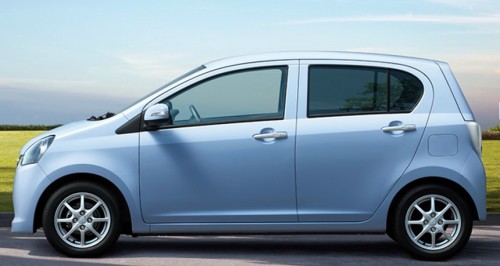
All versions wear the same KF transverse three-cylinder twin-cam 658 cc mill, offering 52 PS at 6,800 rpm and 60 Nm at 5,200 rpm, mated to a CVT transmission. The company is touting the car’s fuel economy as its biggest selling point – claimed figures for the 2WD version on the new JC08 mode test cycle is a healthy 30km per litre (and on the older 10-15 mode, 32 km per litre), close to hybrid territory.
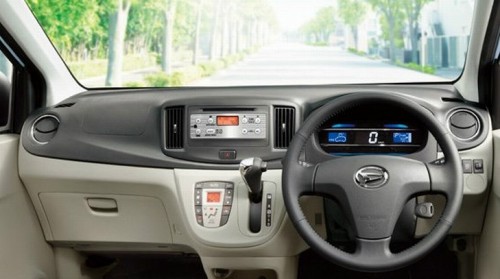
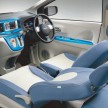
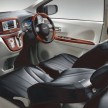
Features on the 730 kg vehicle (790 kg for the 4WD versions), which is 60 kg lighter than the old Mira, include a pre-stop idle reduction system, and all the models wear 14-inch wheels and 155/65 profile rubbers; there are optional Sporty and Premium interior/exterior dress-up packs available for the car, as well as what is tagged an “earth colour interior.”
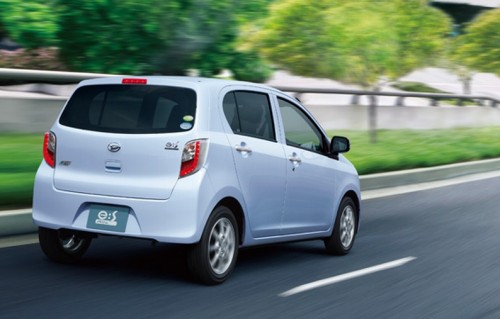
Domestically, Daihatsu is ambitiously aiming at moving 10,000 units of the Mira e:S per month in the first year, according to reports, and says that it will apply the technology used for the e:S to other models and vehicles produced overseas, including that in Indonesia, which was where the Daihatsu A-Concept was introduced in July, at the IIMS.

Looking to sell your car? Sell it with Carro.

 BMW POWER FOREVER
on
BMW POWER FOREVER
on 

 KAPOW!
on
KAPOW!
on  junaidi
on
junaidi
on  Prismo
on
Prismo
on  policeman
on
policeman
on  awan
on
awan
on  toyo
on
toyo
on  Kent
on
Kent
on  niz
on
niz
on  4G63T DSM
on
4G63T DSM
on  Jolo
on
Jolo
on  Payne
on
Payne
on  Cheah Tat Cheong
on
Cheah Tat Cheong
on  kitty lion
on
kitty lion
on  lonelyobserve
on
lonelyobserve
on  Chris
on
Chris
on  Cucukman
on
Cucukman
on  Aris
on
Aris
on  OMG
on
OMG
on  Name
on
Name
on  Wake up
on
Wake up
on  amir
on
amir
on  Gladiator
on
Gladiator
on  haha
on
haha
on  DarkAvenger
on
DarkAvenger
on  awg1031
on
awg1031
on  PakAbu
on
PakAbu
on  kuncisudu
on
kuncisudu
on  Nono
on
Nono
on  komenturg
on
komenturg
on  Just me
on
Just me
on  b
on
b
on  lmst
on
lmst
on  TFazuin
on
TFazuin
on  Aaron Lim
on
Aaron Lim
on  aref
on
aref
on  farghmee
on
farghmee
on  atan
on
atan
on  littlefire
on
littlefire
on  balb
on
balb
on  sutheshkumar
on
sutheshkumar
on  proton supporter
on
proton supporter
on  albag
on
albag
on  nobody
on
nobody
on  Julian Lee
on
Julian Lee
on  William
on
William
on  Unforgiven
on
Unforgiven
on  l3ryan
on
l3ryan
on  key
on
key
on  autojohndoe
on
autojohndoe
on  MoFaz
on
MoFaz
on  Karl
on
Karl
on  nebula87
on
nebula87
on  Cron
on
Cron
on  sfssd
on
sfssd
on  i
on
i
on  nazreen
on
nazreen
on  fuel cell phone
on
fuel cell phone
on  Kipas_Susah_Mati_Proton
on
Kipas_Susah_Mati_Proton
on  akinablue
on
akinablue
on  scgtimk1
on
scgtimk1
on  Daihatsu CEO
on
Daihatsu CEO
on  zas
on
zas
on 


AI-generated Summary ✨
Commenters mainly discussed car pricing strategies, import taxes, and local vs. imported car quality, expressing frustration over high costs and lack of updates from local manufacturers. Many noted the Mira e:S's impressive 30km/l fuel efficiency and criticized the design, comparing it unfavorably to older models or other brands. Some expressed excitement about the potential rebadging of the Mira as the new P2 VIVA, while others commented on safety features and design similarities. Overall, the tone ranged from critical to hopeful about the car's prospects.