
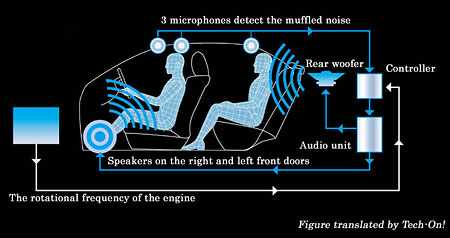
Toyota has added an “active noise control” system to the Toyota Crown Hybrid which works similiar to the way noise canceling headphones work.
Toyota says during slow city drives of between 20 to 40km/h where engine RPM is between 1,000 to 3,000rpm, muffled noise of between 50 to 150Hz can typically be transmitted to the car, impairing the car’s interior comfort.
Three microphones in the car’s interior picks up this noise and sends it to the active noise control system. The system then generates an antiphase sound signal from a set of speakers to counter the noise. Three speakers are used located on the left front door, right front door and one rear woofer. Distance between the mics that pickup the noise and the head of a passenger as well as the shape of the car’s interior has to be taken into account. Toyota says this can reduce noise levels by between 5 to 8dB.
Although there are similiaries between the Crown Hybrid and the Lexus GS450h’s hybrid drive system, the active noise control is not necessary in the Lexus GS as the engine RPM in the GS is higher at the same speeds. This is because the Crown Hybrid’s ratios are tuned for better mileage.
Looking to sell your car? Sell it with Carro.



Sweet.. i like Toyota Crown..
Do these speakers double as sound system speakers or are they solely for the noise cancellation system?
Cool….
2 words- Ear Plugs
Sounds a bit like cheating to me by “tricking” the brain into thinking there is less noise.
What happened to the traditional method of more insulation and more engine refinement?
Interesting. Perhaps they have come to the limit on the traditional method and taking things one step further? Surely there is more from the traditional methods. Perhaps this is cheaper?
instead of spending cost on developing sound deadening material (which is quite archaic) this is a rather intelligent way of doing the same thing. Plus, the technology can be pushed further.
This does not sound good for a car ICE fan. Anti phase sound has been developed in car ice years ago and it has impact of disturbing certain range of sound frequency. No good for good hifi.
i like quiet cars
i dont care much bout engine noise anyway. its always relative to car price…
more expensive less noise
if i’m not mistaken, active noise ctrl has already implemented in airliners.
using frequency (sound) to annihilate another disturbing frequency (unwanted sound). i forgot the term, but that is how it works.
i prefer passive noise ctrl- less maintenance & less electronics ;)
You know for certain this is a disastrous idea. Imagine if the mic rosak then you get augmentation of sound in your cabin non stop. Something too complex is just bound to get faulty…
hybrid…pah
mystvearn said,
July 24, 2008 @ 5:38 pm
You know for certain this is a disastrous idea. Imagine if the mic rosak then you get augmentation of sound in your cabin non stop. Something too complex is just bound to get faulty…
Hikaru said,
July 24, 2008 @ 11:17 am
Sounds a bit like cheating to me by “tricking” the brain into thinking there is less noise.
What happened to the traditional method of more insulation and more engine refinement?
Interesting. Perhaps they have come to the limit on the traditional method and taking things one step further? Surely there is more from the traditional methods. Perhaps this is cheaper?
—————————————————————
I noticed from the diagram that the input to controller consists of engine signal and feedback loop from microphones. and from paul’s statement i can’t read any claim that this system is intended to compensate for the ambient noise. therefore i believe the main input to controller comes from the engine bay, not from microphones (the mics are just to compare the output vs target for continuous adjustment). if the mics are faulty, there shouldn’t be any serious effect, as far as i can think.
Convensional insulation materials contribute significantly to the weight of a car (and thus increase fuel efficiency), and the demand for comfort is always going to be higher. so this is better way to save cost in the long run.
mystvearn said,
July 24, 2008 @ 5:38 pm
You know for certain this is a disastrous idea. Imagine if the mic rosak then you get augmentation of sound in your cabin non stop. Something too complex is just bound to get faulty…
—————————————————————-
don’t be too judgemental. this concept has been in practice for years, maybe toyota took longer time to reach production due to their characteristic cautiousness on the reliability of new tech. so they won’t gamble their reputation (and customers’ trusts) by applying half-cooked tech in production.
I would rather want woofer to boost some bass sound of my audio instead of using it as noise cancellation speaker.
We can always put something like sound insulator at the engine bay or the side door or even the hood…..
But one thing scares me, does cars loaded with wires will naturally get short circuit and burn out the whole unit just like the house?
scary…
doesnt the latest honda accord has the same technology,as i have experienced on my new honda,when the going on “ECO” mode a.k.a 3 cyclinder activation,the stereo system kinda goes odd,only few noticed it…..
Bravo zerachiel. U own a new V6 accord? I know that the V6 has noise-cancellation in the cabin and this kinda thing is for the premium cars…
is this the same tech used in aircraft?
to Porkbutcher,
yes,got mine two weeks back,car is superb !!