
Click to enlarge
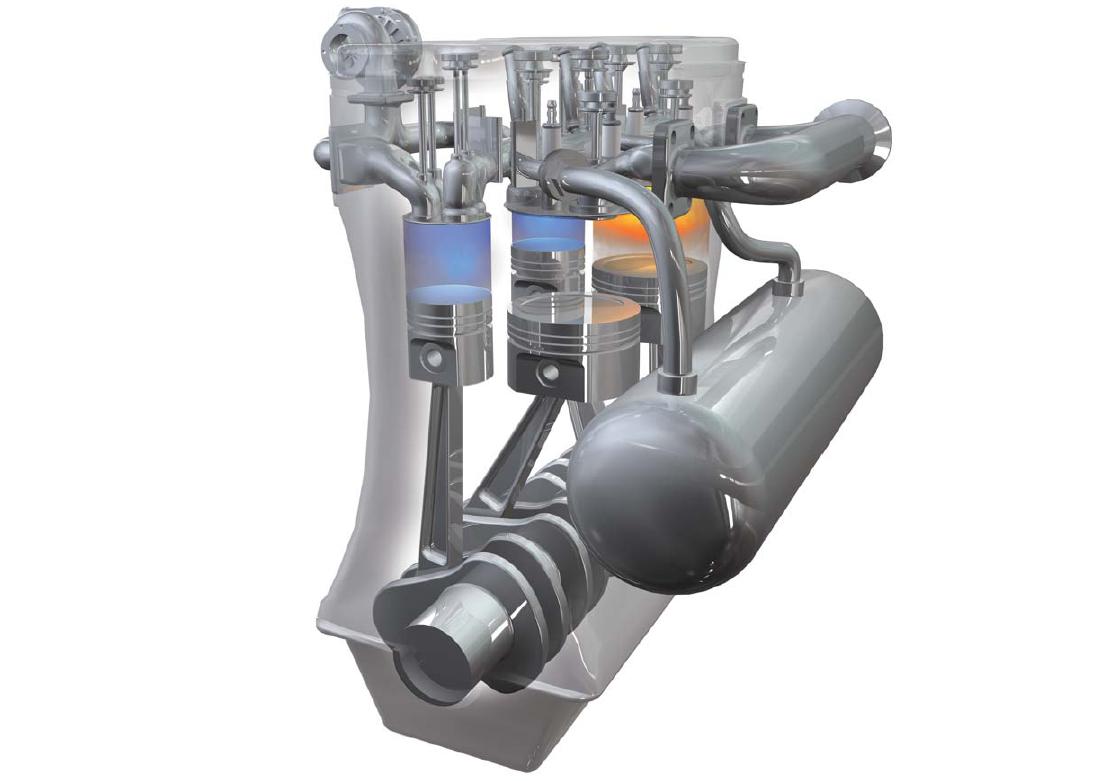
Here’s something for the techies. It’s a split-cycle mill called the Scuderi Engine, and it’s designed by the Scuderi Group, a US engine development company. What the company says it has come up with is a design – featuring Miller-like valve control strategies, extended expansion and turbocharging – that enables maximum levels of power and torque while reducing the rate of fuel consumption and engine size.
The Scuderi Engine divides the four strokes of a combustion cycle between two paired cylinders — the left cylinder functions as an air compressor, handling intake and compression, while the right cylinder handles combustion and exhaust. The key to Scuderi’s split-cycle design is that it compresses the air before it fires.
Consistent with conventional four-stroke engine designs, the combustion cycle of the Scuderi Engine has two high-pressure strokes — compression and power, and two low-pressure strokes (intake and exhaust). The power stroke is positive work, or the energy that is produced by the expanding gases to create mechanical work. The intake, compression and exhaust strokes are all negative work, or the energy that the engine consumes to create mechanical work.

Click to enlarge
By separating the compression cylinder from the power cylinder and by using a standard turbocharger to convert recovered exhaust-gas energy into compressed air energy, the size of the compression cylinder can be downsized to achieve substantial reductions in negative compression work.
Key features include fully variable intake and exhaust valves, outwardly opening crossover passage valves and high geometric compression and expansion ratios. Independent lab tests reveal that the Scuderi block has fast and robust combustion, offers a diesel-like, flat torque curve and is highly knock-resistant.
The engine – when fully developed – will reduce NOx emissions up to 80% and improve fuel efficiency by 50%, compared to a conventional gasoline engine. The engine requires one crankshaft revolution to complete a single combustion cycle and is projected to have higher torque, thermodynamic efficiency, and lower emissions than possible with today’s engines.
Click to enlarge
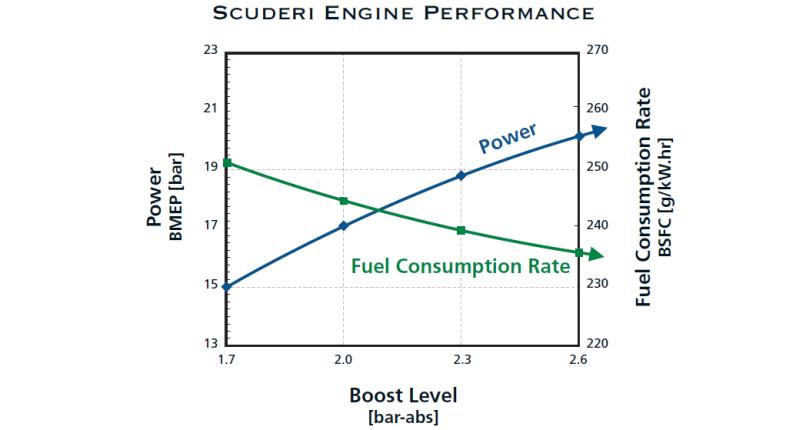
Other figures and percentages – the engine, when boosted with a turbocharger to 3.2 bar, decreases the brake specific fuel consumption (BSFC) up to 14%, and a simultaneous increase occurs in the engine’s power brake mean effective pressure (BMEP) by 140%. At the same time, the size of the engine is reduced by over 29%.
The net result, the company says, is a smaller, higher-performing engine that yields significant gains in volumetric efficiency and power as well as reducing BSFC. Studies are underway at the lab that will soon show impressive results of the Scuderi split-cycle engine modelled in a 2011 Nissan Sentra.
Looking to sell your car? Sell it with Carro.



Wow.. this is quite inovative also… Better engine design to help cut fuel consuption.. Anyway i still think diesel engine have more to improve..
Animated image of the engine cycle would be great. Easier to understand the concept
found one animated video of how this scuderi engine works , but took some time for a noobie like me to understand though :P
http://www.youtube.com/watch?v=Kogz4wedwtk
Found teh video on youtube http://www.youtube.com/watch?v=Kogz4wedwtk
The animation is the first thing pop up on their website.
http://www.scuderigroup.com/
This concept have been surfaced for quite a while, since 2008 i believed.
i remembered it since i downloaded their videos and concepts back then.
over the years, they have been improving their concept and building up prototype engine to proof it.
i also read somewhere that they are trying lobby OEM to buy thier idea for production vehicle.
The engine – when fully developed – will reduce NOx emissions up to 80% and improve fuel efficiency by 50%, compared to a conventional gasoline engine.
Fitting this engine with another hybrid plug in. We can even save more fuel and less emissions. Then, we will go wherever we want with our car. peace
The idea was, before they added the turbo, that a compressed air tank was going to be added to the engine so that air could be compressed by the compression pistons during braking. When the tank was full, the compression pistons could be given a rest and the energy required to compress air could be saved. The engine could then run more efficiently by saving that compression work. Originally, the compression pistons were larger than the power stroke pistons allowing extra air to be stored in the tank. Now, with the turbo added, they have made the compression pistons smaller. With the turbo, will they also be adding the air tank hybrid piece after all? The air tank was to be simple and cheap compared to adding a redundant battery and electric motor to drive the car.
Yes, they will still be adding an air storage tank to the design… with the Miller cycle – like addition, the turbocharging will assist the compression cylinder in feeding the air storage tank, thus reducing the work of the cylinder. By doing so, it will have to work less so they can reduce its size and still maintain the compression needed. With a smaller piston there will also be less friction making it that much more efficient.
Practical idea & i think it efficiency will be greater than turbine type turbo charger.
This by far the easier fix to energy resource. With this, alternative fuel programme can be activate without the fear of supply shortage.
looks promising… could be the next in-thing for ICE to come. Great! Imagine a 1.2 l car could be performing FC like a motorbike but have torgue close to a mitsubishi triton. but that’s just my wild guess. still it’s good to know there are ppl out there still figuring out what can be further improved. keep it up guys…. the world is waiting
sounds great idea but.. i don’t understand this thing.
This Scuderi Engine is not ONLY a GREAT Development…..it’s an awesome INVESTMENT !!!! It will make many of us a HAPPY FAMILY….that’s why I got into this stock and will now BUY as much as I can !!!!!
:)) :)) :))
Very good concept from an engineering application standpoint,as an Automobile Engineer myself,i would reckon that they are still doing the development phase now.The yield results are near excellent and the volumetric efficiency of this engine is extremely good,hence the figures.But i would prefer to see a working animation of this concept to undersatnd this better.But i do get the idea based on the writeup.Personally speaking,it’s a simple and very efffective concept and should be cheap to produce.
When the production feasibility becomes fruitful,they might produce it in low numbers on certain applications to gain acceptance.Then you have to address the issue of competitors(if any)who might contest this idea and say theirs is better.
Since the Scuderi Group does not make cars,it’s patent rights for this engine can be used by other car manufacturers should they choose to do so.With royalties for the copyrights of course per manufactruing application.
Brilliant idea.Hope to see this engine under the hood of some car soon.Cheers.
according to website, Honda, Peugeot-Citroen, Fiat and Daimler are interested in the technology
http://online.wsj.com/article/SB124025229305035879.html
Considering there are only 2 power strokes i imagine there are lots of balancer shafts to balance the engine for smooth operation.
Anyways this would not be the first alternative engine but would be the first if it makes it into production, many many many have already fallen long before this
i can see how it works for small engines like lawn movers, motorbikes and boat engines. I dunno how it’ll do with car tho?. its just more mechanical moving parts. Means more friction and energy lost and also more weight and space required. Unless they intend to run the car in a 2 cylinder configuration or a (2+2) in this case..
It like 2 stroke engine combine with 4 stroke..
turbo without the siput..plsss make this into production
Theoretically very promising, be it its good promises, as a replacement to 2 stroke engine, or even as an advancement to diesel engine. As far as I know, otto-cycle base concept is applicable for both petrol and diesel.
I’m guessing it runs hotter than regular motor, no?
Now you’ve gone and make me all excited! But I’ve got so many questions. Like how are the smaller pistons suppose to provide enough air to the bigger pistons. They could go with different length con-rods, but the vibrational characteristics would be a nightmare!
It’s simply a ‘DKW Ladepumpe’ engine from the 1930s, converted to four stroke… ;)
Just compare both pics (the DKW had a piston charger instead of a turbo): http://www.emot.nl/fotoalbum/displayimage.php?album=13&pos=5
Not new technology. This concept has been around for a long time (maybe even before year 2000) but it was not materialized. Good to see that someone took it a step further, although in the end, it’s still an Otto based engine.
“The key to Scuderi’s split-cycle design is that it compresses the air before it fires.”
Which internal combustion engine doesn’t compresses air (and fuel – in most cases) before fires ?
The split design engine compress air inside compression cylinder before being transferred inside power cylinder. That’s the different!
The compress air volume will be much higher since it is cooler. This in the end will produce more combustion when compared to conventional design. The conventional method does all work i.e. intake, compression, power exhaust inside 1/same cylinder.
It’s one of the advantage but there could be disadvantage as well we don’t know.
The evolution of engineering never ends, seems like yet another big step forward from the outdated common four stroke four cylinder engines!!!
Designed by a thermodynamics genius it works well with gasoline or but likely even better with diesel. No heat issues to date. Emissions are lower than Otto. The key seems to be firing after top dead center. Brilliant but who knows where it will go.
hi anthony,
in your 5th paragraph, could you reveal the source for the ‘independent lab’ and also kindly explain the meaning of ‘is projected to’ in 6th paragraph?
Anyway, a noble idea for this engine!
The independent lab is Southwest Research Institute. The lab is in San Antonio, Texas.
I think the meaning of the “is projected to” phrase is there is only one working prototype that I know of that the lab is testing and some of the projected numbers are based on the lab’s computer models rather than on data they got directly from their tests on the prototype. The two cylinder prototype has been running for a little over a year. What I mean by that is it runs and the lab has been running tests on it for that long, but the engine has not been running continuously for a year.
John, thanks for the info, as well as that earlier above.
Does anyone know whether the Southwest Research Institute (SRI) is the authority on car engines? Are there others, or is SRI the most reputable? Is anyone familiar with the process of how a car engine gets tested? Do they all go to SRI, and is the SRI seal of approval mean that it is a done deal? I hear from my physics professor that the engines need to be placed into a vehicle to be tested properly, not just computer simulations. But I’ve also heard that computer testing is actually the standard now… so I don’t know. Do you guys know? Thanks!