
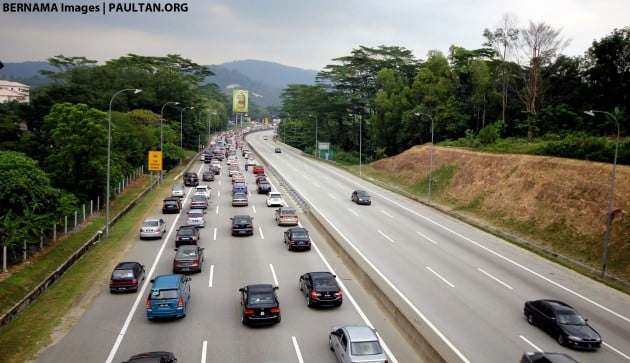
Malaysia should have more concrete roads, as it is more cost-effective in the medium to long term compared to asphalt ones, according to the local cement and concrete industry.
The call was made by outgoing Lafarge Malaysia president and CEO Bradley Mulroney, who was asked about the industry’s wish for Budget 2016 by The Star.
“We would like to see more concrete roads in Malaysia as it is competitive in usage as well as cost. Concrete roads are particularly suitable for rural and flood-prone areas as they are more durable. The promotion on this is also in line with the effort to support homegrown industries such as ours,” he told reporters at the celebration of the Cement and Concrete Association of Malaysia’s 50th anniversary.
International Trade and Industry Minister Datuk Seri Mustapa Mohamed, who officiated the event and coffee table book launch, said that concrete roads were more durable than asphalt roads and also required less maintenance. “They also contribute to our economy as the raw materials are produced locally as opposed to bitumen for asphalt roads,” he said.
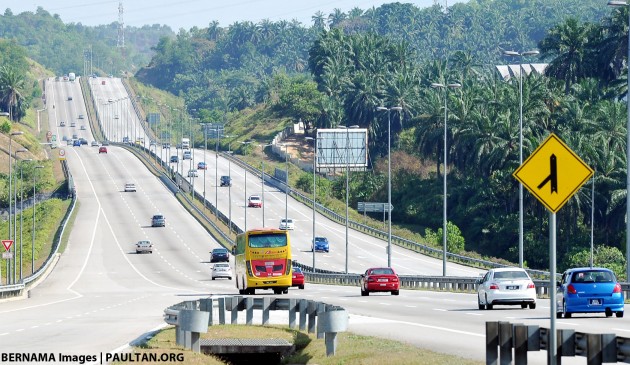
“A portion of the central spine road linking Gua Musang to Kuala Lipis was built using the continuous reinforced concrete pavement technology, thanks to the association. It is a cause I continue to support until today,” the minister said, adding that the industry accounted for 4% of the country’s gross domestic product.
Concrete roads make up less than 1% of Malaysian roads due to the lack of awareness.
In June, the Public Works Department (JKR) and the Malaysian Rubber Board signed a Memorandum of Agreement to undertake joint research in the use of the frozen rubber “cup lumps” as an additional material in asphalt. Rubberised roads have a longer lifespan compared to normal tarmac.
The move to include rubber in roads was hailed as good news for the rubber industry, and is expected to boost domestic demand for rubber by 10% annually.
Looking to sell your car? Sell it with Carro.



Guess they forgot to mention how noisy they are or the fact that natural grip levels plunge when it rains with the present technology…
Perhaps for slower speed federal roads but not for highways or ring roads… I guess if you are from that industry, your bound to advocate it. the rubber infused roads seem like the better idea IMO
Cement for non-highway roads. Much lower cost to maintain.
This will be done because Cement factories are all UMNO linked companies. See the shareholders, mostly UMNO members who hold big positions.
So, Gomen sure to approve this for the big UMNO boys to make even more money from the rakyat’s coffers.
You will be suprised who actually owns the cement industry and they are not by majority race either ;-)
Asphalt vs cement vs rubber
When will they start using our naturally linked places using waterways?
Obviously all rivers, sewers and canal has been enlarged, even in KL areas, to tackle flood problems. Why not optimizing these waterways to reduce traffic jams e.g KL to Shah Alam, Klang, Sepang.
Imagine owning a private boat and ride daily to office, with some shops and R&R along d way. Seems interesting.
How can! If Puchongites have LDP equivalent river, then those tauke’s uberbarges will block all the other sampans from moving smoothly, thereby creating a watery version of LDP jam!
That would be YTL, Lafarge, Sunway…
Yeap, that’s pretty much the top producers.
Get your facts right 1st “Thank you UMNO”.
In case you are not aware, there is actually a fair stretch of concrete pavement on NSE/NKVE where everyone is speeding without an issue.
Developed countries like the US and Australia have long been using concrete pavement for interstate or major highways. I think this is all about perception.
“concrete roads were more durable than asphalt roads and also required less maintenance.”
Less maintenance means:
– less repair, maintenance jobs for road contractors
– less instant mee road projects especially right before election night
Conclusion: Better keep asphalt roads. Or else many contractors close shop and losing more votes.
Dont be an idiot if you havent driven on a concrete stretch road before. Just like a commenter posted above, there are other cons which relate to safety. Maybe thats the main reason it is not widespread use.
Might I add also those stretches are noisy and bumpy as hell. I can never go more than 100kmph without feeling jarring on the road.
less rakyat money spend to contractor. Rakyat happy.
Before ya’ll whine let me be the first to tell you that other countries have been using concrete roads (mainly in highways) for decades. It is however noisier and the roads do need channels for rain water to flow. But it is very very very low maintenance
Please name the countries and name the roads that were built with it. Good also to provide statistic how much % of concrete road that countries have. Thank you.
Wouldn’t be surprised if brick industry also calls for more brick roads in Malaysia.
Sure, if they come in yellow
Not to mention that it would drive up cement price, pissing off the property developers in this country, driving up real estate prices and hurting the economy…
The Rubber infused road seems promising .. the Concrete road should be use for housing area.
No.. Just no!
Acceptable on city streets but really annoying on highways. Even godcars will suffer in NVH on cement roads.
cement on estate road for Palm oil estate is far better than gravel
What ever the road is made of,toll is still hike!!
ting ting…this is a three way fight WWE style. Rubber industry cronnies vs Cement cronnies vs asphalt cronnies. End of the day, monies spend for below par quality.
As President of the Malaysian Gold Trader’s Association, I’d like to propose solid gold roads in Malaysia.
u funny lar bro !
Solid gold road is very much slippery! Plus potentially and high likely theft during daytime or night time.. not recommended. :)
LOL at the amount of people on the emergency lane
My first long distance travel on a concrete highway was an unpleasant one – noisy. By the time we reached the asphalt section, the noise just went away. Perhaps concrete can be used on suburban/residential streets for slow traffic. Leave open roads and high speed motorways be made from asphalt.
Do you know how noisy driving on concrete road?
Work hard and buy Lexus car. Very quiet and superior soundproof.
Silencer, dont be so arrogant, no matter what we do, there are always rich n poor people in this world. There are things we (rich n poor) share eg the road, it is the responsible of gov to give convenient to all, mind you that tmr is a new day, u might be destined to be poor n lost your valuable, be kind in words n heart
Material concrete banyak menyebabkan tayar kereta cepat botak. Dengan ekonomi yang teruk. GST lagi. Hal ini lagi membebankan rakyat malaysia dari segi keperluan dan kehendak. Hal ini nampak kecil. Tapi bagi kesan buruk kepada kemampuan masing2.
And the next thing they’ll suggest is rubberized-asphalt on reinforced-concrete roads for durability, comfort and safety (like flyovers)… But then completely forget about manholes and occasional piping and wiring reworks and then they will suggest manhole-tunnels for wiring, piping, sewerage and drainage under the to be rebuild roads again (like lrt tracks with asphalt)… So they can songlap mega-sums of money over and over again…
I’m not against better quality roads with high durability, My only problem is reworking on the same roads for things that could have been planned earlier, a little foresight and cooperation between affected parties. Wishful thinking… Sigh…
Damn. Why Malaysian companies always like to do something out of ordinary? If you have abundance of unsold cement, lower the price so that the cost savings would be passed on to consumers.
There is nothing wrong with concrete or asphalt roads.
Asphalt roads can be long lasting if it was actually built properly. And we all know how corners (erh…. thickness) is cut.
The other matter is proper enforcement of weight restriction on HGV and transports.
As many have already hinted. Build a road that last forever, how to keep some people fed?
The cement industry also urged to fill the head of every minister in Malaysia with concrete since they cannot even utilised their brain to fix our economy or even how to answer without stupidity.
rigid pavement is not cheap and expensive to repair.. mana boleh tampal2 macam asphalt, even more its noisy and slippery.. much better to find a solution to increase asphalt lifespan..
there a whole stretch of 10KM concrete road that i need to goes thru daily and these are weaknesses that i found:
1) Noisy & jarring ride
2) Wear off tyre, even mis-align tyre in long run
3) Reduce Shock Absorber life span
4) Slippery when its rain, increase chance to aqua-plan
5) Increase braking distant
1 affect passenger comfort
2 & 3 increase TCO
4 & 5 safety issues
I definitely thumb down at this proposal.
Also, i urge this Gov to reduce cement price, housing price are so so high! wage earner that earns 3.5K per month cant afford to buy house(after deduct food, car loans, parkings, water and electricity bills, mobile plans & streamyx).
We also urge the govt to walk into the desert and die
Doesnt work that way, biggest crony will get the contract, asphalt or concrete is irrelevant.