
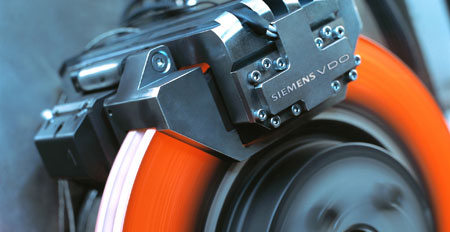
So you’ve got the drum brake, then the disc brake, then the disc brake with multiple calipers. Then you improve that further with slots, cross-drill holes and make the whole disc ventilated. Even brake by wire has been introduced. What next, something totally different?
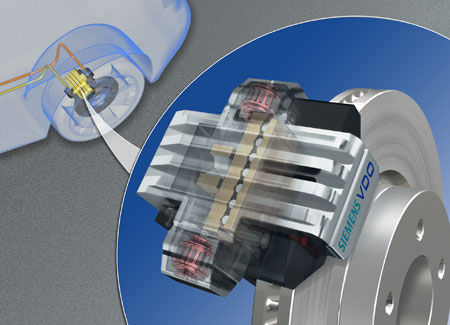
Introducing the Electronic Wedge Brake (EWB), a technology by Siemens VDO, based on a concept from aerospace engineering. The Electronic Wedge Brake completely bypasses any hydraulic system, instead it is powered by a simple 12-volt power system that already exists in the car. The system also has a faster reaction time, it works about a third quicker than conventional brakes, only requiring 100ms to reach full braking power compared to a hydraulic brake’s 170ms.
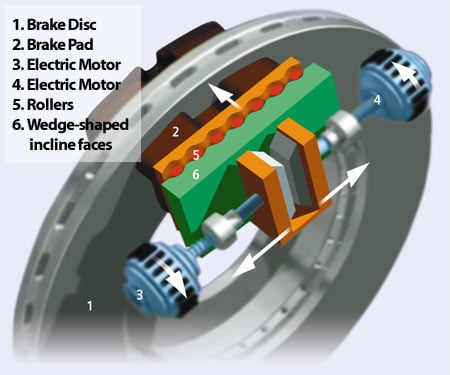
Basically, a brake pad connected to a wedge is pressed between the rod and the disc through the use of electric motors. The electric motors turn and push the pad onto the disc. The use of a wedge means braking power is multiplied with minimal energy expenditure (about one tenth of hydraulic brakes), through the principle of self-energization. The faster you are going, the stronger the brake force is going to be. The lack of a physical connection between brake pedal and brakes also makes this a brake by wire system by default. Sensors measuring wheel speed about a hundred times a second can adjust brake forces and wedge position to a high degree of accuracy, somewhat like ABS and stability control rolled into one.
Test results have been amazing so far. An Audi A6 fitted with the Electronic Wedge Brake system was put to the test comparing against another A6 with conventional brakes. The braking distance required from 100 km/h to 0 km/h was reduced by half in the EWB-equipped A6!
However, all brake by wire systems make you wonder what would happen if somehow power supply were to be disrupted. Something simple like the battery going flat because the engine’s alternator malfunctioned. To take care of this, the EWB is specified to be connected to two power supplies, a main one and a backup one with a secondary battery.
This is a good advancement in braking technology. The first car with EWD is expected to debut by 2010, and it will most likely be a German marque. Might be Audi since they were testing with Audis. More photos and a video after the jump.
Video: Siemens Electronic Wedge Brake (EWB)
Looking to sell your car? Sell it with Carro.



simply is brilliant design , self-energising..good,,
to a point can it produce a brake feel and modulation? ….i guess,,,
as an extention of electric power steering,
i bet theres gonna be a steering without rod one day, just like aircraft, and complete with steering weight feed back,maybe
electrical connection should be in gold to prevent corrosive causing open circuit perhaps, ($$$)
…..scarry..im nor ready yet, but its aerospace tech, higher safety standard,
sevice periodically like an aircraft,
really not ready for this,
anyway no one can stop technology evolves,
This product is still a PROTOTYPE.
I think the concept is good, but size and reliability does matter to OEM.
If you compare the size with Hydraulic type its almost double and bigger in every dimensions. Before OEM apply it on Mass-pro Siemens should come out a better solution of its size and reliability of it, therefore they need time to study it…..until 2010.
Don't know if I'd be too confident driving something like this.
Modulation could be odd.
If I can draw any parallels with BMW's active steering and throttle by wire, they just feel artificial and lacks "feel".
Not all technologies work well first time out. Like run flat tyres, which rode horribly.
Having my brakes not work perfect the first time out is disconcerting to say the least.
what if the electronics doesnt work?..if that happens the brake wont let you stop right?if the brakes still works without the electronics ,great innovation.
I have a phobia with more and more electronics taking over the good old traditional mechanical stuff. But for the benefit of safety and timing, electronics would eventually be standard. I'm sure that Siemens would take the necessary precaution if its primary systems failed.
another brilliant design from market leader.
but what will be the price to have one???
hopefully we can see it fixed into our proton one day…
god bless us long life..
I suppose brake feel and modulation goes out the window with this. Binary brakes to the max.
these kinda high tech brakes fitted in a proton?
haha…
i, as the CEO of Proton, announce that the prices of all the Proton range this year will be up by 10k…
that is because we will be fitting all the models with an EWB as standard and
this is to ensure the safety and the well-being of our dear customers driving our not soo strong milo-tin cars…
we just want our customers to know that we really care and value our customers just like the way they value our masterpieces(milo-tins)
yours truly,
ceo of proton
Can't imagine what future car will looks like when all those mechanicals stuff taken over by electronics.Car will be much lighter,engine compartment will be smaller and we will get more space in the passenger compartment.
The problem with technology is that you can't advance it without making it more complicated, two power supplies with another back up battery? Come on some people already have trouble maintaining one, wats more two that powers the brakes.
Very good idea, although I am abit worried about it being fully electronic.
This is a good technology, if people is speeding like crazy, it gives people more allowance to stop in time to avoid a disaster. A total revolutionary in car technology.
This is nice brake. If electric motor malfunction, then got story about the crash. But electric thing need to maintain every time, very easy get broke. Long lasting? Some people still don't know how to maintain their car. =/
so now bad people will be able to mess with the electronics and make the brakes rendering useless haha just a thought
a bit of history
aston martin virage shooting brake 5 dr
http://www.astonmartins.com/virage/images/am043.j…
sorry wrong posting
I'll pick electronics over mechanical any day. If everyone is worried that electronics may malfunction, what makes them think hydraulic mechanical brakes wont? It's evolution, live with it!
very innovative!
but still lack confident on "electronics items" , especially this is a life saving items!
especially the motor life-span, reliability and robustness ?
just a small point:
"Even brake by wire has been introduced as a concept technology"
It has been used on the Mercedes E-class, CLS-class, and SLR since 2002. In fact, it has already been discontinued and replaced by the next generation of brakes in the facelifted E-class (2006) although it continues in the others. So it's not just a concept technology.
By 2010, the best car will use EWB, but the hopelessly P1 stone age Iswara still use drum break!
"Err bang, change the brake pad pls, how much ar? "
"RM40 lar i give you."
"ok."
"eh, not right lar bro… your electric motor in your Siemens EWB brake caliper rosak lar"
"How much??"
"Around 800 per motor….you have 2."
"……………………."
Nola, I don't think EWB is a good idea.
Throttle by wire is fine and good, that's because I know I can still stop the car even if the throttle goes whack. But break is last resort and it definately should be the conventional stuff or some other reliable and non-electronic stuff.
I'm an Electronic Engineering student, and I don't trst electronics to save my life. To me right, Electronics should be there to help improve the underlying system, not replace the system itself.
Final words: Braking by wire is very very very dangerous and I strongly (X1000) discourage any auto manufacturer from pursuing this.
hello.
please send me full'information in EWB.
thank's.
How does it take-up slack (Pad & Disc wear).
My final year project in Bachelor of mechanical is Electronic braking System only …
i read the above comments all are gave some ideas thnks guys
hey what is the use of vacuum pump in EWB???
The only after-market device that should ever be connected to a Proton is a very large lump of hardened concrete shaped like a boat anchor having a short rope.
What this article neglected to mention is that an electronic wedge brake can sample and adjust the pressure being placed on the disc rotor by the brake pads at a rate of 2,000 times per second and because of this the electronic wedge brake is a superb ABS system.