
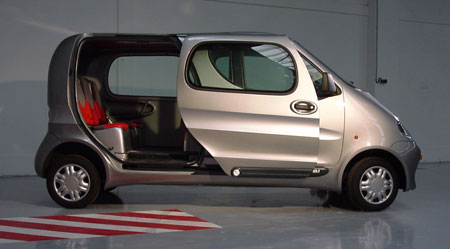
Guy Negre was a Formula One motor racing engineer. The Frenchman has been looking for 15 years for backers for his invention – a car that runs on air – and he now has the backing of Tata, who have invested 20 million Euros in his project.
Negre’s car uses compressed air to move pistons, which in turn also helps compress the air again in a reservoir. The car also has an electric motor, which also compresses air. This electric motor uses batteries that need to be charged. The compressed air can also be filled up at service stations in a matter of minutes.
His company Motor Development International based in France has developed an entire series of engine and car prototypes, some of which include fuel engine options together with the compressed air system. The fuel engine is used to extend the car’s range when not in reach of a special power point or a service station.
The car will be built in India and pre-production will start this year. It is protected by 50 patents, and the car will cost between 3,500 to 4,000 euros (RM17,000 to RM19,400). It weighs not more than 330kg and goes up to a top speed of 150km/h. Projected range is about between 160 to 320 km, depending on traffic conditions.
“It is clear that with oil at $100 a barrel this will force people to change their use of fuel and pollute less. My car is zero pollution in town and almost no pollution on the highways,” said Negre.
Look after the jump for a video on how the engine works.
Video: The Air Engine
External Links:
How the air engine works
The Air Engine on Wikipedia
Looking to sell your car? Sell it with Carro.

 hypermount (Member)
on
hypermount (Member)
on 

 kazai (Member)
on
kazai (Member)
on  cole planet (Member)
on
cole planet (Member)
on  azrai (Member)
on
azrai (Member)
on  MisterBenjo (Member)
on
MisterBenjo (Member)
on  dr_carz (Member)
on
dr_carz (Member)
on  4G63T DSM (Member)
on
4G63T DSM (Member)
on  osh_kosh (Member)
on
osh_kosh (Member)
on  Akazamabamaboo (Member)
on
Akazamabamaboo (Member)
on  KY (Member)
on
KY (Member)
on  ezralimm (Member)
on
ezralimm (Member)
on  kjryth (Member)
on
kjryth (Member)
on  farghmee (Member)
on
farghmee (Member)
on  wookie00 (Member)
on
wookie00 (Member)
on  moto_moto (Member)
on
moto_moto (Member)
on  armandd (Member)
on
armandd (Member)
on  yippi33 (Member)
on
yippi33 (Member)
on  gonggok (Member)
on
gonggok (Member)
on  chap_de_x (Member)
on
chap_de_x (Member)
on  MyviKiller (Member)
on
MyviKiller (Member)
on  ganz (Member)
on
ganz (Member)
on  nmh (Member)
on
nmh (Member)
on  xetronic (Member)
on
xetronic (Member)
on  BigFish (Member)
on
BigFish (Member)
on  Jeffrey1977 (Member)
on
Jeffrey1977 (Member)
on  proton.GL.. (Member)
on
proton.GL.. (Member)
on  kei9 (Member)
on
kei9 (Member)
on  GlowJo (Member)
on
GlowJo (Member)
on  cbljkkj (Member)
on
cbljkkj (Member)
on  szw (Member)
on
szw (Member)
on  megahyper (Member)
on
megahyper (Member)
on  detguaq (Member)
on
detguaq (Member)
on  ang (Member)
on
ang (Member)
on  Mohd Zamhri Bin Abu
on
Mohd Zamhri Bin Abu
on 


AI-generated Summary ✨
Comments express excitement about Tata’s compressed air-powered car as an affordable, environmentally friendly alternative to petrol vehicles. Many highlight its low cost, simplicity, and potential for reducing pollution, though concerns about range, safety, engine efficiency, and energy to compress air are raised. Some suggest it could revolutionize transport and replace traditional engines, while others worry about practicality under real-world conditions. Overall, sentiments are optimistic with cautious questioning of technical aspects.