
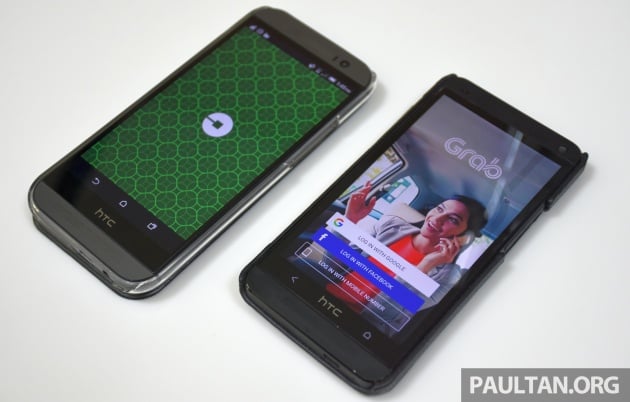
Much has been said about taxi services in Malaysia, after ride hailing tech companies such as Uber and Grab gave us an much-needed alternative to cabs. Taxi drivers have put up a fight, and some have made the decision to switch camps. Seeing their monopoly crumble, the taxi companies have been hostile, venting frustration at the now legal Uber/Grab and the Land Public Transport Commission (SPAD).
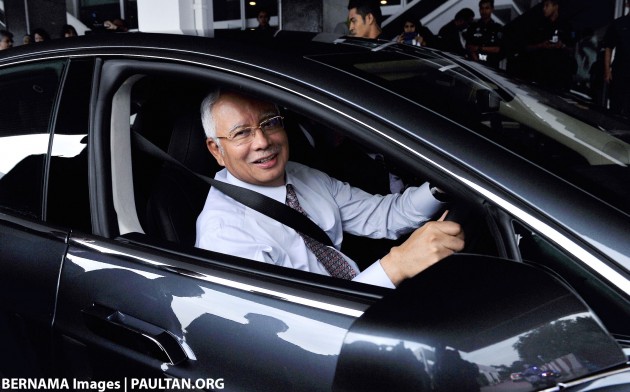
Now, prime minister Datuk Seri Najib Abdul Razak has had his say on the matter, pointing out the problems facing the taxi industry and reiterating the steps and decisions taken by the government to transform it.
The taxi industry plays an important role in first and last mile connectivity, but its service must be upgraded with the latest business practices in line with technological advancements, the PM said on his najibrazak.com blog, reported by Bernama.

He said that the government had identified several problems which bogged the industry such as an archaic business model, maintenance costs which exceeded income, as well as the quality of drivers and standard of vehicles. Other problems included the absence of centralised monitoring, negative public perception and the challenges of new innovations such as e-hailing.
“We have introduced many initiatives to help the taxi industry resolve these problems and improve the quality of taxi services in line with the Taxi Transformation Plan,” he said, pointing out the Teksi Rakyat 1Malaysia (TR1Ma), Teksi 1Malaysia (TEKS1M), 2015 Fare Review and 2015 Taxi Industry Laboratory initiatives. The latter paved the way for the Taxi Industry Transformation Programme (TITP) that was approved by the cabinet in August.
“It is not just from the monitoring aspects, but also a reshuffle of the business model in line with developments in innovations and technology in order to allow for fairer competition between all providers of national taxi services,” Najib said.
“Let me stress here that the decision (TITP, which legalises e-hailing players) was made not for the interests of any party. Instead, it was made to encourage entrepreneurship and innovation, allowing for bigger changes in our efforts to transform the taxi service in general,” he added.
The PM said that TITP also includes initiatives to protect the welfare of taxi drivers through introducing uniformed leased contracts, allowing applications for individual taxi licences, increasing the list of cars as taxis with emphasis on safety features, and having KPIs on taxi companies.
In addition, SPAD will rationalise taxi fares by having uniform metered taxi fares, reviewing the coupon system based on distance and not zones, and allowing dynamic fares, which will give the taxi driver the freedom to opt for fares set by the e-hailing services.
Najib said although SPAD had been appointed to lead the industry transformation, it could only be carried out with the cooperation of all parties.
“The reality is that all changes will surely face many challenges. Especially when we want to transform a service which is long-entrenched and comfortable with the traditional ways. To progress, we have to move in tune with today’s technology and innovations, and we must focus on making our service consumer-friendly and on par with other countries in the world,” he urged.

Tighter… ever so slowly… tighter. Its time to clean house and finally boot out the ex-tenant.
Kiter pakai TESLA buat Teksi, nak?
Tak mau. Nanti dia punye skynet AI kasi early afterlife aku.
Oic..MP dah masuk 100bijik pulak. Oh wai…
Apa susah. Stop paying spad. Join under uber or grab car.
They already join.
Gomen No Action Tok Only. jobless Taxi drivers will turn to Crimes. Wake Upp!!
no. The taxi service needs civilized & attentive drivers. Not some uncle / pak cik in his late 50s driving slow in the fast lane. It also needs properly maintained cars in the fleet. Unlike the modified rubbish excuse of a car that taxi drivers are driving now
Najib wan taksi diver use e heiling. But taksi diever have mental problem to use it. I olso. Better sleep under tree after tree in the morning and afternoon.
For your information taxi gangsters,
Unless there’s no more overcharged, rude, junk car,
Current situation won’t change,
Keep on trying useless protest as it won’t help.
Yes we want fair price and good services,
Opportunities are for those well-prepared,
Understand or not?
if doesn’t understand, please read the first letter of all the sentences and just wait for extinction. btw saw that face? vomiting inducing face?
There PM osO said ad. Taxi industry need to improve… now settle down
The authorities must come down hard on the taxi drivers for; public nuisance, obstructing traffic, intimidation etc
To be honest I am very embarrassed with my foreign friends when they come and visit my city and have to use our taxis. Driver tipu overcharged with kurang ajar service, riding in an unsafe crampy smelly old junk.
In Germany they use Mercedes E-Class or even 7-Series
In South Korea they use Hyundai Sonata and Kia K5
In Taiwan they use Toyota Camry
In Thailand they use Toyota Corolla
In Indonesia they use Toyota Vios
In Malaysia we use crappy tiny dinosaur Proton Saga
Come on la, use at least a Proton Persona
Malu la
Err. Memang pun teksi using Persona1, oso Exoras, Innovas, Sonatas, and some say Wajas too.
I stopped reading after ‘PM….’
That is why some basher bash without logic. Did not know what the whole story is. Topkek.
Lets see why is Taxi drivers generally are look down upon
1) They are mostly less educated
2) older/retired or HAVE to work bcos have debts & commitments due to not enough savings to retire.
3) Their cars are NOT as clean/cold/comfortable as your car
4) The most damning of all is they refuse to use the Meter to take advantage of their monopoly in places where they are presumed as their TURF.
It is so easy to “Dislike” these taxi drivers. We should partly blame our Gov for their diabolic situation bcos our gov is the one who is “Looking” after them.
What is more shameful is most of the Taxi drivers are from our very OWN M’sian Malays/Indians & some Chinese brothers.
1) Less educated dun mean they have to be less civilised.
2) If they know they job is important to them, then they wun slack of like they do now.
3) They dun treat their cars like they treat their home. Some cabbies make it comfy, others treat it like shiet.
4) This I agree.
Its easily to point finger at Gov, but just like a certain person, they had their chances and for 2 decades they blew it. If they had maintained a gud (but traditional) cab services, they might have a fighting chance, like london black cab. Now its time to clean house.
john, thanks for confirming what I’ve said regarding #It is so easy to “Dislike” these taxi drivers”
Learn from our neighbours, Singapore & Indonesia…..ours is a corrupt system!!!
Learn how to outright ban Grabuber like in SG or learn how to upcar faiya Grabubercar like in indomee?
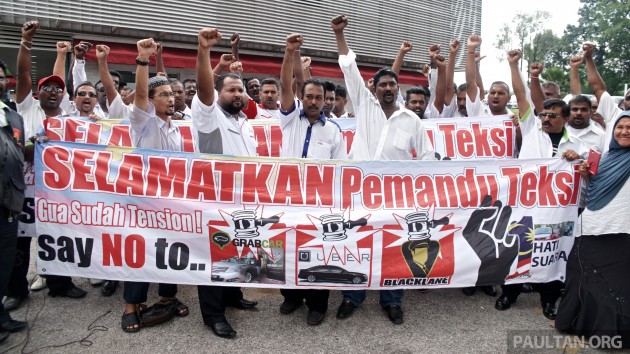
LOL looking at the photo with arms and fists raised plus those banners, i’m a bit confused; are they ASKING for help or DEMANDING for help. Will the homeless, beggars and addicts and street hawkers resort to the same tactic, I wonder.
Increasing the list of cars as taxi?come on!we only need 1 single uniform taxi model…..big,comfortable and efficient car
We need standardized pricing
We need no coupon system that benefit only the operator and not the taxi driver and the passenger
Come on….just pick a car model by fair tendering system….
Big,comfortable and pre install with ngv tank that won’t take up the space for luggage or go for diesel/electric cars…..
Reduce licensing fee for taxi driver
And what’s with annual jpj checking on taxi that approve below par vehicle to the public,it should be done on monthly basic both on performance and cleanliness
PM is so right. Taxi suffers because of lousy Proton cars. Thanks to Proton creator many taxi drivers suffer today. Cars so old till like gonna fall apart anytime. Still dare to ask Malaysians for money? Just dream on!!. PM we support you !!! And please please PM liberalise the car market and force Proton to close shop!!
PM wun fully liberalise the car market until he makes it difficult for pipu to choose to use private vehicles instead of public transport.
Ha ha ha, Yes John, blame the old man for all the malice he has bring to this Taxi drivers. Blame also P1 for he is the brainchild of P1.
U only blame P1 when it involve the old tenant but U forget who is behind the old tenant at that time.
U did not blame the current PM for telling this very Taxi drivers that he will take care of them when he needed their votes. Janji di CHAPATI instead Di-Tetapi/diketapikan di jalan.
Teksi just got wrecked by the PM
No! Whole taxis should be disposed in the ocean and replace with better bigger and comfortable cars.See all ‘high income nation’ around the world,Jibby.Do u see their taxis look like hell as ours? Don’t say u not traveling much around the world.That is another lie.
That is what he mean when he said – Taxi services need upgrading; business model too – tak da baca ka?
First of all, I want to ask what does Najib really know about the taxi industry ? During his entire life he probably doesn’t even sit or hail a taxi before. To come out with all sort transformation plan is easy for a person who has never experienced the first hand encounters like us do. Anyway, let’s keep our fingers crossed and see how will the new plan “transform” the taxi industry to the better or worse.