
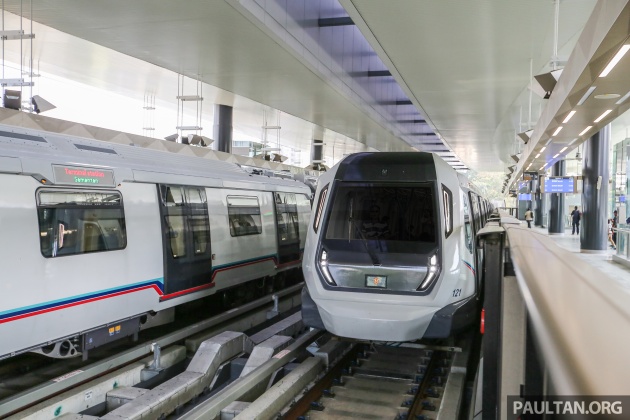
Malaysians are certainly getting their money’s worth in terms of public transport, it seems. According to the Malay Mail – which cited a report by FT Confidential Research – users over here spend pretty much the same as those in other South East Asian countries, but get more or better transport services.
“Indeed, Malaysians spend less as a proportion of their income than ASEAN rivals when it comes to transport,” stated the research arm of the Financial Times. The report follows the World Economic Forum (WEF) Global Competitive Index 2016-2017 released last September, which rated Malaysia 11th out of 138 countries in terms of transport infrastructure.
The country netted a score of 5.7 on the index, with the best score being a 7. “Malaysia’s high WEF scoring can be explained by its having made large infrastructure investments earlier than other ASEAN countries,” said FT Confidential Research, adding that Malaysia increased its spending on transport to 0.7% of its gross domestic product (GDP) last year compared to 0.6% in 2015, and is set to at least match that figure this year.
“One landmark project is the Sungai Buloh-Kajang mass transit line, a driverless commuter rail system that will connect an area north west of the capital Kuala Lumpur with Kajang, a fast-developing town located to the south east,” it said. However, this spending has also resulted in the highest debt-to-GDP level among top ASEAN countries such as Indonesia, the Philippines, Thailand and Vietnam, according to the report.
Looking to sell your car? Sell it with Carro.

 jon
on
jon
on 

 Albert Yong
on
Albert Yong
on  john
on
john
on  Shabudin
on
Shabudin
on  Nasser
on
Nasser
on  COE
on
COE
on  ducatiscrambler
on
ducatiscrambler
on  cnp
on
cnp
on  Dedak In The House
on
Dedak In The House
on  Annoynamous
on
Annoynamous
on  Leonardo
on
Leonardo
on  malaysian
on
malaysian
on  Sukhdev Singh
on
Sukhdev Singh
on  Warga langat
on
Warga langat
on  ali
on
ali
on  Redidiot
on
Redidiot
on  Hidan
on
Hidan
on  Bat
on
Bat
on  JL
on
JL
on  lilytan
on
lilytan
on  Ahmadjr
on
Ahmadjr
on  Passerby
on
Passerby
on  Bernard
on
Bernard
on  Sgt Scoop
on
Sgt Scoop
on  reqis
on
reqis
on  spree
on
spree
on  Alex (Member)
on
Alex (Member)
on  Anon
on
Anon
on  David CL Chua
on
David CL Chua
on  krishna
on
krishna
on  skeptic
on
skeptic
on  nexto
on
nexto
on  Ben Yap
on
Ben Yap
on  Blanko
on
Blanko
on  Noah Thiruchelvan
on
Noah Thiruchelvan
on  Tom
on
Tom
on  youmoron
on
youmoron
on  Ariff
on
Ariff
on  meanwhile
on
meanwhile
on  Wong yee Huei
on
Wong yee Huei
on  Darma
on
Darma
on 


AI-generated Summary ✨
Comments show mixed opinions on Malaysia’s public transport, with some praising its affordability and value, especially in comparison to Singapore, while others criticize its reliability, coverage, and frequent breakdowns. Several highlight that Singapore’s transport system is more efficient, integrated, and offers better service, though at higher costs and salaries. There’s skepticism about the survey's credibility, mentioning potential biases and inaccuracies, but overall, many feel Malaysia’s transport system is rated favorably mainly due to cost advantage and limited offerings, not quality or coverage.