
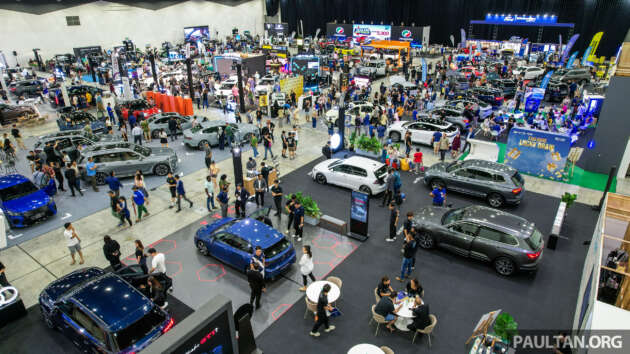
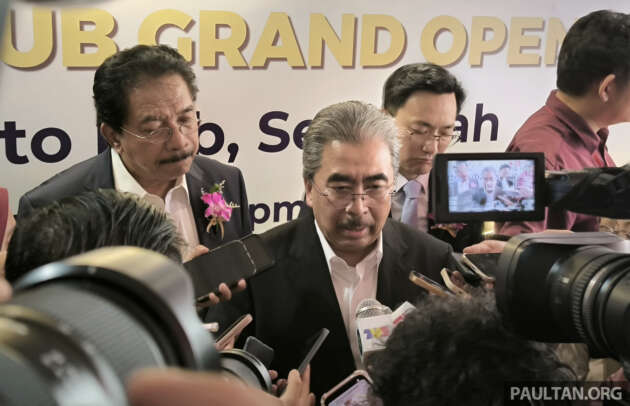
Speaking at the launch of the MCE Auto Hub in Serendah today, minister of investment, trade and industry Datuk Seri Johari Abdul Ghani said that locally assembled (CKD) vehicles’ local content must include value creation, and that the rise of CBU (fully imported) vehicles puts the supplier ecosystem in Malaysia at risk.
While the aforementioned safeguarding measures are crucial, the minister also said that the protection of the Malaysian automotive industry without permitting competition will become a liability.
“We are cognisant that that protection without competitiveness will inevitably become a liability. Industries insulated from competition rarely become global leaders, as success must come from continuous innovation,” the MITI minister said.

“This is precisely why our approach to foreign investment remains transparent. We welcome foreign automotive players to establish and expand their presence in Malaysia, to coexist and complement our domestic ecosystem,” he continued.
Whenever he is approached by an investor asking for approvals, Johari says he tells them that Malaysia is “not a place only to sell cars. We want you to come and bring all the technologies, all the components, so that you can use Malaysia as a hub,” he said.
“I can understand that no investment can give you 100% localisation on day one, but at least, after some time being here in Malaysia, we want a substantial component of car manufacturing to involve real and effective localisation,” he added.
The ministry of investment, trade and industry was accused of protectionism through its new policy for fully imported EVs that it confirmed in May. This stipulated that any EV being imported must have a minimum declared cost, insurance and freight (CIF) value of RM200,000, and a minimum power output of 180 kW (which is equivalent to 245 PS or 241 hp).
In March this year, MITI issued a statement following a news report indicating that the ministry imposed terms on BYD for its CKD local assembly plans, which the Chinese conglomerate could not agree to.
In the initial report cited, Johari stated the need to protect the local auto industry. “You must also remember that both Proton and Perodua have 50% local content in their cars, and Proton sells about 150,000 cars a year [while] Perodua sells about 350,000, which is a lot, and these two companies built much of the existing ecosystem for the auto industry in Malaysia. So, we have to protect them.”
In its response statement, MITI stated: “Together, Proton and Perodua have channelled billions into the Malaysian vendor ecosystem, supporting thousands of SMEs, skilled employees, and communities across the country. This is the industrial standard we are working to replicate.”
Looking to sell your car? Sell it with Carro.



Nak tongkat cakap je la
Sohai punya MITI, u ask foreign investor come to invest multimillion but in reality their investment will
Lost because EV car product CANNOT SELL well in market because EV CAR PRICE still very much EXPENSIVE than PETROL CAR. By right EV CAR simply & lower parts should be cheaper. MITI should immediate restructure EV CAR TAX compare to PETROL CAR TAX.
kenapa kita tak boleh export kereta ke negara lain ?
kerana tariff dan sekatan yg membuatkan exoport ke negara tersebut tidak menguntungkan. semua negara ada polisi yg memberi perlindungan kepada sektor automotif masing masing. kita punya protectionism bukan sesuatu yg baru di dunia automlotif
Sembang BN. Padahal nak protect crony.
This is definately what chinese say “USE LUNG TO TALK”
thank you johari for protek proton and perodua
How come Tesla has special treatment? Bottom line is your are protecting your cronies and you are giving all your stupid terms and condition to BYD
please attack the right people. cronies and AP KINGS not tesla. bodoh ke.
Since day 1, it’s all about protecting a few deep pockets.
Every other day release another rubbish statement. Why Johari? Your cronies pressuring you is it, or you want to reassure them?
It reminds me of a quote. “Wise men talk because they have something to say; fools, because they have to say something.”
No conditions for proton and perodua to export. Not even to fellow asean countries as they tried and failed.
p1 and p2 will NEVER be able to export anything. TO be honest, government should seriously consider letting them survive on their own without tongkat. If they fail, so be it. Malaysian consumers are so tired of them.
Support your crony kan
BS lah, just say you want to keep protecting P1 and P2. Low volume sales for foreign brands will not attract them to invest here. No investment, no new jobs.
Tesla apa macam? *Special*
ur bmw got build petrol station?
I am sure BYD would gladly install their chargers to get the *special* treatment like Tesla. Or that deal is only for Tesla?
“Foreign Investors Welcomed” with below terms and conditions
1. You can only sell 2 out of 10 cars you assemble here. The rest must be exported.
2. The 2 cars you sell here must be of higher price range model that do not compete with Proton & Perodua.
3. There are also unspoken unofficial rules that you must hire certain people, use certain vendors. We will casually “recommend” the details/names during one of the entertainment session later.
4. We reserved the right to change the terms and conditions (including the 3 above) anytime and anyway we want. Even if we already signed agreement and your factory half way build.
5. If you decide to abandon the project for any reasons, we will enforce the “exit clause” and seek compensation based on agreement signed.
really…. this dude knows what the sxxt he is talking about?
Sohai punya MITI. EV car should have new different tax structure where it should tax much lower than petrol car. Then it will auto-switch consumer buying cheap cheap EV and auto-saving petrol subsidy. When targeted >80% drive EV then your petrol subsidy also drop 80% too.
nevermind, still got PHEV and ICE cars to buy… no need EV.