
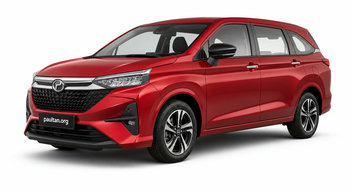

Verdict
The Proton Exora brings the muscle: 138 hp and 205 Nm, against the Perodua Alza’s 105 hp and 138 Nm, with peak torque arriving at just 2,000 rpm. It is also 185 mm longer and rides on 16-inch wheels, but weighs 302 kg more. The Alza counters with a 2,750-mm wheelbase, 20 mm longer than the Exora’s, a slightly larger 137-litre boot and a claimed 5.3 L/100 km. More importantly for a family MPV, it has six airbags, ASA 3.0 and steering correction; the Exora has two airbags and no listed stability control.
Pick the Perodua Alza if you want six airbags, ASA 3.0 pedestrian braking, lane steering correction and a claimed 5.3 L/100 km from your seven-seater.
Pick the Proton Exora if stronger turbocharged performance matters most, with 138 hp and 205 Nm versus the Alza’s 105 hp and 138 Nm.
Key differences
- Price: Perodua Alza RM62,500; Proton Exora RM59,800.
- Output: Perodua Alza 105 hp and 138 Nm; Proton Exora 138 hp and 205 Nm.
- Length: Perodua Alza 4,425 mm; Proton Exora 4,610 mm.
- Weight: Perodua Alza 1,145 kg; Proton Exora 1,447 kg.
- Safety: Perodua Alza has 6 airbags and ASA 3.0; Proton Exora has 2 airbags and no listed autonomous braking.
- Fuel tank: Perodua Alza 43 litres; Proton Exora 55 litres.
Alza
- Six airbags, ASA 3.0 and steering correction.
- Claimed 5.3 L/100 km economy.
- Longer 2,750-mm wheelbase and 137-litre boot.
- 33 hp and 67 Nm down on the Exora.
- Smaller 43-litre fuel tank versus 55 litres.
- 15-inch wheels versus the Exora’s 16-inch alloys.
Exora
- 138 hp turbo engine with 205 Nm at 2,000 rpm.
- 185 mm longer body and 55-litre fuel tank.
- 16-inch alloy wheels and front foglamps.
- Only two airbags versus the Alza’s six.
- No listed stability control, autonomous braking or lane-keeping assist.
- 302 kg heavier than the Alza.
What the Alza has over the Exora
What the Exora has over the Alza
Based on the published spec sheets of the selected variants — a blank field on one side can also mean unlisted data.
The Exora is 79 mm wider — more shoulder room, but a tighter fit in parking bays.
Representative body-type outlines, drawn to scale from each car's length and height.
| Price & overview | ||
|---|---|---|
| Price | RM62,500 | RM59,800✓ |
| Body type | MPV | MPV |
| Segment | B-Segment | C-Segment |
| Assembly | CKD | CKD |
| Ownership | ||
| Road tax / year | RM120 | RM120 |
| Monthly instalment (est.) | RM640/mo | RM610/mo✓ |
| Insurance / year (est.) | RM1,905 | RM1,834✓ |
| Fuel / year (est.) | RM2,109 | — |
| Energy cost / 100 km (est.) | RM10.55 | — |
| 5-year running costs (est.) | RM20,670 | — |
| Powertrain | ||
| Engine Tech | 2NR-VE, 16-valve DOHC, Naturally Aspirated with Variable Valve Timing | 16-valve DOHC, turbocharged |
| Capacity | 1,496 cc | 1,561 cc |
| Horsepower | 105 hp at 6,000 rpm | 138 hp at 5,000 rpm✓ |
| Torque | 138 Nm at 4,200 rpm | 205 Nm at 2,000 rpm✓ |
| Cylinder Arrangement | Inline 4 | Inline 4 |
| Fuel | Petrol | Petrol |
| Bore × Stroke | 72.5 mm × 90.6 mm | 76 mm × 86 mm |
| Compression Ratio | 11.5 | 8.9 |
| Drivetrain | ||
| Transmission | CVT Automatic | CVT Automatic |
| Transmission Name | D-CVT | CVT |
| Transmission Manufacturer | Akashi Kikai | Punch Powertrain |
| Driveline | Front Wheel Drive | Front Wheel Drive |
| Performance & Efficiency | ||
| Rated Economy | 5.3 L/100 km | —✓ |
| Dimensions | ||
| Length | 4,425 mm | 4,610 mm |
| Width | 1,730 mm | 1,809 mm |
| Height | 1,660 mm | 1,691 mm |
| Wheelbase | 2,750 mm | 2,730 mm |
| Weight | 1,145 kg | 1,447 kg |
| Fuel Tank | 43 litres | 55 litres |
| Doors | 5 | 5 |
| Seats | 7 | 7 |
| Boot Space | 137 litres✓ | 132 litres |
| Front Tyre | 185/65R15 | 205/55R16 |
| Rear Tyre | 185/65R15 | 205/55R16 |
| Spare Tyre | Full Size 15" | Full-size 16" Steel |
| Factory Tyres | Hankook Kinergy Eco 2 | Goodyear Assurance |
| Wiper Blade (Driver) | 24 inch | — |
| Wiper Blade (Passenger) | 16 inch | — |
| Chassis | ||
| Assembly | Malaysia (CKD) | Malaysia (CKD) |
| Front Suspension | MacPherson Strut | MacPherson Strut |
| Rear Suspension | Torsion Beam | Torsion Beam |
| Front Wheels | 15" Silver Alloy | 16" Alloy |
| Rear Wheels | 15" Silver Alloy | 16" Alloy |
| Steering | Rack and Pinion (Electric Power Steering) | Rack and Pinion (Hydraulic Power Steering) |
| Crash Safety Ratings | ||
| ASEAN NCAP | 5 stars | — |
| Safety | ||
| Airbags | 6 (Driver and Passenger, Front Side, Front and Rear Curtain) | 2 (Driver and Passenger) |
| ABS/EBD | ✓ | ✓ |
| Stability Control | ✓ | — |
| Alarm | ✓ | ✓ |
| Immobilizer | ✓ | ✓ |
| Airbag Disable Function | ✓ | — |
| Child Safety Lock | Manual for Rear Doors | Manual for rear doors |
| Seat Belts | 7 Three-point | 6 Three-point, 1 Lap-belt on Middle Row |
| ISOFIX | Available on Two Outer Rear Passenger Seats | — |
| Autonomous Braking System | Yes, ASA 3.0 Pre-collision Braking (4-120 km/h) with Pedestrian Detection | — |
| Lane-keeping Assist | Steering Correction | No |
| Collision Warning | ✓ | — |
| Seatbelt Reminder | Front and Second Row Seats | Front Seats Only |
| Safety Notes | Front Departure Alert, Pedal Misoperation Control | — |
| Lighting | ||
| Headlamps | LED Reflector with Automatic High Beam | Halogen Reflector |
| Taillamps | LED Combination | LED Combination |
| Front Foglamps | — | ✓ |
| Wing Mirror Turn Indicators | ✓ | ✓ |
| Cabin | ||
| Front Seats | Manual Adjustment | Manual Adjustable |
| Rear Seats | 60:40 Split-folding Middle Row with One-touch Tumble, Manual Sliding and Recline, 50:50 Split-folding Last Row | 60:40 Split-folding Middle Row, 50:50 Split-folding Last Row |
| Front Air-con | Manual Single-zone with Digital Controls and Memory | Manual Air-con |
| Rear Air-con | Rear Vents with Adjustable Blower | Rear Vents with Blower |
| Power Sockets | 1 Front, 2 Rear USB for Second Row | 1 Front |
| Interior Lighting | Map Lights | Map Lights |
| Cup Holders | 2 Front, 2 Rear | 2 Front, 2 Middle Row, 2 Back Row |
| Audio | Radio with Bluetooth, USB and Four Speakers | Radio with CD/MP3 player, Bluetooth, 4 Speakers |
| Convenience | ||
| Power Windows | Four Windows, Driver's Side Auto Up and Down with Anti Pinch | Four Windows, Driver's Side Auto Down only |
| Engine Start | Keyless Push Button | Manual Key |
| Locks | Remote Control Activation | Remote control activation |
| Auto Start/Stop | ✓ | — |
| Tiptronic | ✓ | — |
| Steering Tilt | ✓ | ✓ |
| Steering Telescopic | ✓ | — |
| Boot Operation | Remote Control Activation | Remote Control Activation |
| Parking Sensor Rear | 2 Sensors | 2 Sensors |
| Bluetooth | ✓ | ✓ |
| Hill Start Assist | ✓ | — |
| Instrument Cluster | Electroluminescent Analogue | Electroluminescent Analogue |
| Parking Brake | Handbrake | Handbrake |
| Warranty | ||
| Warranty Mileage Manufacturer | 150,000 km | 150,000 km |
| Warranty Manufacturer | 5 years | 5 years |
Specs shown for the selected variant of each car. ✓ marks the better figure where lower/higher is objectively better. Road tax: West Malaysia, private registration. Running-cost estimates assume 20,000 km/year. Fuel at RM1.99/litre (RON95, subsidised). Insurance: comprehensive motor tariff, no NCD. Instalment: 10% down, 2.5% flat rate, 9 years. Prices checked November 2026.
Used Alza & Exora for sale
Our reviews & guides
Perodua Alza


Alza vs Exora FAQ
Is the Perodua Alza or Proton Exora better?
The Alza is the better-equipped family choice, with six airbags, stability control, ASA 3.0 and a claimed 5.3 L/100 km. The Exora suits buyers who prioritise performance, as its turbo engine produces 138 hp and 205 Nm.
What is the price difference?
The Perodua Alza costs RM2,700 more than the Proton Exora: RM62,500 against RM59,800.
Which MPV has more power?
The Proton Exora is substantially stronger, producing 138 hp and 205 Nm from its 1.56-litre turbo engine. The Perodua Alza’s 1.5-litre naturally aspirated engine produces 105 hp and 138 Nm.