
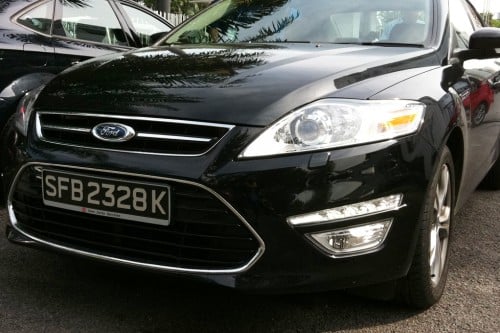
When we first reviewed the Ford Mondeo in February 2010, our man Danny enjoyed the drive and gave his overall thumbs up but commented that the package would be closer to prefect if it had an Ecoboost or a TDCI engine, as the 2.3 litre Duratec HE engine’s 159hp and 208Nm was a little underwhelming.
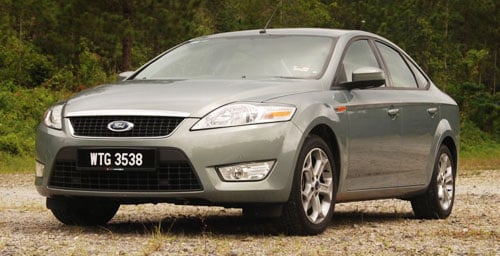
It looks like Danny’s wishes has come true as we hear SDAC is preparing for the launch of an updated Mondeo later this year. We jumped at the opportunity of trying out one of the new facelifted Ford Mondeos currently available in Singapore in Titanium spec with a 2.0 litre Ecoboost engine and a 6-speed Powershift transmission. Our current Mondeo is of Trend spec, with a normally aspirated 2.3 litre engine and 6-speed slushbox automatic.
Look after the jump for our findings after a short drive.
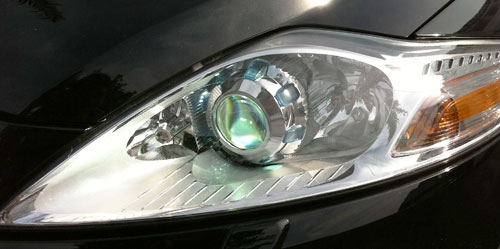
Other than the new front end which features a new grille, LED daytime running lights, bumper design (similiar to the facelifted Focus), and various other changes, the headlamps have also been updated to new feature projector lenses with HID which gives it a more upmarket look compared to the current Mondeo’s reflector lense.
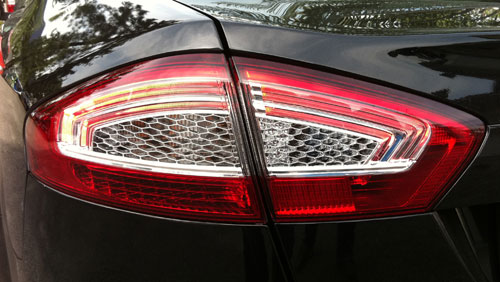
The tail lamp’s shape has been changed very lightly – if you look at the photo above, the right hand side of the tail lamp was not an arrow-point shape as per what you see now – refer to this photo for the pre-facelift shape. There are now LED light bars integrated into the tail lamps so it will stand out more at night.
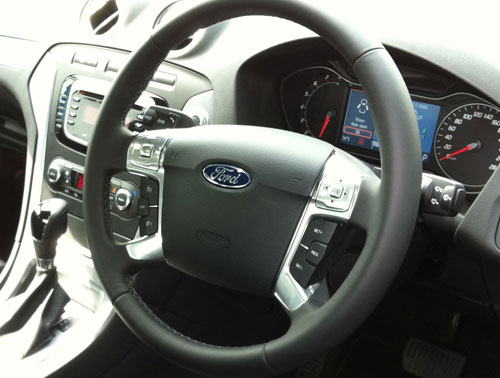
Get in the car and the biggest change will be staring straight at you in the face – the change from the Trend trim level to the Titanium trim level gives us this color LCD multi-info display in between the two instrument gauges, a significant upgrade from the instrumentation panel that does not feature this LCD screen.
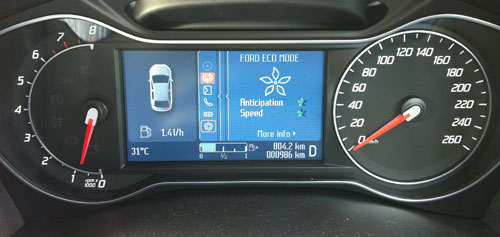
Other than displaying a settings menu which you navigate using the four-way arrow buttons on the steering wheel, the multi-info display also takes on the duty of the fuel gauge, headlamp and door indicators. You can also configure it to show fuel consumption in real time, average fuel consumption, distance to empty, etc. You can also configure the display’s color theme – there are two. This blue theme that you see here looks nice and adds color to the cabin during the day. You can also select a black theme if you want the display to blend in better with the rest of the interior.
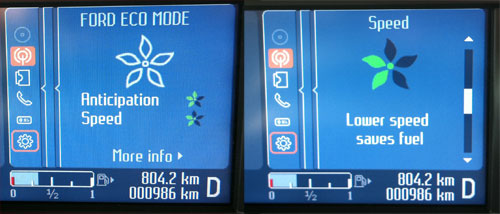
There’s also a Ford ECO mode menu which scores you on how economical your driving pattern is. You can be scored based on speed and anticipation – the latter probably takes into account how often you change between braking and accelerating, which you can minimize if you cleverly predict the traffic patterns around you.
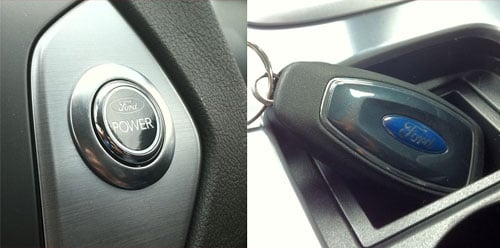
The Titanium spec also adds keyless entry and start to the Mondeo’s equipment level, also an upgrade over the current Malaysian Mondeo’s spec level.
The most significant change is of course the powertrain, which now features a 2.0 litre EcoBoost engine mated to a wet clutch 6-speed Powershift transmission. This is the exact same combination found in the Volvo XC60 2.0T and the upcoming CKD Volvo S60 2.0T. The EcoBoost engine makes 203 PS and 300Nm of torque. This is the lower tune of the two EcoBoost engines available on the Mondeo – there’s also a 240 PS version on the Titanium X Sport trim. I suppose this hints at the possibility of remapping the EcoBoost for more power if you’re interested in aftermarket tuning.
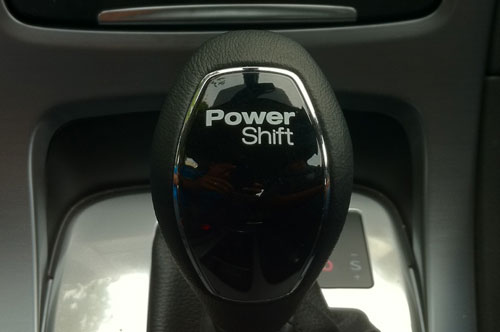
As Volkswagen’s DSG is the benchmark for twin clutch transmissions, a comparison of course has to be done – the 6-speed Powershift doesn’t shift as quickly or as seamlessly as DSG under hard driving but I felt that it did a little better than DSG at low speed high precision maneuvers, such as inching your way through a traffic jam or when precisely maneuvering your car into a parking spot. The creep behaviour of the Powershift transmission also felt more natural and similiar to a slushbox automatic. The wet shift Powershift is miles ahead in refinement compared to the dry clutch Powershift found in smaller Fords.
Being a modern turbocharged engine, the engine was very torquey from the get go and turbo lag was quite minimal. The combo actually feels much better to drive with a light to medium throttle and minimal downshifting as it is quite a desirable trait to have the car pulling away strongly despite low engine RPM (which also translates to low engine noise). The combo allows you to drive this way most of the time and if you do so you’re more likely to save fuel as well. In fact, you may feel a little underwhelmed with the sensation of revving the engine to the redline as the engine already gives you so much punch in the mid-rev punch that it doesn’t get very much better nearer to the redline.
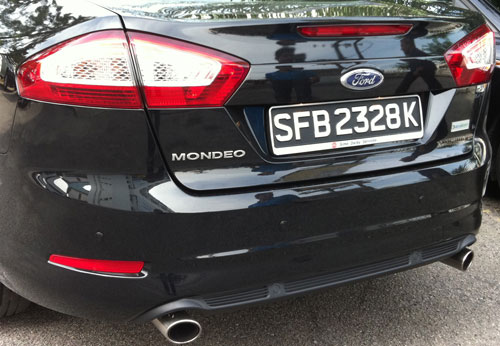
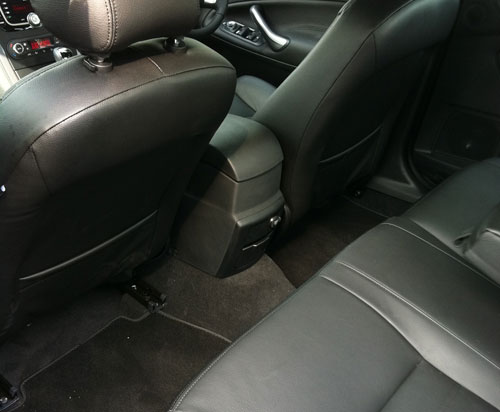
The airbag count remains as 7 as per the current Malaysian spec Mondeo, but ESP stability control has now been thrown into the mix, which is a very welcome addition. I did feel a little torque steer when flooring the pedal on a slightly uneven road. Other changes I could notice – seats are now leather, there are air conditioning vents for the rear passengers integrated into the B-pillars, and there are now proper tail pipes instead of the odd-looking tips hanging down below the rear bumper on the current generation Mondeo.
As an overall, the facelifted Mondeo with EcoBoost and Powershift feels like much more complete package compared to the current Mondeo. Although there’s no word on exactly when SDAC will launch the car here, the price could be revised upwards into the RM18x,xxx range, up from the current RM178,888 price tag (you can currently get a pre-reg unit with integrated GPS at a cheaper price currently), which isn’t too bad for a high spec CBU Belgium car that offers us exactly the same stuff the Europeans are enjoying.
Look after the jump for more pix of the Singaporean car.
[zenphotopress number=999 album=2048]
Looking to sell your car? Sell it with Carro.






keeping my finger cross ford fiesta ecoboost…
the centre aircond vents spoil the interior
The Ford Interior never impressed me, the design n quality of cabin need serious improvement..especially so when comparing it to the mazda’s…
the fiesta interior quite nice what, the design is so modern and futuristic. but the round aircond vent in mondeo totally out of place. why don’t make the one like in fiesta?
This is a good proper modern car.
My choice.
finally!!!!!!!!! forced induction in the ford executive car. about bloody time.
ford fiesta ST?? :) 180bhp in a small 1 tonne car would be ooooooooooh aaaaaaaaahhhhhhh yeeeeeeaaaaaaah! 0-100 in 6.5 seconds?!
We as middle income group always read about dreams cars but in reality we end up paying the same as other country but only in cheaper car, shall we thank our wonderful government for the good job they did to make us stupid.
too bad we still keep voting for the same government
we dont…phantom voters do !
Haiyaa u think by changing govt can give u cheaper cars?
it will the same old story in the end~
it’s more than just cheaper cars man…
Change gomen–> change policy–>finger crossed for AP-free Malaysia
i’m sure the price will be more than 200k if it is ever gonna make it into msia
nope, it’s just around 180k.
Front grille looks a bit Aston-Martin-ish.
why Ford didnt mount paddle shifters on the steering? i mean it has a good gearbox and one could also change the gears manually by using the shifters, but doing so may lift ur hand and that might be tedious
Sime Darby is also the official distributor of Ford in Singapore. Dont know why they cant launch both cars together in malaysia and singapore.
I think Ford would have been better off introducing diesel S max here than another already overcrowded sedan market here. I’m pretty sure those 7 seater MPV lovers/followers would welcome a first ever diesel MPV in the country if not the region. Afterall I’ve read somewhere that the govt is going to introduce higher than EURO 2 diesel sometime this year. Anyway what happened to S max news, seems to quite down.
Agreed…S Max will sell better in our mpv loving Msia….what the heck, skip the mini MPV’s S Max & just bring on the full size MPV’s Galaxy instead…yeap, in TDCi form pls..we need power/torque to move those weights but with low FC
Btw, we have diesel mpv already….from Sime Darby’s Hyundai Starex & heard it is selling very2x well…powerful & frugal too
Oh ya forgot about starex, you’re right, just bring in the Galaxy.
Being a former owner of the Focus I could say this:
1) Ford is great to drive (if at the right spec)
2) Price is very reasonable
3) Built is acceptable
4) reliability is so – so
and last but not least, you will hang yourself when it comes to RESALE due to branding issues …. which matters quite alot if you plan to upgrade
give it awhile more… the times are already changing.
I like it. Period
Add a bit, you can get yourself a brand new Auto-Bavaria non-recond BMW 3 sedan. Why go for this?
BTW same spec as Euro? Got sunroof or nooooot?
Dont you have to add 60k for even the cheapest empty spec 320i with under 200Nm of torque?
Paul , you forgot to mention …. is there BLUETOOTH ?
There is.
As much as i like the Ford Fusion, RM180k+ will kill the market, as I agreed we can get the 320i at RM210K. RM230K you can get the 323i already. If 50K spread into 7 years, its about RM600 more per month…so…I might consider Beemer..if this Ford is such a high price. Just some brain storming in consumer buying thinking.. :)
where are you getting your prices from? 323i is over 270k. your lower prices are all possibly pre-owned demo cars only… used for test drives, you’re telling me you won’t whack a bmw during test drive meh ;)
they should start using the 2-Din Radio with GPS.
Its 2011 already.
How good if it’s comes with hatchback for this front look >.<
If Ford bring in Ecoboost 2.0 model, the cost for the car could be higher from Ford Europe. But the aren’t bloody custom duty and excise supposed to be cheaper ?!!! This is what exactly VW do for the Golf Sport & Polo.
If Ford Malaysia is sincere to maka a difference here and cause a BIG DENT on T&H brand, they should price is the same !
I got my pre-owned Passat 2.0 TFSI for RM179k, with only 1600km on the odometer. With that price, I threw T&H outside the windows. Chipped my car and got me 240BHP with Golf GTI kind of 0-100 km/h wa ha ha.
Its not the goverment, its the businessmen, if you can have a 2.4L Mitsu Lancer and the upcoming Suzuki Kizashi 2.4L at RM130Kodd, why honda sells them at RM170K when it’s not even CBU? Even CBU Mazda 6 is the same price as a CKD Honda and Toyota. And if you look at the specs offered Mondeo should be priced 10-15K lower than Mazda 6.
Yes by all means support the new entrants who are eager to do business. Let all these fat cats suffer a bit more. Its good for the economy.
thank god I came to this site yesterday. I test drove the mondeo last week and was going to place my order yesterday. with the facelifted mondeo coming out, I will be waiting.
tho I asked the salesman the eta of the car, he wouldn’t give me a solid answer.
any1 here know when this will reach our shores?
dunno how much longer my 10yr old harrier can last me
Nice, good that they brought it in. From the previous post, the price will be an upwards of 180k… just make sure they bring in a GPS version, cause the current radio panel is very counter intuitive. It doesnt look as friendly as the fiesta’s panel to sync your phone up and make calls, plus it looks dated and dull.
This car beat mazda six, but sim darby should increase ford service center, it’s a serious problem of ford.
Paul, is it launching on tml?
Saw it in midvalley today! Superb! The sales guy said it’ll probably be launched next month and will be in the region of 165k (I guess our tax is by engine displacement).
If ford Malaysia price it at 150-160k range sure make my hand itchy… Hahah. They should give T&H a surprise at the price n grab their 2000cc buyer.
i think mondeo is a superb car, good handling, good FC, good specs etc, overall amazing ride, been enjoying my frequent long drives
sorry to ask a newbie question: but i think RM180k can also get you a 2-year old Mercedes C-class Kompresor in excellent condition….. can anyone comment if the Ford is better value at that price (despite being brand-new car compared to 2 year old pre-owned car)….??
Power, space, and superd handling, my 5yr old mondeo has it. This new ecoboost really takes it to a new level.
Langkawi free duty price only RM96,888
I’ve test drive a lot of cars with the price tag of less than RM180k (camry, optima, accord). I’ve also drove Passat and A4 but their prices just a bit more than I could reach.
Facelifted Mondeo, nothing else come close.
Booked it last week. Coming to Langkawi next week. Been told that I’ve the first one to own it over here. The price is great too for just RM96888. It’s excellent for holidaying out in peninsular during the school holidays. Best deal ever.
:-)