
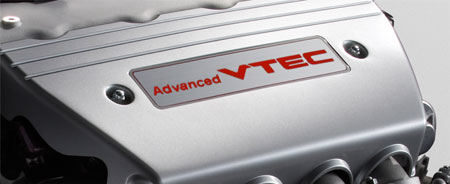
Honda has announced it’s next generation VTEC engine, the Advanced VTEC engine (AVTEC) which will make it’s debut in a production car within the next three years. Honda’s new Advanced VTEC (AVTEC) engine combines continuously variable valve lift and timing control with the continuously variable phase control of valve timing to achieve a good combination of better performance, fuel economy, and lower emissions. This is an improvement over the i-VTEC system which has preset changeover settings in valve lift – the new AVTEC system can adjust the valve lift continuously. There is also a variable-length intake manifold to improve intake airflow.
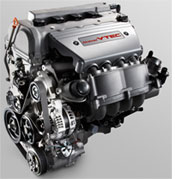 The Advanced VTEC (AVTEC) system allows optimum control over intake valve lift and phase in response to driving conditions for a significant increase in torque across the engine rev range. Under low and medium loads, the valves are set to have low lift and early closure – this reduces pumping losses and subsequently improves fuel economy.
The new AVTEC system will allow for a 13% improvement in fuel economy over the current i-VTEC range of engines. The 13% figure was obtained comparing the current K24A 2.4 litre i-VTEC engine with a new 2.4 litre AVTEC equivalent. Emissions are compliant with US LEV2-ULEV standards and Japanese Low-Emission Vehicles standards with levels 75% lower than 2005 standards.
 Honda WR-V
from RM94,900
Honda WR-V
from RM94,900  Honda Prelude
from RM278,000
Honda Prelude
from RM278,000  Honda HR-V
from RM115,900
Honda HR-V
from RM115,900  Honda e:N1
from RM149,900
Honda e:N1
from RM149,900  Honda Civic
from RM133,900
Honda Civic
from RM133,900  Honda City Hatchback
from RM85,900
Honda City Hatchback
from RM85,900  Honda CR-V
from RM178,200
Honda CR-V
from RM178,200  Honda Civic Type R
from RM399,900
Honda Civic Type R
from RM399,900  Honda City
from RM84,900
Honda City
from RM84,900 
 mits27 (Member)
on
mits27 (Member)
on 

 i'm run (Member)
on
i'm run (Member)
on  geforce (Member)
on
geforce (Member)
on  raybrig85 (Member)
on
raybrig85 (Member)
on  auctioncenter2u (Member)
on
auctioncenter2u (Member)
on  waimak (Member)
on
waimak (Member)
on  Khairy bin Tengku Ma (Member)
on
Khairy bin Tengku Ma (Member)
on  DarkL1ghT (Member)
on
DarkL1ghT (Member)
on  mycar_stolen (Member)
on
mycar_stolen (Member)
on  Hikaru (Member)
on
Hikaru (Member)
on  Zgriffin (Member)
on
Zgriffin (Member)
on  bobdbilder (Member)
on
bobdbilder (Member)
on  v0ices (Member)
on
v0ices (Member)
on  izham (Member)
on
izham (Member)
on  drM (Member)
on
drM (Member)
on  Ricc (Member)
on
Ricc (Member)
on  pirate (Member)
on
pirate (Member)
on  nutsaboutcars (Member)
on
nutsaboutcars (Member)
on  motorhead (Member)
on
motorhead (Member)
on  chris_the_germ (Member)
on
chris_the_germ (Member)
on  rexis (Member)
on
rexis (Member)
on  Whopper (Member)
on
Whopper (Member)
on  Joe Ooi (Member)
on
Joe Ooi (Member)
on  mystvearn (Member)
on
mystvearn (Member)
on  transformer (Member)
on
transformer (Member)
on  armandd (Member)
on
armandd (Member)
on  Isamu (Member)
on
Isamu (Member)
on  nissan130Y (Member)
on
nissan130Y (Member)
on  szw (Member)
on
szw (Member)
on  yytellmey (Member)
on
yytellmey (Member)
on  messiah (Member)
on
messiah (Member)
on  topgunthang (Member)
on
topgunthang (Member)
on  e-nabilll (Member)
on
e-nabilll (Member)
on  intakemanifold (Member)
on
intakemanifold (Member)
on  happymeal (Member)
on
happymeal (Member)
on  king (Member)
on
king (Member)
on  honda_driver (Member)
on
honda_driver (Member)
on  joekwong1 (Member)
on
joekwong1 (Member)
on  matmoto_5125 (Member)
on
matmoto_5125 (Member)
on  blackfox (Member)
on
blackfox (Member)
on  abu
on
abu
on  razi
on
razi
on  danwat1234
on
danwat1234
on  Abg
on
Abg
on  chris Raycraft
on
chris Raycraft
on  Amex
on
Amex
on
AI-generated Summary ✨
Comments show excitement and admiration for Honda's new AVTEC engine, highlighting its fuel efficiency and technological advancement over older VTEC and other foreign engines like VW and Toyota. Many appreciate Honda's continuous improvements and see AVTEC as a significant step forward, while some criticize Proton for lagging in technology, quality, and innovation. Patriotism appears in discussions, with calls for Proton to catch up, but overall, Honda's progress is viewed positively.