

Click to enlarge
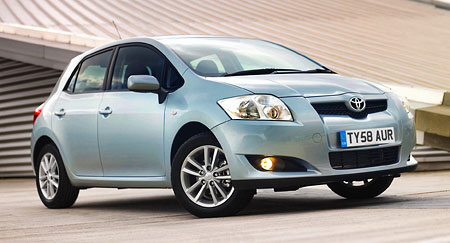
Toyota has replaced the 1.4 litre VVT-i engine (4ZZ-FE) in the Toyota Auris with a new 1.33 litre Dual VVT-i engine (1NR-FE) that produces more power, more torque, more mileage, less CO2 emissions, yet has a smaller displacement and also weighs 13kg less despite having a more complicated Dual VVT-i drivetrain, thanks to pistons that are 36% lighter among other improvements. It’s also more compact, and Toyota claims it is the same size as the inline-3 1.0 litre VVT-i engine.
The new engine also has stop-start capability, which automatically stops the engine when the car is stationary, the transmission is in neutral and the driver’s foot is off the clutch pedal. When the driver presses the clutch, the engine is restarted, and Toyota claims a potential fuel savings and CO2 reduction of up to 15% thanks to this.
For a smoother restart, Toyota says this new engine is 9dB quieter and 0.3 seconds quicker to start compared to the outgoing 1.4 litre engine.
The following is a comparison table between the two engines.
| 1.33L Dual VVT-i | 1.4L VVT-i | |
| Engine Code | 1NR-FE | 4ZZ-FE |
| Displacement | 1,329cc | 1,398cc |
| Power | 101hp @ 6,000rpm | 97hp @ 6,000 |
| Torque | 132Nm @ 3,800rpm | 130Nm @ 4,400rpm |
| Bore | 72.5mm | 79.0mm |
| Stroke | 80.5mm | 71.3mm |
| Compression | 11.5:1 | 10.5:1 |
| Combined economy | 48.7mpg | 40.9mpg |
| CO2 emissions | 135g/km | 163g/km |
With the new engine also comes a new 6-speed manual transmission with ratios to match the new torque curve. Both the 5th and 6th gear are overdrive gears for a reduced cruising engine RPM during highway driving. Toyota says this new transmission can handle more torque than the outgoing 5-speed unit and is 11% smaller and has 15% less components despite having one extra gear ratio.
All these improvements come with a price of course. The new Auris 1.33 litre models are on average about £200 more expensive than the outgoing 1.4 litre models.
Looking to sell your car? Sell it with Carro.
 Toyota Yaris Cross
from RM 99,900
Toyota Yaris Cross
from RM 99,900  Toyota Hilux
from RM 226,300
Toyota Hilux
from RM 226,300  Toyota Urban Cruiser
from RM 198,000
Toyota Urban Cruiser
from RM 198,000  Toyota bZ4X
from RM 220,000
Toyota bZ4X
from RM 220,000  Toyota GR Yaris
from RM 315,600
Toyota GR Yaris
from RM 315,600  Toyota GR Corolla
from RM 368,950
Toyota GR Corolla
from RM 368,950  Toyota Camry
from RM 221,800
Toyota Camry
from RM 221,800  Toyota Corolla Cross
from RM 133,800
Toyota Corolla Cross
from RM 133,800  Toyota Hiace
from RM 169,000
Toyota Hiace
from RM 169,000 
 DRC (Member)
on
DRC (Member)
on 

 m4xspeed (Member)
on
m4xspeed (Member)
on  voyager86 (Member)
on
voyager86 (Member)
on  ryan_foong80 (Member)
on
ryan_foong80 (Member)
on  myviRS (Member)
on
myviRS (Member)
on  ALPINA Burkard Bovensiepen GMBH + Co. KG (Member)
on
ALPINA Burkard Bovensiepen GMBH + Co. KG (Member)
on  Nakal (Member)
on
Nakal (Member)
on  LittleFire85 (Member)
on
LittleFire85 (Member)
on  denfire (Member)
on
denfire (Member)
on  onzetool (Member)
on
onzetool (Member)
on  ignas (Member)
on
ignas (Member)
on  BanyakMasukWorkshop (Member)
on
BanyakMasukWorkshop (Member)
on  droll (Member)
on
droll (Member)
on  IsaacVky (Member)
on
IsaacVky (Member)
on  realALPINAowner (Member)
on
realALPINAowner (Member)
on  pirate (Member)
on
pirate (Member)
on  jamsbong (Member)
on
jamsbong (Member)
on  goguncas71 (Member)
on
goguncas71 (Member)
on  si-fu (Member)
on
si-fu (Member)
on  MisterBenjo (Member)
on
MisterBenjo (Member)
on  Xx- Ferrari -xX (Member)
on
Xx- Ferrari -xX (Member)
on  mystvearn (Member)
on
mystvearn (Member)
on  mct (Member)
on
mct (Member)
on  madmarzio (Member)
on
madmarzio (Member)
on  awak (Member)
on
awak (Member)
on  tokmoh (Member)
on
tokmoh (Member)
on  csv (Member)
on
csv (Member)
on  isfufushah (Member)
on
isfufushah (Member)
on  SY0H (Member)
on
SY0H (Member)
on  neurra (Member)
on
neurra (Member)
on  torque (Member)
on
torque (Member)
on  autojohndoe (Member)
on
autojohndoe (Member)
on  Wonder
on
Wonder
on 


AI-generated Summary ✨
Comments express excitement and admiration for Toyota's new 1NR-FE 1.33L Dual VVT-i engine, highlighting its impressive technology, torque, and fuel efficiency. Some discuss its displacement notation, while others compare it to Proton's engines and the local fuel quality. A few mention the broader context of automotive advancements, vehicle pricing, and regional market differences. Overall, the sentiment is positive towards Toyota's technological progress, with some criticism of local market practices and fuel standards.