
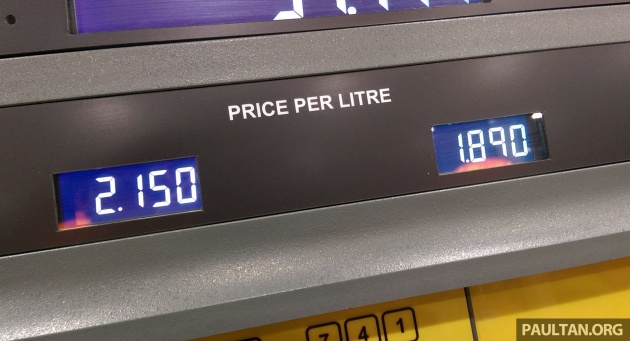
There will be no change to the current system of announcing fuel prices on a weekly basis until the government finds a better way of setting the retail price of fuel in a manner that will satisfy both consumers and petrol station operators, theSun reports.
According to domestic trade, co-operatives and consumerism (KPDNKK) minister Datuk Seri Hamzah Zainuddin, there will be no return to a monthly system. He said that he had been engaging with the Finance Ministry as well as stakeholders in the industry on the matter, and added that the search for a holistic solution that will satisfy everyone will continue.
He explained that the government is looking to find a method that will allow it to liberalise the industry to satisfy all parties, and this could also bring about prices being set on a daily basis, though he did not elaborate on the mechanics of this and how it would come about.


The weekly swing in retail prices of fuel has reportedly been causing headaches to petrol station operators, with many of them saying the losses will eventually cause them to give up the business. The latest fuel price announcement last Wednesday saw a fifth straight week of price decreases, with RON 95 going for RM1.89 per litre, RON 97 for RM2.15 and Euro 2M diesel for RM1.84.
Hamzah said that while public feedback he had received recently was positive, with many happy with the recent drop in petrol prices, the same could not be said about petrol station operators, who said they were stressed and anxious on Wednesdays when new prices were annnounced.
“There must be a win-win situation between oil companies, petrol station operators and the people,” he said.
Looking to sell your car? Sell it with Carro.

 Ditra
on
Ditra
on 

 Henry
on
Henry
on  Missing kunta mana
on
Missing kunta mana
on  Latuk Bandar
on
Latuk Bandar
on  Barang Naik Semua la
on
Barang Naik Semua la
on  Redidiot
on
Redidiot
on  sam lu
on
sam lu
on  gorgoyle
on
gorgoyle
on  Nasi Lemak John
on
Nasi Lemak John
on  john
on
john
on  Jimmy
on
Jimmy
on  Pink Diamond
on
Pink Diamond
on  Comment WIth Fact
on
Comment WIth Fact
on  1ntel Inside
on
1ntel Inside
on  lilytan
on
lilytan
on  everest
on
everest
on  drMpower
on
drMpower
on  bmpower
on
bmpower
on  Albert
on
Albert
on  12yrsold
on
12yrsold
on  Redidiot
on
Redidiot
on  Ah B
on
Ah B
on  Kotaraya
on
Kotaraya
on  Fizah
on
Fizah
on  Silthice
on
Silthice
on  ftw!
on
ftw!
on  Stevie
on
Stevie
on  Theresa July
on
Theresa July
on  BambangPamungkas
on
BambangPamungkas
on  Bat
on
Bat
on  david kam
on
david kam
on  ae101
on
ae101
on  Brent
on
Brent
on  AhKeong
on
AhKeong
on  alyy8128
on
alyy8128
on  Stargazer
on
Stargazer
on  xoxox
on
xoxox
on  zariffrayhan
on
zariffrayhan
on  thepolygonal
on
thepolygonal
on  arowana
on
arowana
on  applegreen
on
applegreen
on  C. P. MOHAN
on
C. P. MOHAN
on  liberato
on
liberato
on  zack
on
zack
on  john
on
john
on  passion
on
passion
on  Phillip Tan
on
Phillip Tan
on  The
on
The
on  Hmm... Much Hmm...
on
Hmm... Much Hmm...
on 


AI-generated Summary ✨
Comments show diverse opinions on fuel pricing, with some suggesting daily price adjustments or a market-based approach, while others criticize government transparency and planning. Several express frustration over perceived government dishonesty and lack of proper strategy, advocating for open-market solutions or fixed ceilings. There’s skepticism about fuel subsidies and concerns over business profitability, with some humor and sarcasm about the current system. Overall, comments reflect a desire for more transparency, market-driven prices, and less political interference.