
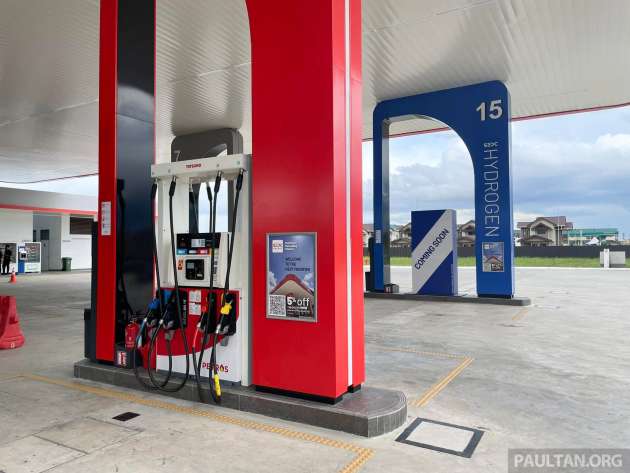
The first hydrogen refuelling stations and hydrogen public buses are expected to be operational in Peninsular Malaysia next year, the minister of science, technology and innovation said, reported The Star. With Sarawak already embracing hydrogen vehicles and trams, it was only proper for the peninsula to embark on a similar effort to tap into the clean energy source, minister Chang Lih Kang said.
“The peninsula is poised to establish its first hydrogen station next year, alongside the introduction of several hydrogen cars and public buses. Once the first hydrogen refuelling station is operational, we will introduce multiple hydrogen vehicles for trial runs and deploy public buses powered by hydrogen,” Chang told the daily.
The first hydrogen refuelling station is a collaboration between the Malaysian government and Gentari, the clean energy subsidiary of Petronas. The ministry has invested RM12 million in the hydrogen initiative, and reflects the government’s commitment to promoting sustainable and innovative energy solutions, the minister said.
He added that the importance of Malaysia’s hydrogen-based energy ecosystem would align with the national hydrogen agenda, and this would be outlined in the upcoming Hydrogen Economy and Technology Roadmap 2022-2050 (HETR). “Prime Minister Datuk Seri Anwar Ibrahim is set to launch HETR and the National Energy Transition Roadmap (NETR) in October,” he said.
The usage rate of battery-electric vehicles was not ideal, mainly due to charging and pricing concerns, Chang said, explaining the rationale behind Malaysia’s simultaneous focus on EVs and hydrogen-powered vehicles. “Therefore, the government is dedicated to the collaborative efforts of the public and private sectors, which will play a key role in achieving the nation’s target of establishing 10,000 charging stations across Malaysia by 2025,” he said.
“Hydrogen vehicles are gaining momentum, so while Malaysia continues developing EV technology, it does not deter the government’s strategic approach to growing green vehicles and fostering a sustainable and environmentally friendly transportation landscape in Malaysia, he added.
The HETR is structured in three phases; the short-term phase from 2022 to 2030 covering the 12th and 13th Malaysia Plans, the medium-term phase from 2031 to 2040 covering the 14th and 15th Malaysia Plans and the long-term phase from 2041 to 2050, covering the 16th and 17th Malaysia Plans, The Star reported.
In terms of petrol, MOSTI predicts that RON95 petrol with subsidies removed will cost RM2.75 per litre in 2030, increasing to RM4.02 per litre in 2040 and RM5.54 per litre in 2050, the report added. “In contrast, the price of green hydrogen per litre could be around RM5.22 in 2030, and when the technology matures, and usage expands by 2050, the price could go down further to RM3.50 per litre,” Chang said.
Looking to sell your car? Sell it with Carro.



My forecast is Hydrogen will be the future. EV will be current trend.
Current EV car will not be a good choice unless short distance traveling. For emergency distance, you will be in great headache. Battery need replacement every 10 years, you do the math.
You sound stupid Bobby. Hydrogen is the past. Its been done many decades ago and lost its traction. EV battery will only get more advanced. Smaller, lighter and durable. The LFP blade battery is already forecast to last more than 20 years. Its super durable and very hard to degrade. I see the only use of hydrogen is for you to breathe in as laughing gas so you can laugh at your stupidity all day. Hahahahahahahahaha
You are the stupid one & also the ignorant one. The hydrogen element has been the basis of energy creation in this universe since the beginning of time. The Sun & the stars have been fueled & are still being fueled by hydrogen.
A lot had been said about lithium battery technology but have they been proven as much in the long term in comparison to fuel cells which have been around for decades?
And proof of your stupidity & ignorance is further confirmed when you described using hydrogen as laughing gas, because in truth, laughing gas actually doesn’t contain a single hydrogen atom at all!
Wanna bet hydrogen for vehicle will fail again? If you lose your Lancho will become smaller and soft. If you say cars will be powered by uranium or other rare elements that generate unlimited power also I can believe. But hydrogen is a failure from the start. Not only hydrogen, we even tried kelapa sawit before but no traction. You think hydrogen power is a new thing? hahahahaha. So stupid la you.
Very low class, mindless, stupid comments. Shut the fuck up!!!
Hey Masami Wasabi, We already know your existence. Yay~ Im so hurt~~
You should stop trying to impress/convince everyone that you are very knowledgeable by mentioning uranium, rare elements or even kelapa sawit, because when you earlier tried to shame someone else’s intelligence, you unwittingly shamed your own intelligence by describing hydrogen as laughing gas, an error big enough to expose your own immense stupidity which has to be due to your brain having become smaller & softer.
Actually the first Hydrogen powered car was running back in 1966 ya which is long past and seems more like Hydrogen is becoming a trend again just because some manufacturer says they can make it great again just like our ICE was invented back in 1871.
Actually EV has also comes a long way in terms of running distance and battery tech will only improve further with the soon Solid State Battery.
Needs huge amount of energy to maintain temperature at −253 °C state of liquified hydrogen storage.
So those taxis running on compressed natural gas is cooled down to -253?
I donth think so
Couldn’t agree more with you Sir.
EV buzz currently is like the smokey haze, everybody jumping in on the bandwagon.
Hydrogen is the true sustainable future of mobility.
Calculate total cost to extract and transportation and storage of cryogenic hydrogen?
Honestly I have never heard of Malaysia plans to go Hydrogen until recently and that also thanks to Sarawak so I guess this another trend implementation? Also who uses Hydrogen powered vehicles in our SEA region and with the limited choices of Fuel Cell cars do one think it can be produced cheaply in economics of scale?
Also Chang didn’t TNB just last year said that Running an EV is between 11.4% to 28.3% cheaper than petrol vehicles using RON 95 – So guess that is purely based on Fantasy Stories by some Final Figure driving our heads.
MOSTI how do you predict the price of petrol until 2050??? Based on current demand when EV and green energy is being pushed hard by all including middle east so what makes you think supply and demand will still remain high? This is exactly like what we the Gen-Y study in our Geography stating that Petrol will run out by 2030 and look at where are we now.
HWere is the maths that says EV is 11%~28% cheaper?
10k stations by 2025?
Checked The Star, minister said 10k stations in the context of EV, not hydrogen. And I dont remember anyone saying we target to have 10k Hydrogen station by 2025. PT quoted wrongly or what
Yeah .. Way to go … something i look forward to.
Kasi kontrak to kuncu kuncu. Biasa lah no maintenance semua break down.
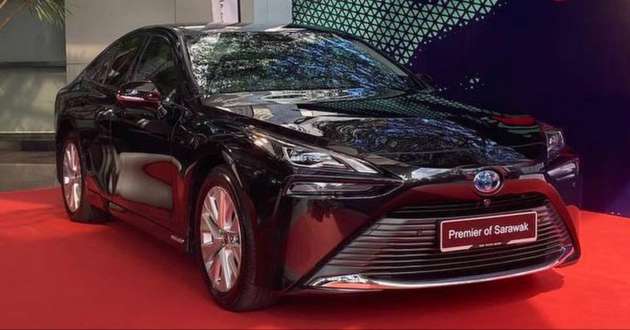
premier indah. Letak je la Ketua Menteri. Bukan ada faedah pun kpd rakyat sarawak
As he said if petrol will get less demand in the future, competing with EV, hydrogen fuel cell etc. The price of it should come down, not go up.
Hydrogen can be extracted from the air through cryogenic distillation or get a cut of cracking from processing the crude oil. Crude will still be relevant in many commodities.
Hydrogen is dead…it will be like the rare NGV.
Sarawak has to use alternative energy to power up our plants and machinery. We are at the mercy of Malaya’s Petroleum Act 1974, where Taib gave away our natural resources rights. Profit from Oil and Gas are used to develop Malaya, with the reason of more population, when tax are divided equally among 13 states. Only, with hydrogen, Sarawak will be less dependable and stop begging for more fund to develop Sarawak. Plus, Malaya is not politically stable to set long term policy. Sarawak Hydrogen is Green Hydrogen.
Hydrogen is a good alternative compare to EV because refueling the car is as fast as petrol and you promise clean energy.
However there are serious challenges which was not spoken out here. 1. The engine use for hydrogen power vehicle is very complex and require more spare parts for maintenance compare to ICE 2. Safety is a concern if the tank is rupture. Explosion of hydrogen is very serious and can cause massive damage all around recently us hydrogen refueling station exploded . 3. Harvesting hydrogen through electrolysis is very expensive and emery consuming. The efficiency is about 50% and the energy use for electrolysis come from fossil fuel which in turn does not make it green.