
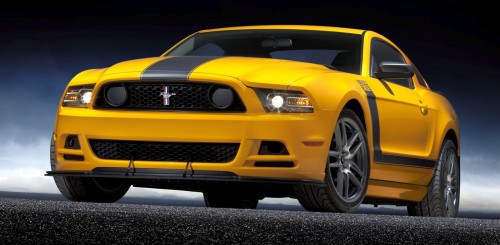
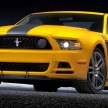
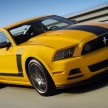
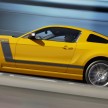
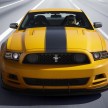
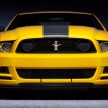
‘Tis the season to be draped in yellow – you’ve seen the Dodge Charger SRT8 Super Bee and the Challenger SRT8 392 Yellow Jacket, and now, here’s the 2013 Ford Mustang Boss 302. The edition – and the Boss Laguna Seca – features a heritage-inspired School Bus Yellow paint job that honours Parnelli Jones’ 1970 Trans-Am championship car prepared by Bud Moore.
The Boss 302 also features a new, reflective hockey stick graphics package, which gets its first modern application on a production car, the company says. The reflective stripes – which follows the classic hockey stick motif by going over the fender and extending down the body panel – come to life when lights hit them, similar to how they did in 1970 on the Mustang Boss 302.
As for the Boss Laguna Seca, this one delivers race-ready suspension, aerodynamic details and a removed rear seat, and features new Sterling Gray accents and black paint offerings, complemented by hockey stick stripes and a grey interior rear cross-brace.
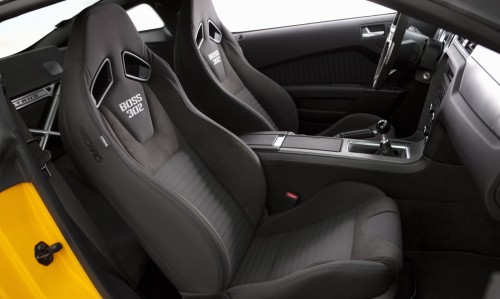
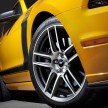
Grey is also to be found on the front grille, mirror caps and rear pedestal spoiler on this one, while Laguna Seca rear badging and unique two-tone gray and silver wheels round out the version’s exterior accents.
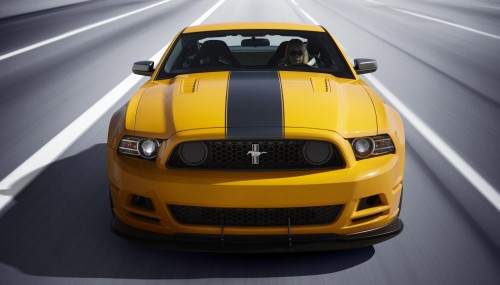
Compared to the base Mustang, the front end of the Boss offers a more powerful design with a more prominent grille, as well as a more powerful splitter and functional hood extractors. The car also gets new signature lighting, with standard HID headlamps and LED-surround taillamps.
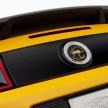
Elsewhere, the grille features removable covers where fog lamps would be – for improved cooling on track days, the covers can be easily removed with a screwdriver. Additionally, the rear end features a high-gloss black panel that connects the taillamps, which have a smoked finish.
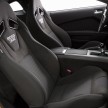
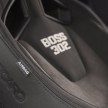
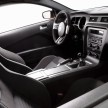
The 444 hp and 515 Nm Boss has a race-inspired clutch, with upgraded friction materials, and a short-throw, close-ratio six-speed manual. Power is delivered to a 3.73-ratio rear axle using carbon fibre plates in the LSD to improve handling and longevity, though an optional torque-sensing (Torsen) LSD is available, coupled with Recaro front seats.
The Boss also gets a revised suspension, with adjustable shocks and struts, higher-rate coil springs all around, stiffer suspension bushings and a larger-diameter rear stabiliser bar, and the Boss models are lowered by 11 mm in front and 1 mmm at the rear compared to the Mustang GT.
In line with the suspension upgrades, the Boss 302 wears lightweight 19-inch black alloy racing wheels in staggered widths, wrapped by Pirelli PZero 255/40 front and 285/35 rear rubbers. Four-piston Brembo calipers and 14-inch vented rotors up front and Boss-specific high-performance pads at the rear round off the items list.
Looking to sell your car? Sell it with Carro.
 Ford Mustang
from RM 461,271
Ford Mustang
from RM 461,271  Ford Ranger Raptor
from RM 248,888
Ford Ranger Raptor
from RM 248,888  Ford Everest
from RM 266,388
Ford Everest
from RM 266,388  Ford Ranger
from RM 115,888
Ford Ranger
from RM 115,888 


crut!! crut!! crut!! i’m squirting
With this car, now you can drive LIKE A BOSS!
Nice to see the reincarnation of Larry Shinoda’s Boss 302. The rumble of the V8 must be very musical to the ear.
Unfortunately in the land where cars are taxed based on engine capacity, all these will remain academics. :(
Exactly dude,i agree with you.Shinoda must be proud.I had the original 69′ Boss 302 in Grabber Orange as driven by Parnelli Jones(In the Trans Am and SCCA race series)when i was in the States.What a ride!
Anything more than 4000rpm in first gear will result in a plume of smoke,a vicious small block roar,2 black lines of at least 20 yards and a violent frontal shove.It will do the century in 5.4 secs(my fastest time)and the standing quarter mile in 12.5 secs@121mph(mildly tuned@480bhp at the wheels)on street legal road spec radials,not slicks.Even then it will chirp the tyres all the way to the end of the quarter mile right up to 4th gear on Ford’s Top Loader 4 speed.I really loved that car.What a ride!All muscle and attitude.I had for 10 years before i had to sell it to get back home to Malaysia.It’s something i regret till this day…
They don’t make them like they used to bro,this late model Stang is a decent interpretation of the original legend and we all know all too well that we will never see this ride over here though.Nice effort by the Blue Oval boys anyway.
Cheers.
MUSTANG, CAMARO,CHARGER,CHALLENGER ?
what is ur choice?
btw, who’s that yellow Camaro always been seen around bandar putri puchong??
I’m more of a Blue Oval and Mopar clan dude.
I like the Stang and the Charger’s,Challenger’s,Super Bee’s and Roadrunner’s.
All of which i have owned in States and many other muscle cars including Corvettes.
Cheers.
A car worth saying, “MOTHER OF GOD!”….