
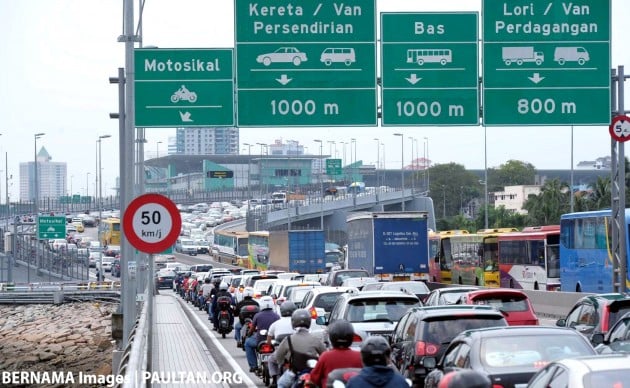
The Singapore Land Transport Authority (LTA) has confirmed that beginning February 15, 2017, all foreign-registered cars will have to pay a higher reciprocal road charge (RRC) of SGD6.40 (RM20) when they enter Singapore via the Tuas or Woodlands Checkpoints, Channel NewsAsia reports.
This confirms earlier reports that Singapore will match Malaysia’s recent implementation of a RM20 road charge, which was implemented on November 1 last year, the LTA said. The road charge will be collected along with the daily Vehicle Entry Permit (VEP) fees, toll charges and fixed Electronic Road Pricing (ERP) fees upon departure at the Tuas or Woodlands Checkpoints.
Motorists can pay for the applicable charges with their Autopass card or CashCard at the immigration booths. Those who attempt to evade payment could face a fine of SGD50 (RM156) for a first offence and SGD100 (RM312) for a subsequent offence, while those who fail to pay the fine could be charged in court, facing a fine of up to SGD1,000 (RM3,125) or a three-month jail term.


Khaw Boon Wan, Singapore’s Transport Minister, previously stated that the country had a “long-standing policy” of matching any levy, tolls or fees charged by Malaysia at land checkpoints between the two countries, if it discriminates against Singapore-registered vehicles.
Meanwhile, Datuk Seri Liow Tiong Lai, Malaysia’s Transport Minister said the road charge was not discriminatory against Singapore-registered vehicles, and pointed out that Singapore had been charging Malaysian-registed cars for the past 44 years.
Looking to sell your car? Sell it with Carro.

 timbuktu
on
timbuktu
on 

 Kunta Kinte
on
Kunta Kinte
on  john
on
john
on  Neutral
on
Neutral
on  Facebook
on
Facebook
on  Amriji
on
Amriji
on  Stevie
on
Stevie
on  Kiasu no1
on
Kiasu no1
on  sugarhill
on
sugarhill
on  Don't panic, Ringgit will bounce back
on
Don't panic, Ringgit will bounce back
on  songeng
on
songeng
on  Mikey
on
Mikey
on  Elchino
on
Elchino
on  john is otak batu
on
john is otak batu
on  KR
on
KR
on  Dedak in the house
on
Dedak in the house
on  Hot dog
on
Hot dog
on  Rip
on
Rip
on  DK
on
DK
on  Philip
on
Philip
on  Letstorqur
on
Letstorqur
on  Same Old Lousy Execution
on
Same Old Lousy Execution
on  ali
on
ali
on  DaveSter
on
DaveSter
on  ToHellWithPlagiarism
on
ToHellWithPlagiarism
on  Peter
on
Peter
on  Ben Yap
on
Ben Yap
on  Dibs
on
Dibs
on  Semi-Value (Member)
on
Semi-Value (Member)
on 


AI-generated Summary ✨
Comments reflect strong opinions on Malaysia's RM20 road charge, with some arguing it benefits Singapore due to their higher costs and better infrastructure, while others see it as unfair or purely revenue-generating. Several express frustration over Singaporeans crossing for cheap petrol and shopping, with accusations of discrimination and unfair treatment. There’s also discussion on broader issues like cross-border relations, workforce movement, and national sovereignty. Overall, sentiments are mixed, with some viewing the charge as justified and others criticizing it as a form of retaliation or economic discrimination.