
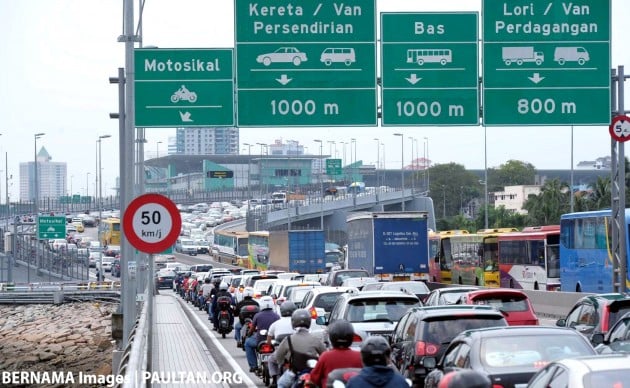
Singapore will soon match Malaysia’s RM20 road charge at the two land entry points to Johor “in some form”, according to a Bernama report. Singapore’s Ministry of Transport was quoted as saying that Malaysia’s road charge (RC) was “discriminatory against Singapore-registered vehicles as it is only applied at the Singapore checkpoints.”
Details will be announced by the republic in due course. Singapore’s Ministry of Transport had earlier said that the republic will continue to match any increase in Malaysia’s tolls.
However, Malaysian transport minister Datuk Seri Liow Tiong Lai said that the Malaysian government had never practised discrimination in implementing RC for foreign-registered vehicles from Singapore entering Malaysia, and it would implement the charge at entry points from other countries in phases.


“Singapore has been charging RC on us for decades. We are only about to start now. There is no discrimination. We will impose the road charge not only at our border with Singapore, but also our borders with Thailand, Brunei and Indonesia with a similar charge of RM20 per car,” Liow said. He also added that his counterpart in Singapore had been notified of the implementation of RC in advance.
As of 12:01am on November 1, drivers of Singapore-registered cars entering Johor either via the Causeway or the Second Link have been charged an additional RM20 fee, on top of checkpoint toll charges imposed by both Malaysia and Singapore. With the new charge, a round trip for a Singapore-registered car entering Johor will incur over S$19 (RM57) in fees.
Looking to sell your car? Sell it with Carro.

 dhl
on
dhl
on 

 Kunta Kinte
on
Kunta Kinte
on  Dedak in the house
on
Dedak in the house
on  john
on
john
on  Nancy
on
Nancy
on  Samlorh
on
Samlorh
on  pak atan
on
pak atan
on  Krasher
on
Krasher
on  Pondan lembik
on
Pondan lembik
on  Leonardo
on
Leonardo
on  kopiokaokao
on
kopiokaokao
on  x
on
x
on  Jack
on
Jack
on  Pity those Malaysian PR
on
Pity those Malaysian PR
on  ex-VGM staff
on
ex-VGM staff
on  kzm (Member)
on
kzm (Member)
on  Anonymous
on
Anonymous
on  Hot Cat not Hot Dog
on
Hot Cat not Hot Dog
on  ali
on
ali
on  Kenn
on
Kenn
on  Bahomet
on
Bahomet
on  FirYa
on
FirYa
on  DK
on
DK
on  Why
on
Why
on  4G63T DSM
on
4G63T DSM
on  Nex100
on
Nex100
on  Yong Tau Fu
on
Yong Tau Fu
on  Leafable
on
Leafable
on  seletar
on
seletar
on  reservoir
on
reservoir
on  Machoman
on
Machoman
on  BlurSotong
on
BlurSotong
on  KontiKinte
on
KontiKinte
on  Gaviny
on
Gaviny
on  Peter
on
Peter
on  Semi-Value (Member)
on
Semi-Value (Member)
on  a
on
a
on
AI-generated Summary ✨
Comments express mixed feelings about the road charge issue, with some supporting Malaysia's reciprocal charges, citing fairness and economic reasons, while others accuse Singapore of being unfair or hypocritical. Several emphasize the economic dynamics, with Singaporeans highlighting high local costs and Malaysians noting the impact on workers and cross-border trade. There's criticism of both governments' handling of the situation, with some viewing charges as discriminatory and others debating the fairness of the currency conversion. Overall, sentiments range from pragmatic to sarcastic and critical.