
The Malaysian government’s review of the East Coast Rail Link (ECRL) is not limited to its construction cost, but also includes the viability of maintaining the rail network, said finance minister Lim Guan Eng in a report by The Star.
“It must be noted that even if the rail project is completed, the operational cost will be very high to cover the project cost. Don’t even talk about capital expenditure, as we can’t even cover the operational cost, which is estimated to be RM600 million to RM1 billion annually,” the finance minster said in response to a question in Parliament.
Operational costs is a crucial factor in the government’s decision to review the ECRL project, and it is a “mega project that will result in a mega debt,” Lim added. Negotiations between the government and the Chinese project contractor, China Communications Construction Co Ltd (CCCC) are still ongoing.
However, no common point had been reached between the parties, even following the prime minister’s special representative Tun Daim Zainuddin’s visit to China. “The viability and feasibility of the project remains the biggest question,” he said. The finance minister also said that the government will adhere to the provisions under the Land Acquisition Act for land that was acquired for the ECRL.

The Malaysian government will assist only locals affected by the suspension of the project, a decision which was made on July 3 following advice from the Attorney General; the immediate stop-work order was done in order to put a halt to the government having to make progressive payments to the Chinese contractors.
The actual cost of completing the project was RM80.92 billion, instead of the RM55 billion figure as announced by the previous government, Lim said. Launched in August 2017, 85% of the project’s cost was funded by the Export Import Bank of China (EXIM), while 15% was funded by Islamic bonds.
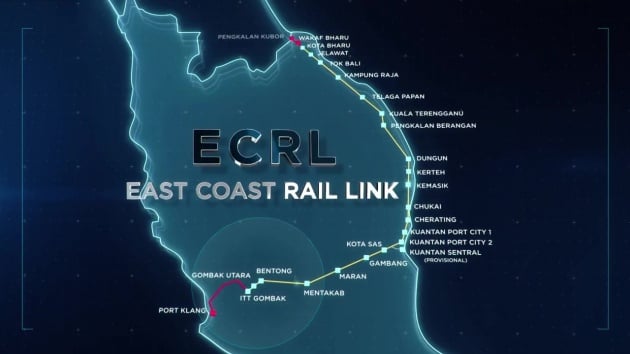
Initially, the railway was to consist of two phases; Phase 1 with 21 stations along a 600.3 km line, connecting Kota Bharu in Kelantan to the Integrated Transport Terminal Gombak (ITT Gombak) in Selangor – a future interchange for the Kelana Jaya LRT line – and Phase 2, which comprises 88 km of combined track from Gombak North to Port Klang, and an extension link between Kota Bharu and Pengkalan Kubor.

Another excuse to price up but call it cost down activities. Expect another Kawan to benefit from this.
Just look at Kota Bahru to Wakaf Bharu. 18KM = 18Billion. Why?
Have you been to Wakaf Bharu? You think its flat land as far as eye can see ke? Do you know geography prepping?
Leave the plan alone but cut down the number of stations, only to be built later when the financial situations allows.
Its time to bash LGE/Pakatan Gomen for flip-flopping john. Give it your best shot bcoz the people here love your bashing.
Not just me only lor. The rakyat r angry at getting shortchanged but paying more. In other countries, its called a scamgame.
See on the route. ECRL is just another alternate route for Karak. I prefer they expand the existing route from northern states to west coast states better. And introduce route from southern direct to west coast state through west coast of Pahang.
It will actually may reduce karak highway usage as it split to additional northern and southern getaway especially during Hari Raya
Karak is hiway, ECRL is rail. Not exactly same same. But it will be useful to some during festivals.
Gomen gonna repeat the same measures… cut down number of stations… cut down number of trains sets… then call it success in reducing cost. This would lead to inefficiency and more cost in the future. But they don’t care. Idiots.
assuming government were to go ahead with the high cost, care to elaborate where the money should come from?
Ask what have you done for the country and how much have you paid to the country rather than always asking goodies from the government. It is attitude like yours which have cost our country to bleed for the past 60 years
Its oredy explained here (https://paultan.org/2018/04/12/china-gave-the-best-deal-for-ecrl-project-pm-najib/)
Ignoramuses such as -well- you, are the ones that cost us to bleed for the past 60 years.
Lol you meant what Najib said “For seven years, there is no need to service the loan. By then, the ringgit would have appreciated, and the interest would be almost negligible”
Other than that don’t see how Najib addresses how the previous corrupted government mentioned how they going to cover the operational cost.
You must be kidding me if that’s how you think business can cover their cost by hopping MYR to appreciate, such ignorant fool
Costs of the ECRL can be recouped through other means.
Once economic development of the East Coast takes root, the taxes they receive can easily pay the project cost, as well as the operation costs.
It’s a long term thing, so why only think in the short term….
From the way I see it, Gov should split the entire project into stages stretched into a decade or two. The only possible daily use for this track at this moment is for cargo freight. The best option is to bypass the stops in between kl-kuantan port-kuala terengganu-kota bharu. Focus on building trade in those hubs, less stops means quicker logistics, then only focus on passengers. This will also build a lot more localized service businesses, where localized logistics experts can run supply lines between the hubs, creating more higher income jobs and businesses at those areas.
I believe that tourists won’t be bothered to train to those areas, a quick search over the internet and they will always choose to fly, bus or drive there. A seasoned traveler myself, I would avoid taking a train to a place that lack on demand public commute for food, sundries, entertainments and emergency services.
This would mean that locals are the main commuters on those tracks, but as I’ve already subtly pointed out, it’ll always be far cheaper to fly or bus to other destinations than train. Unless it’s a maglev train that gets us from Kota Bharu to KL in under 2 hours.
During peak season especially raya time took me minimum 16 hours for me to go back to kota bharu, very tiring and stressfull driving, ECRL can be alternative transportation to go back home. i hope the government will proceed with the project maybe by reduce scope of work.
Generally, no matter ECRL or any other rail infrastructure, at the very least , it’s a low carbon emission transportation that is environmental-friendly. Take a look our country ownership of car that is increasing day by day, causing more carbon emission and air quality is getting poor due to too many cars on the road. The rail infrastructure will reduce all these problem as long the location of the station is strategic for travel. Moreover, I do think investing on ECRL to boost the time travel and reduce by more than 60% of the original time travel is vital , it is good for local business, tourism and many more , you name it, it’s not just for Hari Raya though, it’s existed with a special purpose , to connect tightly with East Coast and West Coast.