
In March last year, the government – under the previous administration – reiterated its aim to have 10,000 electric vehicle (EV) charging stations in place by 2025, as initially outlined in 2021 under the Low Carbon Mobility Blueprint (LCMB) 2021-2030.
These would be made up of 9,000 units of alternating current (AC) chargers and 1,000 units of direct current (DC) fast chargers. At that juncture, there were around 600 EV public charging points in the country.
Earlier this year, the investment, trade and industry ministry (MITI) said that another 4,000 charging points were expected to be put in place in 2023, but at last count, the number was just over 1,000, which has led to the question of whether the country will be able to meet the 2025 target.
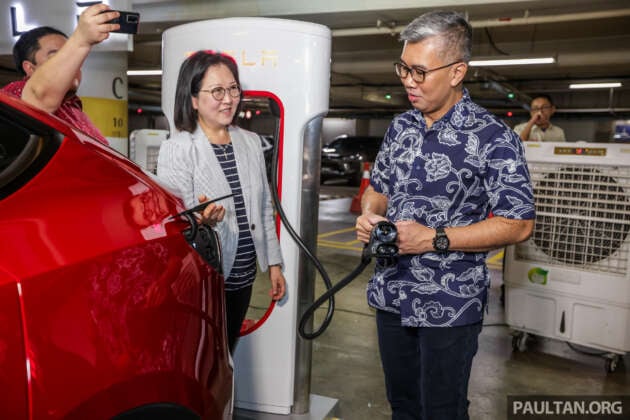
MITI minister Tengku Datuk Seri Zafrul Abdul Aziz believes that it can be met as a result of upcoming changes. Speaking on the sidelines of the Tesla Supercharger station launch at Pavilion KL last week, he said the government is in the process of speeding up the process to enable charge point operators (CPOs) being able to secure approvals for installation in far quicker fashion than that presently.
Right now, the primary bottleneck is the time needed to deploy a charging point – red tape and bureaucracy (approval from local councils, land owners etc) means that it takes eight to nine months for an installation to be made from start to finish, but he said this will soon change.
He said that a series of meetings held by the recently-appointed national EV steering committee (NEVSC), which was formed under the ambit of the national EV task force, is in the midst of speeding up the development process.

Having discussed the issue, he said that the various ministries, government agencies and even stakeholders are on the same page for the need to speed up the process, with the plan being to reduce the time needed from approval to charging by a third from what it is now.
“Everyone is on the same page to make sure we can expedite things and move faster. Led by the Malaysia Productivity Corporation (MPC), there will be an improvement in timelines. We are targeting to get it down to three months. That is what has been agreed on, and so now we are finalising and fine-tuning this,” he told paultan.org.
He added that despite the shortening of the timeframe, there would be no compromise on safety. “Of course, safety is paramount, and here, the government has to strike the right balance between what industry wants and what regulators feel is safe for consumers. We want to make sure the regulations are clear, but we have looked at other countries to learn from them, to see how it is done,” he said.
Looking to sell your car? Sell it with Carro.



Tq for allowing cheap Tesla prices
How about those staying in low cost flat but want to charge their EV at home??
If can afford EV shouldn’t be staying in low cost flats. Let the real poor people stay there la.
Good thing about our slow take off is that we can mix and match regulations from around the world. We also have the benefit of seeing what works and what does not and adapt accordingly.
Singapore mandates power provision, cabling routes and installation of chargers at new builds. For existing properties, laws to mandate, with MC approval, the same. Also specify the kind of charging standard used.
For UK, new draft law mandates uptime (99%!), online update on availability, contactless payment with sign-up requirements, etc. New builds are required to have EV points and also cable routes, renovated properties are also subject to the mandate.
Steal power from nearest lamp post or pull extension cord from our PPR units
what about upgrading the electricity grid? prepare for rolling blackouts
Will the installation of new power stations also sped up? Or where do the electricity will come from for 10,000 new chargers with up to 350kW each (together 3.5GW)?
want ppl to buy ev but all price damn high.