
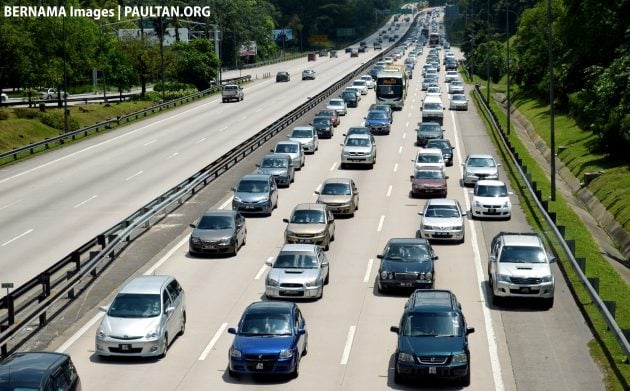
Traffic congestion in Kuala Lumpur, especially in the city centre, remains a long-standing issue, but the government says it is committed to resolve the matter and is engaging in discussions with stakeholders to seek ways to address the problem.
According to minister in prime minister’s department (Federal Territories), Dr Zaliha Mustafa, solutions are being looked at by the police and the Kuala Lumpur city hall (DBKL). Additionally, a Cabinet committee on traffic congestion has also submitted several suggestions regarding the issue, Bernama reports.
With about 1.3 million to 1.5 million vehicles recorded entering the city daily, she said the issue could be alleviated if more people chose to travel via public transport.
“We find that traffic congestion occurs at peak periods from 6am and during the rush hour home, and we know the sources of traffic congestion here usually involve motorists who commute to work and for other business, so I encourage the public to use public transport to reduce traffic congestion,” she said.
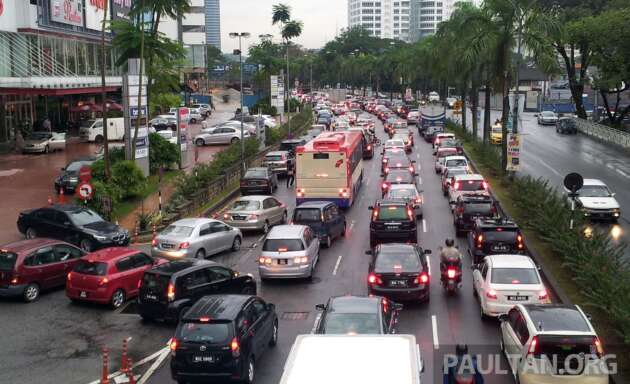
The level of traffic woes motorists face in KL is measurable. Last year, a TomTom Traffic Index report indicated that in 2022, KL drivers spent 159 hours on the road during rush-hour traffic in the city centre, 75 hours of which was due to congestion. It estimated drivers spent RM1,023 on fuel (RM221 due to congestion) and emitted 833 kg of CO2 (180 kg due to congestion).
In May 2022, DBKL said it was conducting a detailed study on how to reduce traffic congestion in KL. The council said that attention would be paid to certain aspects including traffic light coordination and parking management systems, which have disrupted traffic flow.
One solution is to impose vehicle congestion charges, but that is still a long way from becoming a reality, as it has been stated that congestion charges for KL will only be considered after the MRT3’s completion in 2030, with the fee structure for vehicles entering the city to only be looked at when the public transport network system was fully completed

 Eazy
on
Eazy
on 

 Heavy Traffic
on
Heavy Traffic
on  Dah Menang Semua
on
Dah Menang Semua
on  re
on
re
on  Rakyat Malaysia
on
Rakyat Malaysia
on  The real Malaysian Citizens
on
The real Malaysian Citizens
on  Fake News
on
Fake News
on  Gomorrah
on
Gomorrah
on  seitha
on
seitha
on  When to scrap old cars??
on
When to scrap old cars??
on  meladam
on
meladam
on  Tireman
on
Tireman
on  Lanhb
on
Lanhb
on  Azmir
on
Azmir
on  plakat
on
plakat
on  118Petaling
on
118Petaling
on  far east
on
far east
on  ROTI CANAI
on
ROTI CANAI
on  someone
on
someone
on  AutoFrenz (the original)
on
AutoFrenz (the original)
on  Ex PH Supporter
on
Ex PH Supporter
on  Stay at Semenyih
on
Stay at Semenyih
on  dong gor
on
dong gor
on  dong Gor
on
dong Gor
on  Din
on
Din
on  Peppa
on
Peppa
on  beep beep
on
beep beep
on  anonymous
on
anonymous
on  minahlokal
on
minahlokal
on  Thana
on
Thana
on  Rempit king
on
Rempit king
on  robert moses
on
robert moses
on  Eyo
on
Eyo
on  Gridlock
on
Gridlock
on
AI-generated Summary ✨
Comments highlight that KL traffic congestion persists due to too many cars, illegal parking, road design issues, and insufficient public transport. Suggestions include raising car ownership costs, implementing congestion charges, improving last-mile public transport, and building more elevated highways. Many emphasize the need for better urban planning, pedestrian infrastructure, and regional coordination. Some criticize current policies as ineffective or politically motivated, advocating for long-term solutions rather than temporary sacrifices or short-term fixes.