
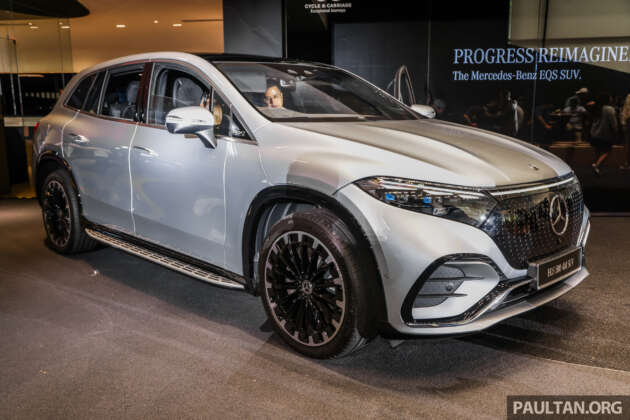
Mercedes-Benz has reportedly cancelled development of its MB.EA Large platform for large electric vehicle models, originally planned to form the basis of EV models such as the successors to the current EQS, EQE and their SUV derivatives, according to Autocar citing a Handelsblatt report.
The decision to cancel further development of the MB.EA Large platform was reportedly made due to poor sales of the current EQS and EQE models, and the halting of development and infrastructure changes at the carmaker’s production sites that would have been required for the new platform are estimated to bring investment savings of between four to six billion euros (RM20.4 billion to RM30.6 billion), it said.
Two versions of the MB.EA platform were originally planned, these being the MB.EA Medium for the upcoming EQC sedan and SUV, and the aforementioned MB.EA Large for the larger, luxury-oriented models. As such, successors to models such as the S-Class, GLS, GLE and GLE Coupé are expected to be developed on an updated version of the existing MRA platform.


With the reported cancellation of the latter, Autocar understands that Mercedes-Benz intends to develop the EVA2 platform further for future deployment, where an 800-volt electrical architecture will succeed the current 400-volt setup. Other developments for the EVA2 platform include new battery cell technology and more efficient motors for increased range, Autocar reported.
Aside from the MB.EA Large platform, Mercedes-Benz appears to have firm plans for platforms including the MMA for compact EVs, the MB.AMG for its sports car range, and MB.VAN for commercial vehicles, it continued.
The MMA platform is to underpin the next-generation successors to the CLA and CLA Shooting Brake, GLA and GLB, while sharing its electric drivetrain architecture with the MB.EA Medium platform.
The decision to cancel further development of the MB.EA Large platform is part of a wider realignment of the German carmaker’s development plans, as it had pushed back on its electrification targets of achieving 50% BEV and PHEV sales by 2025, to 2030, where market conditions allow.
Looking to sell your car? Sell it with Carro.



Actually they dont need to developed new platform, since most EV battery has intergraded cell to body structure, cheaper just to buy the whole platform form battery company like BYD or CATL..
EV is not a long term solution, event BMW one step a head switch to Hydrogen fuel…
Your sun going to send human species back to stone age very soon. Prepare to learn how to ride donkeys and navigate buffalo carriage ok.
Got tesla who mau mercedis. Boikot yahudi.
One giant has fallen. Electric Large SUVs have not yet reached the optimum efficiency. Maybe in future they will come back with a more efficient battery or motors. Still waiting for Volvo EX90 reviews to know whether its a flop or not.
the masterminds behind the “EV concept” made their money, now no body cares !
All EQ models are ugly. No wonder poor sales. Failed designs.
Agreed. Hideous & monstrosity.