
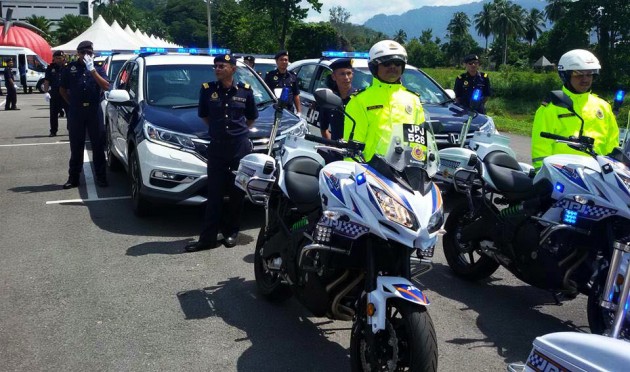
The Road Transport Department (JPJ) has launched its fleet of new vehicles that is aimed at enhancing its services nationwide. The new assets, which are comprised of various types of vehicles were procured with a cost of RM22 million.
Among the new vehicles that are a part of the new vehicle fleet include 80 Honda CR-Vs, 71 Ford Rangers, 14 Ford Transits and for the first time ever, the JPJ will use high-powered motorcycles with 20 Kawasaki Versys 650s being deployed as well.
Present at the launch was Transport Minister Datuk Seri Liow Tiong Lai, who highlighted the various applications of the vehicles. “In order to reach more areas, JPJ will use the robust Ford Ranger,” he told The New Straits Times


On the usage of the Kawasaki Versys 650s, Liow said, “the addition of the motorcycles will allow our JPJ officers to beat traffic congestion, allowing them to solve any issues on the road quickly.” Of the 20 units, half will be used by the Selangor JPJ, while the KL JPJ will receive deliveries of the remaining 10.
“We also plan to use more high-powered motorcycles in large cities such as Ipoh and Johor Bahru next year based on the needs and available funds,” he added. The new fleet of vehicles will expand the JPJ’s arsenal, which also include 14 mobile units that offer eight services including licence and road tax renewals, and the transfer of vehicle ownership.
Liow was also present to officiate the launch of the ‘Jom JPJ‘ programme at the Bentong Bus Terminal. The campaign is part of the Department’s initiative to provide its services to Malaysians who are living in rural areas during weekends. Recently, the Kuala Lumpur City Hall (DBKL) has begun using electric vehicles (Renault Twizy and “electric chariots”) for patrols.
Looking to sell your car? Sell it with Carro.
 Ford Ranger Raptor
from RM 248,888
Ford Ranger Raptor
from RM 248,888  Ford Everest
from RM 266,388
Ford Everest
from RM 266,388  Ford Ranger
from RM 115,888
Ford Ranger
from RM 115,888  Ford Mustang
from RM 461,271
Ford Mustang
from RM 461,271 
 sudonano (Member)
on
sudonano (Member)
on 

 Open Letter to JPJ Boss
on
Open Letter to JPJ Boss
on  Same L0rrrr
on
Same L0rrrr
on  hailthepurist
on
hailthepurist
on  Joey
on
Joey
on  TYpical
on
TYpical
on  =O
on
=O
on  zulmaksom
on
zulmaksom
on  ben yap
on
ben yap
on  rewq
on
rewq
on  siliauhakkacommunity
on
siliauhakkacommunity
on  mig29_ria
on
mig29_ria
on  Donald
on
Donald
on  Janji najix tak ditunaikan,penipu Rakyat!
on
Janji najix tak ditunaikan,penipu Rakyat!
on  nabill (Member)
on
nabill (Member)
on  TopsyBoXyTurvy
on
TopsyBoXyTurvy
on  alldisc
on
alldisc
on  Lalang
on
Lalang
on  kazanixm
on
kazanixm
on  Gill
on
Gill
on  Pak Musang
on
Pak Musang
on  Ootai
on
Ootai
on  mr_em
on
mr_em
on  St
on
St
on  Sam Sempoi
on
Sam Sempoi
on  lcms
on
lcms
on  CCTV
on
CCTV
on  sparcov
on
sparcov
on  old dog
on
old dog
on  Danny
on
Danny
on  Tree Hugger
on
Tree Hugger
on  LOL bro
on
LOL bro
on  1Kangkung Malaysia
on
1Kangkung Malaysia
on  tttm
on
tttm
on  Rusmah
on
Rusmah
on  Mr.chairman
on
Mr.chairman
on  bibo
on
bibo
on 


AI-generated Summary ✨
Comments largely reflect disappointment and criticism over the RM22 million expenditure on new vehicles for JPJ, with many arguing it's an unnecessary waste of public funds. Some feel the vehicles are excessive and question the need for high-powered bikes and SUVs, suggesting these funds could be better spent on public services like healthcare or infrastructure. There is also concern about corruption within JPJ, skepticism about the practicality of the fleet, and questions about the use of local products, with many expressing frustration over perceived misallocation of resources.