
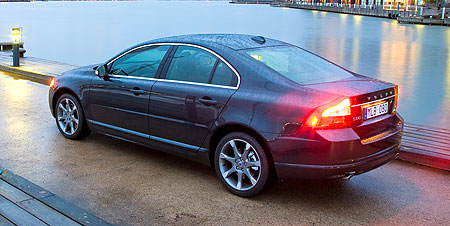
Sabah Chief Minister Datuk Seri Musa Haji Aman says his government has switched from the Proton Perdana V6 Executive to new “black Volvo 2.5” cars as the state’s new official cars. Once again as with Perak (Camry) and Terengganu (Mercedes-Benz E200K), the reason given was the high maintenance cars for the Perdanas.
He says the arrangement for the purchase is through a company called Angkatan Hebat Sdn Bhd (a company which the state government holds 70% of through its Warisan Harta Sabah Sdn Bhd investment arm), which will then lease the cars to the state.
The Perdana V6 is still in use as official cars for some senior officers including permanent secretaries and heads of departments. The new imported Volvos are for the 12 Sabah Ministers only. A 2.5 litre Volvo sedan would most likely point to the Volvo S80, the 2.5T model in particular, which offers an effortless drive thanks to its torquey 2.5 litre inline-5 turbocharged engine. The Volvo S80 2.5T has also been spotted being used by the PDRM as part of its police car fleet. But if it is not a sedan (New Sabah Times sources only revealed it was a “car”, did not specify any bodyshape), an XC90 would make sense.
The only question right now is, how will the S80s be maintained well when according to the Volvo Cars Malaysia “Find A Dealer” page, there are no authorised dealers or service centers in Sabah? I hope Volvo Cars Malaysia will be able to provide training to Angkatan Hebat technicians or some other kind of arrangement, otherwise it might end up being “high maintenance” all over again. A quick check with Angkatan Hebat’s company profile (page 14) shows it already maintains a fleet of 38 Volvos and 14 service centers around Sabah so hopefully it should be sufficiently equipped.
Looking to sell your car? Sell it with Carro.
 Volvo ES90
from RM339,888
Volvo ES90
from RM339,888  Volvo XC60
from RM333,888
Volvo XC60
from RM333,888  Volvo XC90
from RM418,888
Volvo XC90
from RM418,888  Volvo EX90
from RM442,888
Volvo EX90
from RM442,888  Volvo EX30
from RM208,888
Volvo EX30
from RM208,888  Volvo EC40
from RM248,888
Volvo EC40
from RM248,888  Volvo XC40 Recharge Electric
from RM278,888
Volvo XC40 Recharge Electric
from RM278,888  Volvo XC40
from RM268,888
Volvo XC40
from RM268,888 
 adunadun (Member)
on
adunadun (Member)
on 

 chee89 (Member)
on
chee89 (Member)
on  HMMaster (Member)
on
HMMaster (Member)
on  delos3nos (Member)
on
delos3nos (Member)
on  Jomo (Member)
on
Jomo (Member)
on  db8 (Member)
on
db8 (Member)
on  Paul Tan
on
Paul Tan
on  jolly_idiot (Member)
on
jolly_idiot (Member)
on  8lways (Member)
on
8lways (Member)
on  e-nabilll (Member)
on
e-nabilll (Member)
on  4x4Fan
on
4x4Fan
on  9166 (Member)
on
9166 (Member)
on  bobdbilder (Member)
on
bobdbilder (Member)
on  haroldz (Member)
on
haroldz (Member)
on  BanyakMasukWorkshop (Member)
on
BanyakMasukWorkshop (Member)
on  biggie (Member)
on
biggie (Member)
on  tanasi (Member)
on
tanasi (Member)
on  Gun (Member)
on
Gun (Member)
on  raverus (Member)
on
raverus (Member)
on  lembagatanah (Member)
on
lembagatanah (Member)
on  p1basher (Member)
on
p1basher (Member)
on  lambov12 (Member)
on
lambov12 (Member)
on  sudha (Member)
on
sudha (Member)
on  normaluser (Member)
on
normaluser (Member)
on  rexis (Member)
on
rexis (Member)
on  WilliamSmith (Member)
on
WilliamSmith (Member)
on  BB (Member)
on
BB (Member)
on  painsama (Member)
on
painsama (Member)
on  whiteeye (Member)
on
whiteeye (Member)
on  theanswer (Member)
on
theanswer (Member)
on  shamel (Member)
on
shamel (Member)
on  not_ah_beng (Member)
on
not_ah_beng (Member)
on  protonundertaker (Member)
on
protonundertaker (Member)
on  nikanasz (Member)
on
nikanasz (Member)
on  Encik Ali (Member)
on
Encik Ali (Member)
on  mukhri88 (Member)
on
mukhri88 (Member)
on  shianghorng (Member)
on
shianghorng (Member)
on  mystvearn (Member)
on
mystvearn (Member)
on  s60t (Member)
on
s60t (Member)
on  7213209 (Member)
on
7213209 (Member)
on  kickurs (Member)
on
kickurs (Member)
on  mervynv (Member)
on
mervynv (Member)
on  RX-ate (Member)
on
RX-ate (Member)
on  Ralliace (Member)
on
Ralliace (Member)
on  YennaDey
on
YennaDey
on  cicak (Member)
on
cicak (Member)
on  Sex is wonderful, bu (Member)
on
Sex is wonderful, bu (Member)
on  fickybabe (Member)
on
fickybabe (Member)
on  Pete
on
Pete
on  i-h
on
i-h
on  Man with dreams
on
Man with dreams
on 


AI-generated Summary ✨
Comments express mixed feelings about Sabah's government replacing Perdana with Volvos, citing concerns over government spending, road suitability, and the timing amid economic conditions. Some highlight Sabah's land wealth and infrastructure development, while others criticize the luxury cars as unnecessary or wasteful. Several comments defend the choice, citing terrain adaptability and loyalty to local businesses. Overall, sentiments range from support to skepticism, emphasizing the need for responsible spending and better infrastructure, with some pointing out the political and economic context.