
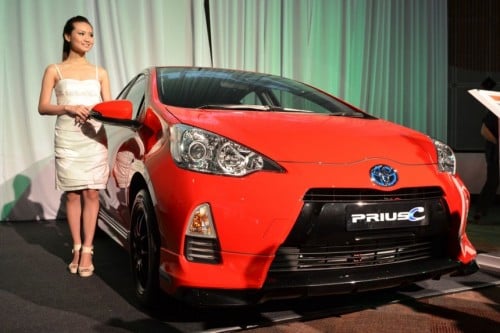
The Prius c has been a hit for Toyota, and the company can’t make enough of them. Toyota is shipping just 6,000 units of the compact hybrid to North America per month, which is not enough to satisfy demand, but that number is set to grow by mid 2012. The Prius c went on sale domestically in December last year, and hits US showrooms this month.
Supply constraints and soaring domestic market demand is keeping supplies low for the rest of the world. In Japan, the small car known as Aqua has racked up a big backlog of 120,000 orders. The rising yen (against USD) is also affecting profit margins for US sales, so it makes sense for Toyota to focus on fulfilling local orders.
The Prius c is exclusively made in Iwate, northern Japan, at a plant run by Toyota affiliate Kanto Auto Works Ltd. Kanto president Tetsuo Hattori revealed that the company is currently working on rolling out more units of the small Prius.
Besides improving efficiency that will increase overall capacity, the plant will gradually shift production of the JDM Toyota Ractis to a sister plant in Higashifuji from May. The freed up capacity will be used to make more Aquas.
Kanto’s Iwate plant makes about 30,000 units of the Prius c units a month. The annual rate of 360k units is already up from the originally planned 240k units, and it accounts for 80% of total plant output. Besides the Prius c and Ractis, the facility also produces the Toyota ist (called Urban Cruiser in UK and Scion xD in USA), Belta (we’re very familiar with this, the Vios) and the Blade hatchback.
The Prius c was launched in Malaysia last month, click here to read our launch report.
 Toyota Yaris Cross
from RM99,900
Toyota Yaris Cross
from RM99,900  Toyota Hilux
from RM226,300
Toyota Hilux
from RM226,300  Toyota Urban Cruiser
from RM198,000
Toyota Urban Cruiser
from RM198,000  Toyota bZ4X
from RM220,000
Toyota bZ4X
from RM220,000  Toyota GR Yaris
from RM315,600
Toyota GR Yaris
from RM315,600  Toyota GR Corolla
from RM368,950
Toyota GR Corolla
from RM368,950  Toyota Camry
from RM221,800
Toyota Camry
from RM221,800  Toyota Corolla Cross
from RM133,800
Toyota Corolla Cross
from RM133,800  Toyota Alphard
from RM548,000
Toyota Alphard
from RM548,000 
 Name
on
Name
on 

 samlyn
on
samlyn
on  Honda Power
on
Honda Power
on  paparadzi
on
paparadzi
on  shin
on
shin
on  Car Driver
on
Car Driver
on  bobdbilder
on
bobdbilder
on  keringkontang
on
keringkontang
on  CK
on
CK
on  Hyundai De La Junk
on
Hyundai De La Junk
on  blackbox
on
blackbox
on  Kampung
on
Kampung
on  littlefire
on
littlefire
on  snaz1 go
on
snaz1 go
on  kzm
on
kzm
on  sure
on
sure
on  aliphatic
on
aliphatic
on  originals
on
originals
on  Right Hand Drive
on
Right Hand Drive
on  WOW
on
WOW
on  papa rich mama shop
on
papa rich mama shop
on  Vin
on
Vin
on  hway de Cruz
on
hway de Cruz
on  snaza go
on
snaza go
on  i
on
i
on  Leong Teong Malam
on
Leong Teong Malam
on  Ajaw
on
Ajaw
on  What?
on
What?
on  Director
on
Director
on  oblong
on
oblong
on  FinancialGuru
on
FinancialGuru
on  kerelbort
on
kerelbort
on  drooo
on
drooo
on  dreaming of maserati
on
dreaming of maserati
on  loveit
on
loveit
on  Trenebaumics
on
Trenebaumics
on  alpha999
on
alpha999
on  mkhor7
on
mkhor7
on  KC
on
KC
on
AI-generated Summary ✨
Comments reflect strong opinions on the Toyota Prius C, with some praising its fuel efficiency and market position, while others criticize its interior quality and high price. Several discuss environmental concerns related to rare earth metals used in hybrids, with mixed views on the Lynas issue and nuclear safety. There’s also criticism of Malaysian car pricing, and some off-topic comments on politics and other industries. Overall, there's a mixture of enthusiasm for the Prius C’s eco features and skepticism about its value and environmental impact.