
The government’s decision to continue with the Open Approved Permit (Open AP) system is in line with the major goal of the National Automotive Policy 2014 (NAP 2014), which is to strengthen bumiputera participation in the national economy, The Sun reports.
“The continuation of an Open AP system will allow the participation of new bumiputera companies in the industry. It will provide the mechanism to strengthen and enhance bumiputera participation and the current 36% bumiputera equity in the sector,” Ministry of International Trade and Industry (MITI) told the English language daily.
The email statement said that a certain amount of the fees collected from the continuation of the Open AP system will be allocated to implement measures that have been outlined in NAP 2014 to increase the competitiveness of bumiputera companies in technology, human capital and supply chain development.
According to The Sun, other concerns raised included the negative impact on the image of brands owned by original equipment manufacturers (OEMs), investment by OEMs, government income in terms of taxes, implication on other supporting industries and services sectors, Malaysia’s international commitment in World Trade Organisation and free trade agreements, and investments made by current AP holders.
MITI insisted that no one was left out during the review done by its consultant. “The consultant appointed for the study had consulted associations that represent various groups in the automotive industry such as assemblers, franchise holders and used-car dealers. Several major OEMs were also consulted. Thus, views and concerns of the industry were taken into consideration in the study/review,” the ministry said.
MITI revealed some of parties consulted, including groups such as the Malaysian Automotive Association (MAA), Kuala Lumpur & Selangor Car Dealers and Credit Companies Association and Persatuan Pengimport dan Peniaga Kenderaan Melayu (Pekema).
The ministry said it also met with OEMs such as BMW Group Malaysia, Honda Malaysia, Mercedes-Benz Malaysia and UMW Toyota Motor. Views from NGOs such as the Consumers Association of Penang (CAP), Majlis Tindakan Ekonomi Melayu and Yayasan Kepimpinan Perdana were also noted.
The AP system was introduced in the 1970s to encourage bumiputera participation in the used-car industry. It came into the spotlight a decade ago when it was revealed that a handful of individuals received the lion’s share of APs issued, and the “AP Kings”, as they were dubbed, monopolised the grey import industry.
MITI issues two types of APs – Franchise APs for official franchise holders of car brands (Honda Malaysia, Bermaz Motor and BMW Malaysia, for example) and Open APs for bumiputeras to import cars of any brand and type. The Sun says that latest figures by MITI showed that there are currently 100 companies holding Open APs and 22 companies given Franchise APs.
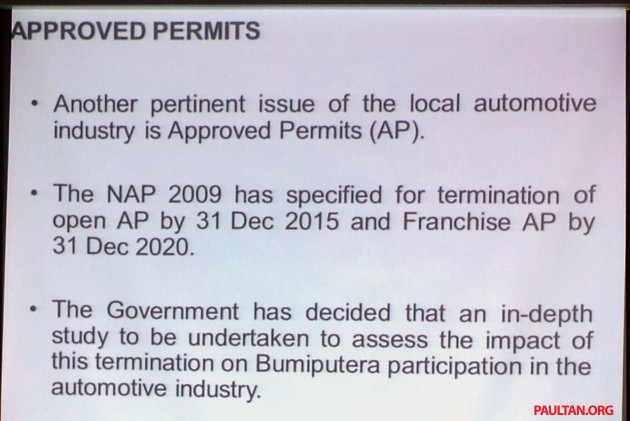
Previously, there were plans to phase out the system. The 2009 NAP mentioned that Open APs would be terminated by the end of 2015, and Franchise APs by end 2020. In NAP 2014, the government said that it would appoint a company to do an in-depth study on the impact of the termination of Open APs on bumiputera participation in the automotive industry.
On December 23 last year, days before the system would have been ended according to the original timeline, MITI announced that the Open AP policy will continue but with improvements to the current system. The improvements, which are yet to be disclosed, will take effect from January 1, 2017.
“The government will (also) launch a programme to use a portion of the open AP fees to enable the public to directly benefit from this new policy. The details of this programme will be announced later,” MITI said.
“The research team opined that the current Open AP system gives opportunities to the public to purchase used imported cars at a competitive price. They also found that the distribution and importation of used cars industry contributed significantly to the automotive industry and the country’s socio-economic development,” it added.
The ministry explained that the Open AP system’s contribution to supporting business and service sectors such as banking, insurance, shipping and logistics was estimated to be in the region of RM450 million per year, besides RM2 billion worth of taxes and fees to the government per year.
The system, which the Malaysian Automotive Institute (MAI) disagrees with, also directly provided jobs to 3,800 high- and medium-income earners and makes up 5% of the 36% bumiputera equity in the automotive sector, it is claimed.
“If the system were (to be) discontinued, there would be no more used imported cars allowed into the country and this would deny many people the opportunity to buy such cars. Also, the percentage of bumiputera equity participation in the automotive sector would reduce to 31%,” MITI warned.
Looking to sell your car? Sell it with Carro.

 medic
on
medic
on 

 dog-eat-dog
on
dog-eat-dog
on  kroni UMNO
on
kroni UMNO
on  Same L0rrrr
on
Same L0rrrr
on  What value does AP gives to bumi
on
What value does AP gives to bumi
on  john
on
john
on  BS
on
BS
on  Nissan
on
Nissan
on  yob qu hitam
on
yob qu hitam
on  DK
on
DK
on  DPCraft
on
DPCraft
on  gt4
on
gt4
on  Low Budget
on
Low Budget
on  Ollie
on
Ollie
on  Every1canTalk
on
Every1canTalk
on  Steve_Kok
on
Steve_Kok
on  xxxxxxx
on
xxxxxxx
on  ae101
on
ae101
on  ioma
on
ioma
on  Conman
on
Conman
on  Oh mak lu cina
on
Oh mak lu cina
on  FIST (Member)
on
FIST (Member)
on  angah
on
angah
on  komarad
on
komarad
on  Bumi
on
Bumi
on  Ootai
on
Ootai
on  Black Dog
on
Black Dog
on  cs
on
cs
on  rojak
on
rojak
on  Horizon Sailor
on
Horizon Sailor
on  Abc
on
Abc
on  karl
on
karl
on  Kahuna
on
Kahuna
on  Pedang Setiawan
on
Pedang Setiawan
on  kaya kronies club
on
kaya kronies club
on  AP King
on
AP King
on  Crony Club
on
Crony Club
on  Sammy Loo
on
Sammy Loo
on  Patr
on
Patr
on
AI-generated Summary ✨
Comments express strong opposition to the AP system, viewing it as a crony-income scheme benefiting a select few bumiputera elites rather than all bumiputera people. Many believe the system perpetuates corruption, inflates car prices, and stifles competition, harming consumers. Some advocate for opening the market to all Malaysians, reducing dependence on cronyism, and promoting fair competition and economic growth. Overall, sentiments are mostly negative, criticizing the system's impact on fairness and development.