
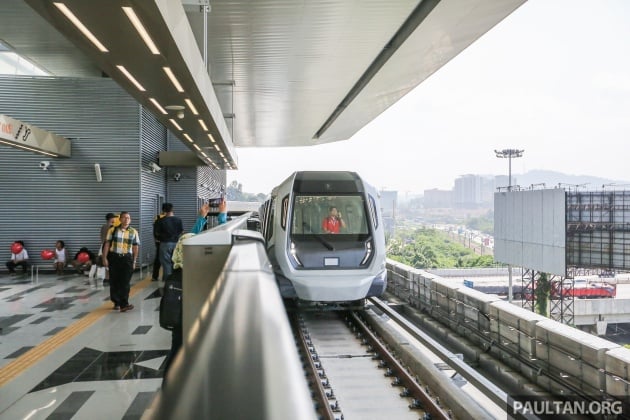
The Mass Rapid Transit (MRT) transportation system isn’t just friendlier for the environment, but it’s also capable of reducing the cost of living for Klang Valley folk, according to domestic trade, cooperatives and consumerism (KPDNKK) minister Datuk Seri Hamzah Zainudin.
He said the 51-km long Sungai Buloh-Kajang (SBK) line, which first started limited operations in December last year before being fully opened to the public last month, had been proven to have reduced people’s transportation costs.
“This transportation concept is comparable to the ones overseas, and tourists who are interested in sightseeing can also travel around easily by the MRT,” he was quoted as saying in a Bernama report.
Hamzah said that he had the opportunity to meet with some MRT users and most of them gave positive feedback on the service. “One person informed me that he managed to reduce his daily transportation cost,” he said.
The service is also expected to reduce traffic in the Klang Valley – last month, MRT Corp said it projected that there would be 160,000 fewer vehicles entering KL daily with the SBK line up and running, based on an estimation of 400,000 MRT riders per day.
Looking to sell your car? Sell it with Carro.

 Kuih
on
Kuih
on 

 Dol
on
Dol
on  komarad
on
komarad
on  Annoynimouse
on
Annoynimouse
on  How about that
on
How about that
on  john
on
john
on  Nkh
on
Nkh
on  ali
on
ali
on  Albert Yong
on
Albert Yong
on  Emartee
on
Emartee
on  Lee
on
Lee
on  horrayooi
on
horrayooi
on  James
on
James
on  tiadaid (Member)
on
tiadaid (Member)
on  John
on
John
on  mastermind
on
mastermind
on  Kunta Multiple Dupes
on
Kunta Multiple Dupes
on  Ruslan bahari
on
Ruslan bahari
on  James
on
James
on  McHammer
on
McHammer
on  Defacto
on
Defacto
on  Kuinosan
on
Kuinosan
on  alldisc
on
alldisc
on  qw
on
qw
on  MkII
on
MkII
on  Ah Kow
on
Ah Kow
on  James
on
James
on  Good Riddance
on
Good Riddance
on  pengguna proton kecewa
on
pengguna proton kecewa
on  Bernard
on
Bernard
on  My england is bad
on
My england is bad
on  Ksatria
on
Ksatria
on  bl00dsuck
on
bl00dsuck
on  ts
on
ts
on  Bullshit
on
Bullshit
on  Faz
on
Faz
on  hafizzul
on
hafizzul
on  Mohd
on
Mohd
on  slirh
on
slirh
on  Self service
on
Self service
on  Topkek
on
Topkek
on  tq gomen
on
tq gomen
on  Yang Benar
on
Yang Benar
on  pondan2
on
pondan2
on  rts
on
rts
on 


AI-generated Summary ✨
Comments generally support the MRT's role in reducing transportation costs and easing traffic congestion, with some highlighting the benefits of lower tolls, petrol, and parking expenses. Many acknowledge that MRT can help lower the cost of living, but some point out factors like rising food prices, inflation, and family size that also impact expenses. Critics call for better town planning, higher parking fees, and more comprehensive public transport solutions, while a few express skepticism about cost savings and government accountability.