

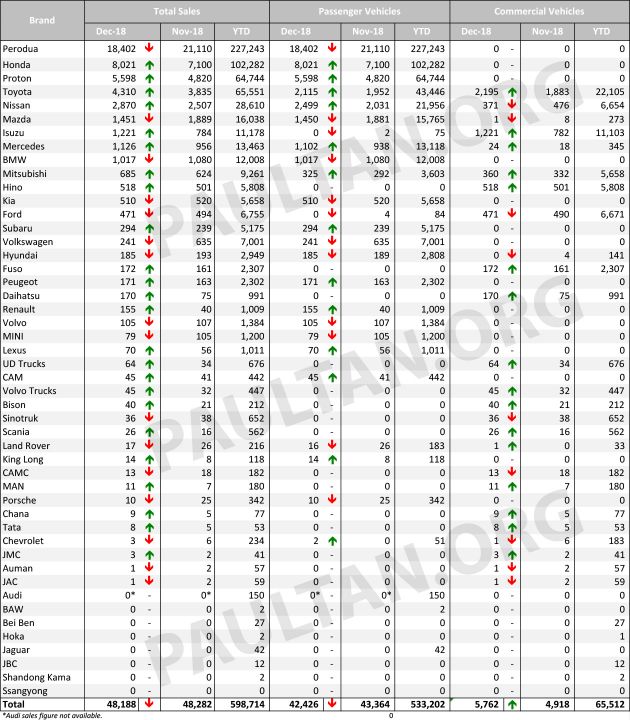
With the start of a new year comes the end of an old one, and the automotive industry rounded off 2018 with a whimper than a bang, sales wise. According to data from the Malaysian Automotive Association (MAA), vehicle sales for December stood at 48,188 units, down 0.2% on the 48,282 registered in November.
This figure was also 12% lower than the same month the year before, during which 54,719 vehicles found homes. Even so, car companies managed to close the year on a high note with a total industry volume (TIV) of 598,714 units, a strong 3.83% increase on the 576,625 vehicles sold in 2017.
December was not a particularly strong month for Perodua, however, with the market leader posting a 12.8% decline in sales to 18,402 units, a drop of 2,708 units – though that wasn’t even remotely enough to trouble its status at the top. The closest competitor, Honda, mustered a 13% jump to 8,021 units, up 921 units.
Proton also enjoyed a fruitful month, recording an impressive 16.1% increase to 5,598 units, up from 4,820 in November – despite the national carmaker’s long-awaited X70 SUV only having been launched in the middle of the month. Meanwhile, Toyota sold 475 more vehicles than the month before, with 4,310 units to its name, while Nissan saw a 14.5% jump to 2,870 vehicles.
On the premium end, Mercedes-Benz sold 1,156 vehicles in December, up 12.4% and making it the eighth top-selling brand in Malaysia. Following closely behind is BMW with 1,017 units, registering a 5.8% drop. Elsewhere, it’s been a good month for Renault (+287.1% to 155 units), Isuzu (+55.7% to 1,221 units) and Subaru (+23% to 294 units).
Click on the table below to view a larger version.
Looking to sell your car? Sell it with Carro.

 YB Albert
on
YB Albert
on 

 YTD
on
YTD
on  Azrul Ahmad
on
Azrul Ahmad
on  John Minum Teh 8X
on
John Minum Teh 8X
on  Not Toyota Fan
on
Not Toyota Fan
on  Falldisc
on
Falldisc
on  Everest
on
Everest
on  Bzzz
on
Bzzz
on  brazbuz
on
brazbuz
on  Digidigi
on
Digidigi
on  Riedzhal
on
Riedzhal
on  john
on
john
on  tokmoh.
on
tokmoh.
on  john
on
john
on  Projohn have been fated
on
Projohn have been fated
on  Amran
on
Amran
on  DK
on
DK
on  English Teacher
on
English Teacher
on  Sobuz
on
Sobuz
on  Green Dog
on
Green Dog
on  Green Dog
on
Green Dog
on  kami
on
kami
on  Nagamerah
on
Nagamerah
on  LOL
on
LOL
on  Murphy and Bros
on
Murphy and Bros
on  CH Kok
on
CH Kok
on  Curious
on
Curious
on  Khalid
on
Khalid
on 


AI-generated Summary ✨
Comments focus on Malaysian vehicle sales, highlighting Perodua’s leadership with over 200,000 units sold, and Proton’s competitive performance, especially with the X70 model. Discussions also compare brand sales, criticising high taxes on imported cars, the impact on local brands, and market dynamics. Some comments praise Proton’s achievements and speculate on future market share, while others criticize certain brands like Toyota and Honda. Overall, reviews are predominantly positive about domestic brands and share enthusiasm for the automotive market’s growth.