
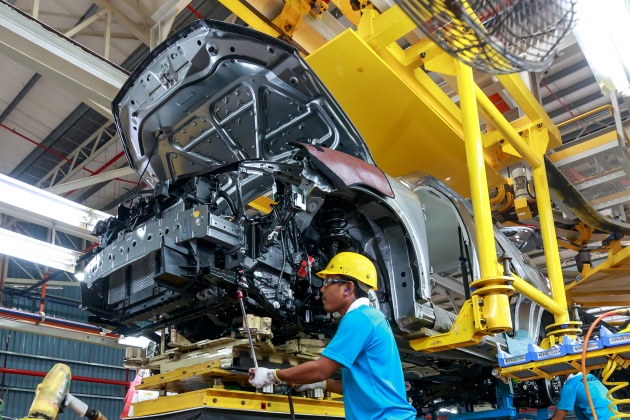
As previously reported, the implementation of revised excise tax regulations under PU(A) 402/2019-Excise Tax Regulations (Determination of Value of Locally Produced Goods for Excise Tax Purposes), which was supposed to have begun this year, had been deferred to January 2026. The latest indication from the government is that the revision is still on track to happen, but the country is presently identifying ways to curb potential car price increases once the new regulation takes effect.
This is because the ‘402’, or open market value (OMV) excise duty revision, will increase the scope of taxable items for locally-assembled (CKD) vehicles by expanding excise duties, which are presently only applied on manufacturing costs, to include non-manufacturing costs such as sales, marketing, administrative expenses and profit.
While the move is expected to push prices of CKD locally-assembled vehicles up, it remains to be seen by how much. Initially, it was indicated that CKD car/bike prices could go up anywhere from 10 to 30%, but the finance ministry firmly denied that that would be the case back in February, stating that the vehicle valuation method was still being determined and that there had yet to be a final decision on the matter.
The engagement is reportedly still going on. According to deputy finance minister Lim Hui Ying, the government is currently gathering data and holding consultation sessions with industry players to obtain feedback and find workable solutions to address concerns over the impact of the regulation on CKD vehicles, as The Edge reports.

She said that the actual impact on vehicle prices has yet to be determined, as local assemblers operate under different business models that lead to inconsistencies in excise duty calculations. “Nevertheless, the government will take mitigation measures to minimise the impact on the public,” she told the Dewan Rakyat. Lim said this in response to a question from Datuk Shamshulkahar Mohd Deli (BN–Jempol), who asked whether the government intends to proceed with or defer the enforcement of the OMV/402.
In July, Malaysian Automotive Association (MAA) president Mohd Shamsor Mohd Zain had said there was no running away from the OMV/402, but added that a new method that will minimise its impact would be announced. “We have had engagement with the ministry of finance, and understandably, the OMV is definitely going to be implemented, as that is part and parcel of the alignment to World Customs Organisation guidelines,” he said back then.
He had added that under the gazetted format, the bandied increase of on the on-the-road (OTR) prices of CKD vehicles would fall within the above-mentioned percentage, but there was indication that a revised approach would be applied to soften things. “Based on feedback we have been getting, the indication is that there will be a new method or new way of calculation for the impact to be minimised,” he had said in July. What and how that is remains to be seen.
Looking to sell your car? Sell it with Carro.



Malaysia offers a favorable environment for investment. Some detractors, however, attribute the country’s challenges to a supposed lack of tax cuts or sales support.
In a sign of progress, several high-tech car companies, though entirely new to the Malaysian market, have recently established themselves. Moving forward, it is important not to let moral qualms obstruct technological advancement.
Chatgpt ahh comment
What is so difficult? Just reduce the quantum of excise duty to stop CKD prices increasing. Is the percentage of excise duty written in stone?
Yalor…Madani dudes…dont talk 3 talk 4..just reduce car taxes.Dont confuse rakyat with all those technical jargon on CKD.
Seems the opposition is gonna organise another Turun mogok.
Why not reduce car taxes,after reducing Ron 95 price?
Sure guarantee,chances of another 5 YEAR TERM is brighter.
actually since petrol is already so cheap among cheapest in the world, then high car prices should remain. its not resonable to expect both to be cheap.
Stop the tongkat for the automotive industry. They don’t need to be protected
Government should do a thorough research and understand the cost factors in local automotive parts manufacturing. different automotive parts have different cost factors. identify keys components sector and help these to be competitive such that they can enter global car maker supply chain. such as Geely via Proton supply chain, Chery via local CKD assembler connection and Toyota/Daihatsu via Perodua supply chain. Seriously engage directly whese these serious local manufacturer to understand the cost factor of localisation and being a part exporter. what they need ?