
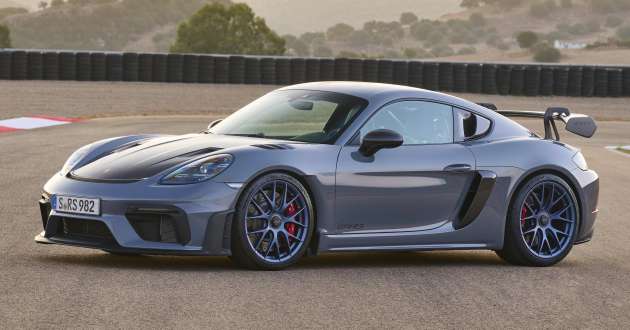
In an about-turn in development for the successors to its mid-engined sports car range, Porsche is preparing to adapt its next-generation Boxster and Cayman models to incorporate internal combustion engines, reported Autocar.
Citing senior sources at Porsche’s engineering centre in Weissach, the report stated that the German manufacturer is working on re-developing the EV-only PPE platform for its upcoming two-seater duo to accept a mid-mounted internal combustion engine.
This shift is part of a wider recalibration of the manufacturer’s strategy that has also seen the Macan line become set to succeed its petrol-powered product line with a new model to go alongside its fully electric offering.
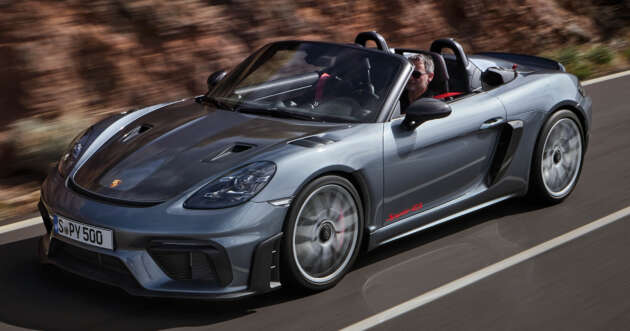
The PPE-based 718 Boxster and Cayman EV models will be different from the “top” variants which are expected to be a continuation of the current-generation RS models, which are to be positioned above the upcoming battery-electric models.
Porsche insiders were quoted as saying that the new-generation, internal combustion-engined Boxster and Cayman must achieve dynamic parity with their BEV relations, and the ICE models will require significant re-engineering as the PPE platform of the electric models use their battery packs as a stressed, load-bearing part of the structure.
Removing the battery would therefore weaken the bodyshell, and so a proposal by Porsche engineers is centred on a new structural floor section that bolts into the BEV model’s existing hard points to add rigidity back into the chassis that would be lost from the removed battery pack. A redesigned rear bulkhead and subframe will then support the engine and transmission, Autocar reported.
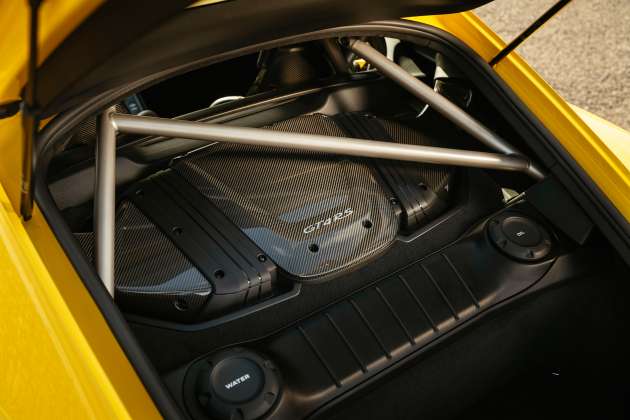
There will be major packaging constraints with the reinstating of the ICE into the PPE-based structure as it has no provision for a central tunnel, fuel tank, fuel lines or exhaust system, and Porsche engineers reportedly suggest that the development of a completely new rear section is required as the architecture was never designed for an internal combustion engine, the report continued.
The specific engine that will go into the next-generation, petrol-powered Boxster and Cayman has yet to be finalised, though new plans by CEO Oliver Blume suggest that the eventual engine will be a development of the 4.0 litre flat-six-cylinder engine that was introduced to the 718 line in 2020, and which produces up to 500 PS in the Cayman GT4 RS and Spyder RS.
The reinstating of the development of ICE-powered products comes against the backdrop that is the reported rolling back of Europe’s ban on new ICE-powered vehicles from 2035, where the initial 100% reduction in CO2 emissions as automakers’ fleet target will be dialled back to 90%.
Earlier in May this year, Blume stated that the company’s ambition of having EVs comprise more than 80% of its total sales by 2030 is not realistic. Among the proponents of a “technology-flexible” approach is BMW, which intends to sell ICE-powered cars alongside EVs, and its CEO Oliver Zipse has said that an outright ban on the sale of new ICE-powered vehicles is wrong.
Looking to sell your car? Sell it with Carro.



that is actually a sensible business decision, they know they cannot compete with the chinese in electric field, so they turn back to what they are famous for – the gasoline engines.
They’re not famous because of gasoline engine. They’re famous because of sport heritage and engineering. Car enthusiast and community almost always synonym with motorsports and combustion engine. There’s no way they could sell an EV sports car other than the SUVs. That’s why Taycan flop hard.
yes you are right, my bad, what i mean is european brands in general, while the japs are hard selling their hybrid
The Taycan actually sold very well the first 2 or 3 years. But Porsche buyers (in first world markets, ie; not Malaysia) are actually the most pragmatic amongst sports car buyers and when they realised the residual value for used Taycans would tank like every other EV, the demand shrank massively. Also, with regards to SUVs, the new electric Macan seems to have very low demand. Above a certain price point, it seems nobody wants to buy EVs, and unfortunately for Porsche every single model they sell is above that price point.
That should be the way ….true sports car should be ICE and they can have both choices for people to choose
While it makes sense given the current consumer sentiment, re-engineering a dedicated EV platform to accommodate ICE just screams COMPROMISE to anyone who even has some experience in engineering. I hope they’re able to still hold on to what makes Porsche cars, well, Porsches.
Nobody wants your overpriced sausage nazi cars
porsche uturn, same like European union uturn from diesel cars then uturn to EV cars now again uturn back to petrol cars. they uturn even more often than the malaysian gomen
50 years later people will still buy and use fountain pens(ICE). The rest of us will use roller ball (EV) at RM1.50 because it fits our budget and needs
i doubt after 50 years still have that much fossil fuels for you to waste on outdated technology
Unfortunately, Porsche is now promising the impossible, a promise upon which they can never deliver. NO vehicle that is designed to support both ICE and EV variants can possibly excel at either one, period. By its nature, Porsche’s mission has always been to design fully integrated, cutting-edge vehicles. ALL successful EV’s are the result deep integration of battery, power and chassis design. Ditto for all world-class ICE vehicles. YOU CANNOT HAVE IT BOTH WAYS- surely Porsche engineers are clever enough to realize this.