
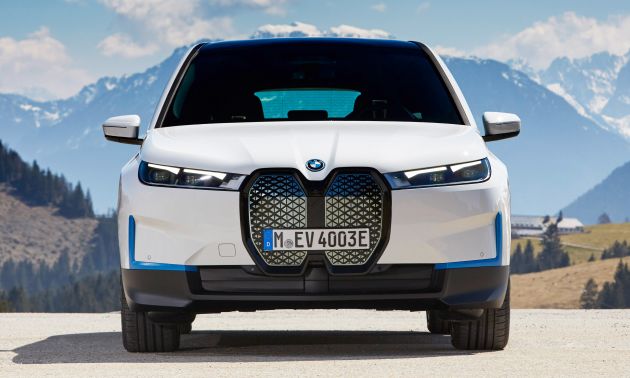
Long before BYD and Tesla became household names in Malaysia, the only electric cars on our roads wore badges like BMW, Mercedes-Benz and Porsche. The traditional, legacy automakers were here first. They built the country’s EV market almost single-handedly.
And then, in the space of about three years, they were comprehensively overtaken in the very transition they had started. JPJ registration data tells the story in stark terms.
Go back to 2021, before the government’s EV incentives kicked in, and battery-electric vehicles were a rounding error: just 257 registered in the whole year.
But of those, 94.9% came from established legacy brands. If you drove an EV in Malaysia back then, it was almost certainly a premium European one. When the CBU import-duty exemption arrived in 2022 and the market began to stir, the legacy brands still held 76.7% of it.
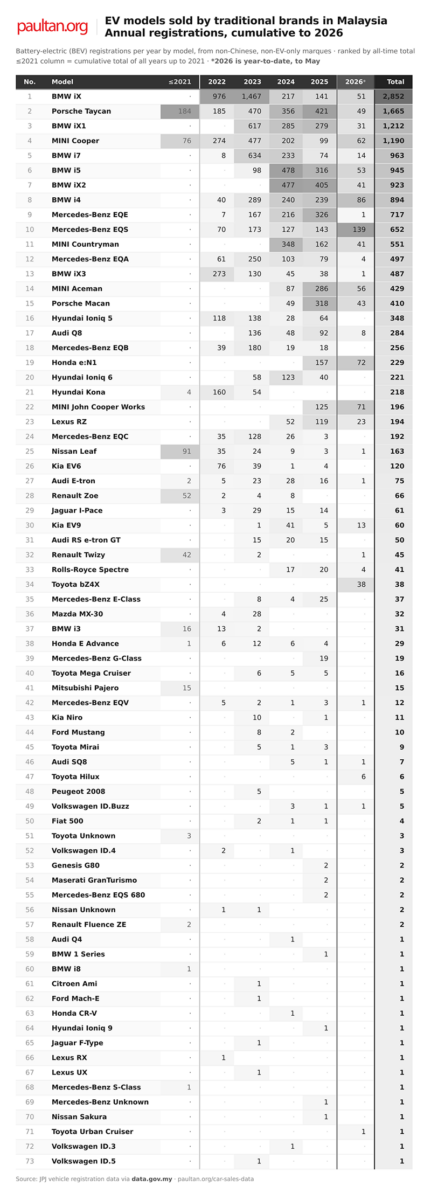
Just how premium and how niche that pre-incentive market was is best captured by a single model: the Porsche Taycan. Of the 579 EVs registered in Malaysia up to the end of 2021, 184 of them, or nearly a third, were Taycans.
A six-figure electric sports saloon starting north of RM500,000 was, remarkably, the country’s best-selling EV. In other words, before the incentives arrived, an electric car was less a practical purchase than a wealthy enthusiast’s novelty, and nothing illustrates that better than a Porsche topping the chart.
From there, the floor gave way. Their share fell to 42.8% in 2023 as the first Chinese brands arrived, then to 18.0% in 2024, 9.1% in 2025, and just 3.6% in the first five months of 2026.
The remarkable part is that the legacy automakers did not actually collapse in volume. They registered around 4,000 EVs a year through 2023 to 2025, broadly flat. They simply stood still while the market exploded around them, growing from 3,129 units in 2022 to 44,813 in 2025.
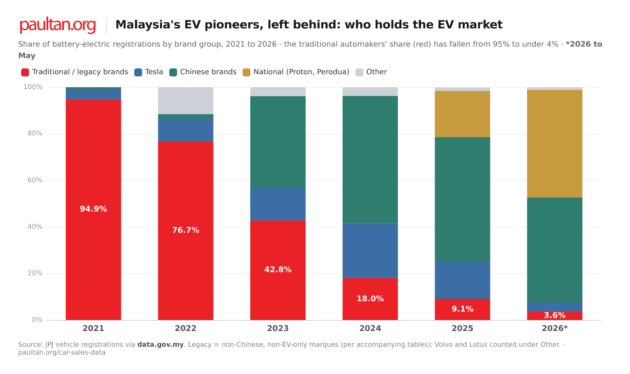
Two moments did the damage. The first was Tesla’s arrival in force. In 2024, its first full year of local deliveries, Tesla alone registered 5,137 EVs, more than every legacy brand in the country combined (3,930).
The second, and bigger, was the Chinese wave. By 2025 Chinese marques held more than half the EV market, and in 2026 they have been joined by Proton, whose e.MAS range has made the national brand the single biggest EV seller in the country. Between the American disruptor, the Chinese newcomers and the resurgent national champion, there was plenty of competition for the legacy players.
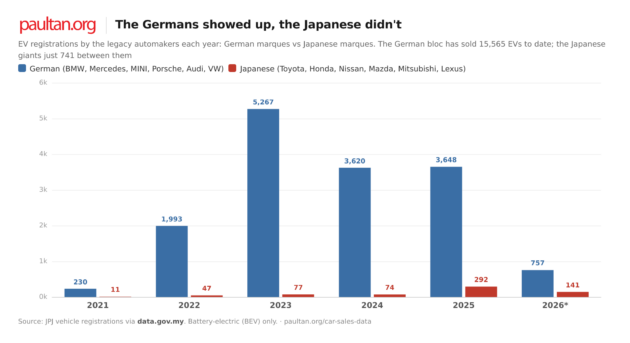
Dig into who the “legacy” players actually are, and a second, sharper story emerges: this was almost entirely a German effort. The German bloc, led by BMW with Mercedes-Benz, MINI, Porsche and others have registered 15,565 EVs to date.
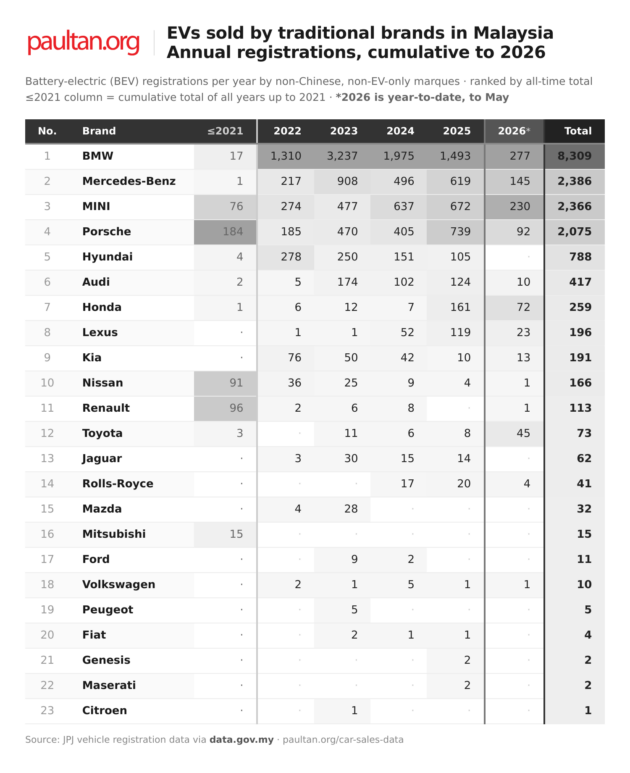
The Japanese giants, the brands that dominate Malaysia’s overall market, have put just 741 EVs on the road between Toyota, Honda, Nissan, Mazda, Mitsubishi and Lexus combined. Toyota sold more than 129,000 vehicles in 2025 alone, but only 73 of them, all-time, have been electric.
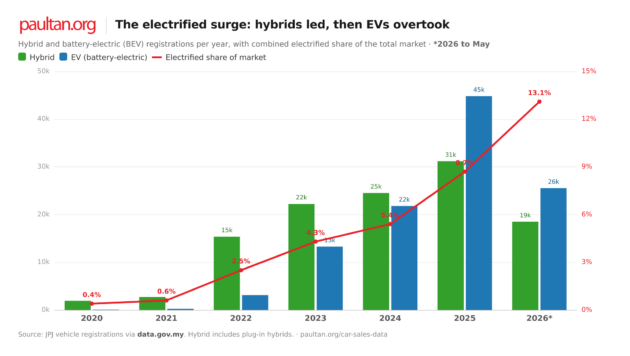
The Japanese chose to bet on hybrids and have done well in that area. Almost every segment of car from Honda and Toyota are available as a hybrid now, and users are able to choose to save on fuel with a car from a brand familiar to them without having to readjust their lifestyle to EV ownership.
But from 2025, hybrid sales were finally overtook by EVs, which happens to be the same year Proton joined the EV market in a big way.
BMW has been by far the most committed legacy brand, accounting for more than half of all legacy EV registrations with 8,309 units. But even BMW peaked back in 2023, with 3,237 registrations. If the best-resourced legacy effort in the country has gone backwards, it underlines just how hard this transition has been for the old guard.
And it wasn’t that BMW didn’t put a great effort. If you remember, back in 2021 we mentioned how the BMW iX’s Malaysian launch price was a bargain compared to how it was priced overseas. At that time we highlighted how the Langkawi duty-free price (pre-incentives, so the launch price had tax) was much lower than the overseas prices, and we made the conclusion BMW Malaysia was likely working on small margins.
None of this means the legacy brands are finished. They remain dominant in the petrol and hybrid segments that still make up the vast majority of the market, and a premium EV is a different proposition to a mass-market one.
Do you think the legacy brands can claw back EV share, or has that ship sailed? Let us know in the comments.
Looking to sell your car? Sell it with Carro.




Malaysia is best dumping ground for overpriced underspec outdated japanese cars.
That Guy – Go suck a railroad spike, you PRC POS cybertrooper. We have real world testimonies instead of your propagandist bs. Geely’s new efficient engine isn’t exactly what’s in the Protons right now, is it?! No matter how much you whine online, Honda/Toyota/Perodua still sitting pretty near the Top 10 because people can see it in the petrol bills of the China car users. And even more so due to the idiotic war in the ME.
1. geely world-beating 47% thermal efficiency engine will come to proton soon .
2. toyota/honda already ousold by proton which is geely.
3. perodua still sitting on top because they protected by meetee. remove that protection and a flood of commie cars priced at 60k will wipe out perodua in one year.
Malaysia is a dumping ground for unwanted ice cars from china and we stupidly worship European makes
Until another shift in the landscape happens. Most likely in the form of the consolidation of the Chinese brands, or some changes in the benefits/exemptions they receive from their government.
BMW iX and i7 sales is a scam la. if u went upstairs of BMW Ara Damansara, u will see all their sold car are sitting there as pre-reg.
This is true, then they mark down the prices to sell them off. Normally that would be a good deal for a premium car but BMW is notorious for planned maintenance costs to the buyer. Their ICE cars are riddled with plastic fasteners and joints that should have been metal, when these brake you have to visit the dealership for a costly fix. The cost of the parts are very cheap but the labor is where they will strangle you. No one can give that lousy excuse that if you can afford BMW you can afford the repair costs. NO that’s not how it works, many buy the car because of BMW’s fit and finish which is excellent but BMW designers are no ignoramuses, they know exactly what they are doing because business directives from the very top demand they have wear baked into their inner parts that nets them future maintenance revenue. This is a criminally contrived business model. The EVs are not spared either. In EVs people are already facing EV motor brush-wear, EV motors are parts that usually last like 20-30 years well after the car’s battery is long gone kaput. BMW marketing claimed they wanted to go “fully rare earth element free” by eliminating permanent magnets in their motors but little did they talk about the brushes that need to make contact to excite the coils. These are wearing down in just 120,000 KM. You’d think they would have made it easier to replace it then when it does fail. BMW claimed they made a catch to separate it from the motor main components, they even claimed the part is just 100euros but they did not tell the buyer the amount of labor needed to change it. When the shavings and powdery fine flakes get nasty, you get an electrical fault warning on the dash asking you report to the dealership immediately to avoid arching and other HV hazards. Technicians will drop the under tray, remove the battery, remove the motor and then take out the catch housing. The costs are expected to be atleast 15-20K in Malaysia, I am not joking. 100 euro part but labor is just insane. Many buy BMWs as their long term car because it means ‘premium’ and they see the fit and finish looking promising but the innards are just deliberately engineered to not last long enough once past warranty. BMW can design a catch thats very easy to replace but they wont because that kills their future revenue stream. P1/P2 and many Jap cars do contrived revenue streams differently by enforcing a maintenance schedule, only difference here the costs are far lesser but it is still an unnecessary requirement you have to follow lest you want to void the warranty. The only EV brand that’s not enforce the schedule is Tesla, their cars are not exactly cheap but they only ask to go to them after a remote diagnosis yields no easy over the air fixes. The whole scheduled maintenance in premium cars is a scam, be it with any brand, unless your vehicle is a 600K+ sport car there is no need to be forced into these schedules. It is also a scam in affordable cars under 100K, if I don’t reach 10K KM in 6 months why should I have to visit them its just to give the dealership business. Tyres wear, wiper fluid are all monitor dan buat sendiri anyway.
Why Volvo EV is missing
Legacy premium brand will always target prestige customer. Mean, low volume high margin. They will go that way for their EV too. Imagine a BMW EV drop price to RM100k-160k, all China EV buyer will drop tears and potential buyer will choose i3 i4 iX iX3 ix2 and whatever i there are available. Imagine, BYD and BMW EV same price at 150k. Or Proton EV same price as BMW at Rm100k. Even you who reading this will go BMW at that time. So? Different market target, diff strategy. Cant compare. Like a swatch vs rolex, both Swiss both watches but different. There world is large enough, many could exist simulteneously. You have the money, test both and choose. No money? Go for lower price one. Thats it.
do you know that in china, their local EVs are already priced higher than BMW EVs. but why still can sell? its because their local luxury EVs are simply superior to BMW even at priced parity.